Minister Christopher Musa Assumes Office at Defence Headquarters, Promises Unity and an End to Bloodshed
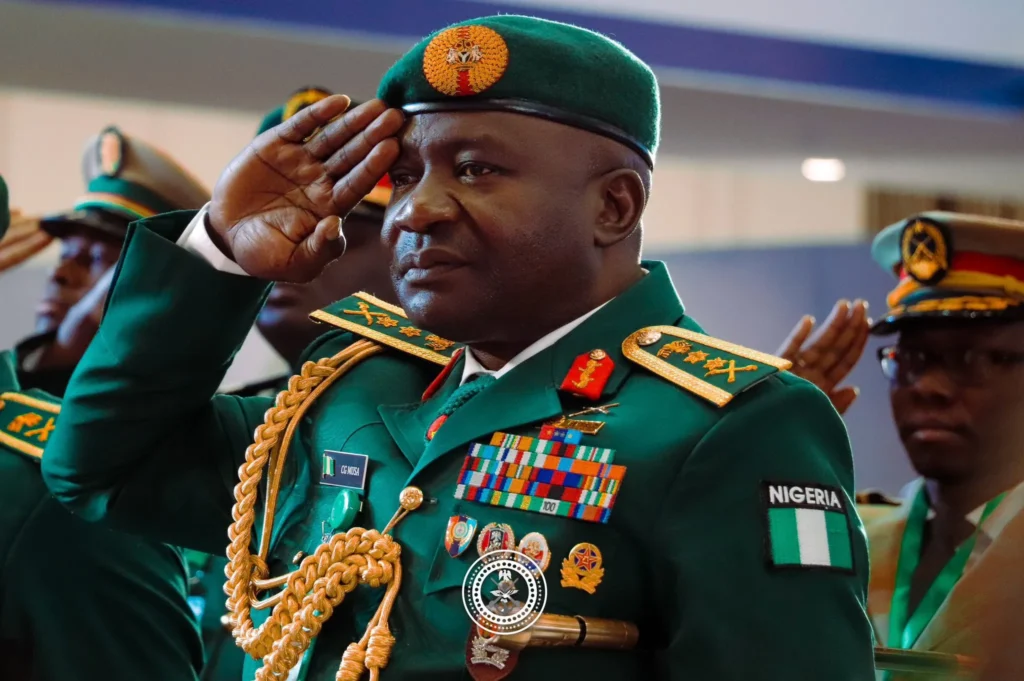

Major General Christopher Gwabin Musa (rtd), recently appointed Minister of State for Defence, officially resumed work at the Defence Headquarters on Thursday, marking a significant transition from his previous role as Chief of Defence Staff (CDS) into a top ministerial position. His arrival attracted notable attention both within military circles and across the wider public sphere, as Nigerians expressed mixed reactions ranging from optimism to skepticism.
During his address to staff and service chiefs, Musa delivered a message centered on unity, duty, and the urgent need to restore peace across the nation. His tone was firm and direct, declaring: “Enough of bloodshed.” He emphasized that Nigeria’s security architecture cannot succeed if divided along ethnic or regional lines, adding, “There must be nothing like North or South, Hausa or Igbo under my watch.”
According to Musa, national security must remain above tribal, political, or sectional interests. He pledged to foster a culture of collaboration across all branches of the Armed Forces and civilian defence structures, noting that with the collective support of the system, “we’ll make this place so much better.”
Related News

Many Feared Dead as Boko Haram Fighters Overrun Military Base and IDP Camp in Borno
Suspected militants from the Islamic State West Africa Province launched a coordinated early-morning assault on a military base and an…

Gun Attack on ADC Leaders in Edo Raises Fears of Violent Election Season
A gun attack on African Democratic Congress leaders in Benin City, including Peter Obi and Chief John Oyegun, has heightened…

Nigeria Issues Travel Advisory as Israel-US and Iran Conflict Escalates in Gulf Region
The Federal Government of Nigeria has issued a travel advisory urging Nigerians in Iran and neighbouring Gulf states to exercise…
However, his assumption of office was marked by a notable absence: former Zamfara State governor and Minister of State for Defence, Bello Matawalle, who was expected at the ceremony but did not attend. The absence stirred conversations online, with many speculating about tension or political undercurrents within the ministry. Some commenters pointed out that the optics were “embarrassing,” while others dismissed it as administrative timing.
The resumption ceremony, which was also captured in a widely circulated YouTube video, showed enthusiastic staff and officers lining up to welcome Musa — an unusual level of fanfare for a ministerial arrival. Observers commented that he appeared approachable and well-respected, a factor some believe could boost morale within the military.
Public reactions, however, were deeply polarized. Supporters praised President Tinubu for what they consider a “strategic appointment,” with some describing Musa as the most qualified candidate currently available to manage Nigeria’s complex security challenges. Others warned that such early praise is premature, noting that he was only recently relieved of his CDS position and did not produce major breakthroughs in that role.
Some citizens expressed frustration that Nigerians often celebrate ceremony over results, pointing out that Musa — despite his likeable disposition — must demonstrate practical progress. Others argued that the key challenge he must immediately address is the welfare of military personnel, including improved pay, medical care, insurance, and support systems for wounded soldiers and bereaved families.
A segment of commenters also injected political and ethnic sentiments into the discussion, with accusations and counter-accusations about loyalty, competence, and regional bias. Several individuals criticized the idea that security leadership must be viewed through the lens of partisanship, calling instead for a national mindset focused on outcomes, not politics.
Despite the mixed reactions, many Nigerians say they are cautiously hopeful. The prevailing sentiment is that if Musa can deliver — if he can significantly reduce terrorism, banditry, insurgency, and other violent crimes — history will judge him favorably.
His message upon assumption of duty was clear: unity, professionalism, and a decisive confrontational stance against insecurity. Whether this new leadership approach will translate into tangible progress remains to be seen, but Nigerians across political and ethnic divides are watching closely, waiting for results rather than rhetoric.