President Talon Assures Beninese Citizens as Government Declares Failed Coup Attempt Fully Contained
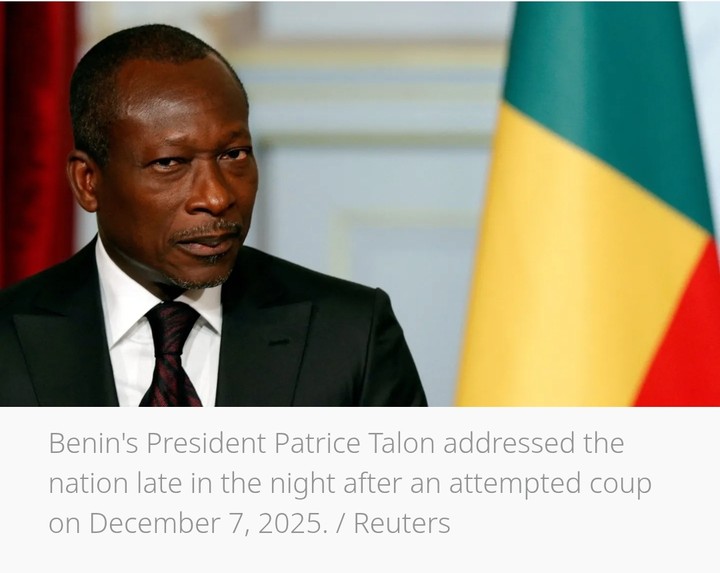

President Patrice Talon of the Benin Republic has assured citizens that calm has been fully restored across the country following a failed coup attempt that briefly unsettled the nation. In a national broadcast carried by state television on Sunday evening, the president declared that the situation was “completely under control” and urged the public to return to their normal activities without fear or anxiety.
The statement came hours after a group of soldiers appeared on state television earlier in the day, announcing that they had removed President Talon from office. The group identified itself as the “Military Committee for Refoundation” and claimed it had taken over the affairs of government. The announcement caused immediate tension across the country and triggered swift security responses from loyalist units within the Beninese armed forces.
According to Beninese military and security sources, the attempted takeover was rapidly neutralised as loyal troops secured strategic locations, including government buildings and broadcasting facilities. By the end of the day, authorities confirmed that around a dozen soldiers had been arrested in connection with the failed coup, including some of those believed to be directly involved in planning and executing the operation. Security operations continued into the night as forces carried out mop-up actions to prevent any regrouping by the conspirators.
In his address, President Talon thanked the armed forces and security agencies for their professionalism and loyalty to the constitution. He emphasized that the integrity of Benin’s democratic institutions remained intact and that there was no justification for panic. “I would like to assure you that the situation is completely under control and therefore invite you to calmly go about your activities starting this very evening,” the president said.
Related News
Two Accused of Financing Alleged Coup Plot Against Tinubu Identified – PREMIUM TIMES
Security agencies investigating an alleged coup plot against President Bola Tinubu have identified two individuals accused of funnelling ₦835 million…
Five Key Moments Nigeria Intervened to Stop Coups in Other African Countries
Over the decades, Nigeria has played a decisive role in countering military coups and protecting constitutional order across West and…
The crisis also attracted the attention of neighbouring countries and regional partners. Reports indicated that military support was mobilised under existing regional security cooperation frameworks, with particular reference to Nigeria’s rapid reaction under ECOWAS security arrangements. While Beninese authorities maintained that loyalist forces were primarily responsible for restoring order, regional coordination was activated as a precautionary measure to prevent the crisis from spreading.
The attempted coup adds Benin to a growing list of West African states that have faced military insurrections in recent years. The region has witnessed a surge of successful and attempted coups in countries including Niger, Burkina Faso, Mali, Guinea, and Guinea-Bissau. These developments have raised deep concerns within the international community about the erosion of democratic governance and the growing influence of military factions in political transitions.
President Talon, who is expected to hand over power in April next year after completing two terms in office, has presided over a decade marked by economic reforms and steady growth, but also increasing political tension and security challenges. In recent years, Benin has faced rising threats from extremist groups operating near its northern borders, especially along frontier areas close to Burkina Faso and Niger. These security pressures have placed additional strain on the country’s military and intelligence systems.
Analysts believe the failed coup reflects both domestic political tensions and wider regional instability. While Benin has traditionally been regarded as one of West Africa’s more stable democracies, the attempted takeover has highlighted underlying vulnerabilities within its security architecture. Observers also note that the proximity of recent coups in neighbouring states may have emboldened dissident elements within Benin’s armed forces.
Public reaction to the incident has been mixed. While many Beninese citizens expressed relief that the coup did not succeed, others questioned how such a breach of national security was able to occur at all. Regional observers have also debated the implications of foreign military involvement in containing internal political crises, raising broader questions about sovereignty, regional intervention protocols, and the balance between national independence and collective security.
Despite the controversy, authorities insist that constitutional order has been fully restored. Security patrols have been intensified in major cities and border areas, and investigations into the coup plot are ongoing. The arrested soldiers are expected to face military tribunals and possibly civilian courts, depending on the outcome of legal reviews.
As Benin moves past the immediate shock of the attempted takeover, attention is now turning toward long-term reforms within the military and security services. With President Talon’s tenure nearing its end, political stakeholders and civil society groups have renewed calls for transparent elections, strengthened democratic institutions, and deeper security sector reforms to prevent future threats to constitutional governance.