Popular Mobile Apps That Consume the Most Data in 2024
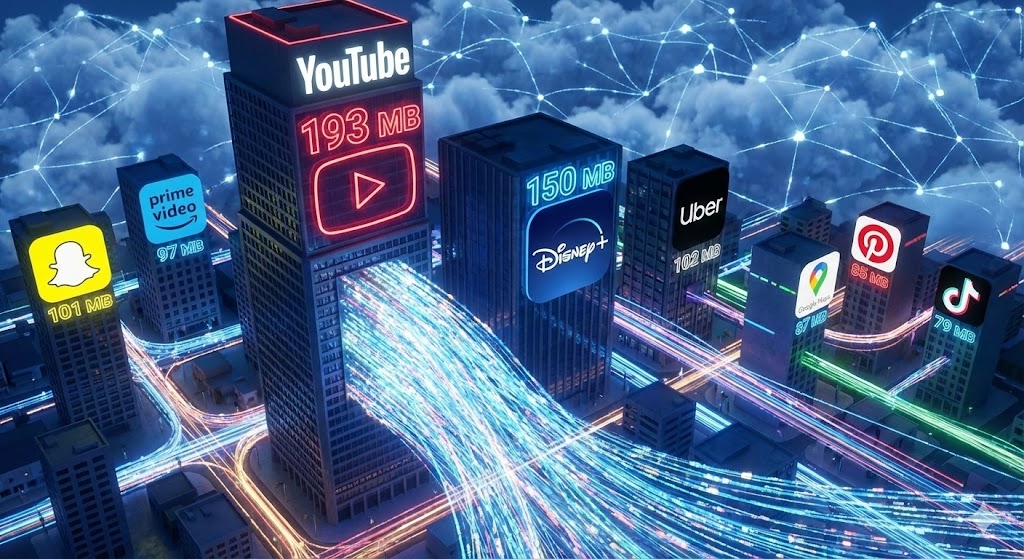

Mobile data consumption continues to rise globally as smartphones become central to entertainment, navigation, communication, and commerce. In 2024, a new ranking of popular mobile applications by average data usage has highlighted just how quickly everyday apps can drain data bundles, sometimes within minutes of use.
According to the data, just five minutes on certain applications can consume close to 200 megabytes (MB) of data, a figure that may surprise many users who rely heavily on mobile networks rather than Wi-Fi. The ranking, which measures average data usage over a five-minute period, places video streaming platforms, social media apps, and navigation services at the top of the list.
YouTube emerged as the most data-intensive app in 2024, consuming an average of 193MB in just five minutes. This is largely due to its high-resolution video streaming and autoplay features, which can quickly escalate data usage if video quality settings are not manually reduced. Close behind is Disney Plus, which uses an average of 150MB in five minutes, reflecting the heavy data demands of on-demand video streaming.
One of the more surprising entries in the ranking is Uber, which placed third with an average data consumption of 102MB in five minutes. While Uber is not a streaming service, its frequent use of real-time GPS tracking, background data syncing, and map updates contributes significantly to its data usage. Snapchat followed closely with 101MB, driven by its video-heavy content, filters, and constant background activity.
Related News

Nigeria Enters a New Fuel Era as First Unmanned 24-Hour Filling Stations Launch Nationwide
Nigeria has taken a significant step toward modernising its fuel retail sector as A.A. Rano Nigeria Limited unveils the country’s…

How Nigerian Student Oluwapelumi Dada’s Bold Hustle Took Him From Lagos to Silicon Valley
Oluwapelumi Dada, a Nigerian computer science student, turned down Tesla and Dell internships to build Sorce — a job-matching app…

AI to add over $15tr to global economy, says ex-lawmaker
AI to add over $15tr to global economy, says ex-lawmaker : AI: Artificial Intelligence Former two-term member of the House…
Other major video platforms also featured prominently. Prime Video ranked fifth at 97MB, while Netflix, often assumed to be among the biggest data consumers, ranked lower at 53MB for the same time frame. Analysts note that Netflix’s relatively lower ranking may be due to more efficient compression and adaptive streaming technology.
Navigation and discovery apps also showed substantial data usage. Google Maps ranked sixth at 87MB, reflecting its reliance on live traffic updates, satellite imagery, and route recalculations. Pinterest followed with 85MB, driven by image-heavy feeds that automatically load high-quality visuals.
Social media platforms dominated much of the mid-range rankings. TikTok used an average of 79MB in five minutes, while Telegram consumed 70MB, particularly when video files and channels are involved. Instagram and Duolingo both recorded 69MB, with Instagram’s data usage attributed to Reels, Stories, and auto-play videos, while Duolingo’s interactive lessons and audio features contribute to its consumption.
E-commerce and general-purpose apps also made the list. Amazon Shopping averaged 68MB, Facebook used 65MB, and X (formerly Twitter) consumed about 50MB. Gmail, despite frequent syncing and email attachments, used a comparatively lower 42MB.
At the lower end of the ranking were LinkedIn at 23MB, Audible at 10MB, WhatsApp at 9MB, and Spotify as the least data-intensive app on the list at 7MB. These lower figures are largely due to text-based interactions, audio compression, and offline playback options.
The data rankings have sparked widespread reactions among users, particularly in regions where mobile data remains expensive. Many users noted that apps like TikTok, Instagram Reels, and Facebook videos often consume more data in real-world usage than the rankings suggest, especially when background autoplay is enabled. Others expressed surprise at seeing Google Maps and Uber ranked so high, given their importance as everyday utility apps.
The findings have also renewed calls for greater user awareness around data-saving features such as lowering video resolution, disabling background data, restricting autoplay, and relying on Wi-Fi where possible. As mobile apps continue to evolve and incorporate richer media experiences, experts warn that data consumption is likely to increase further unless efficiency improvements keep pace.
For millions of users who depend on mobile data for daily connectivity, understanding which apps consume the most data is becoming increasingly essential—not just for convenience, but for managing costs in an increasingly digital world.