Higher Institutions Confirm Receipt of Tuition Support Funds from NELFUND
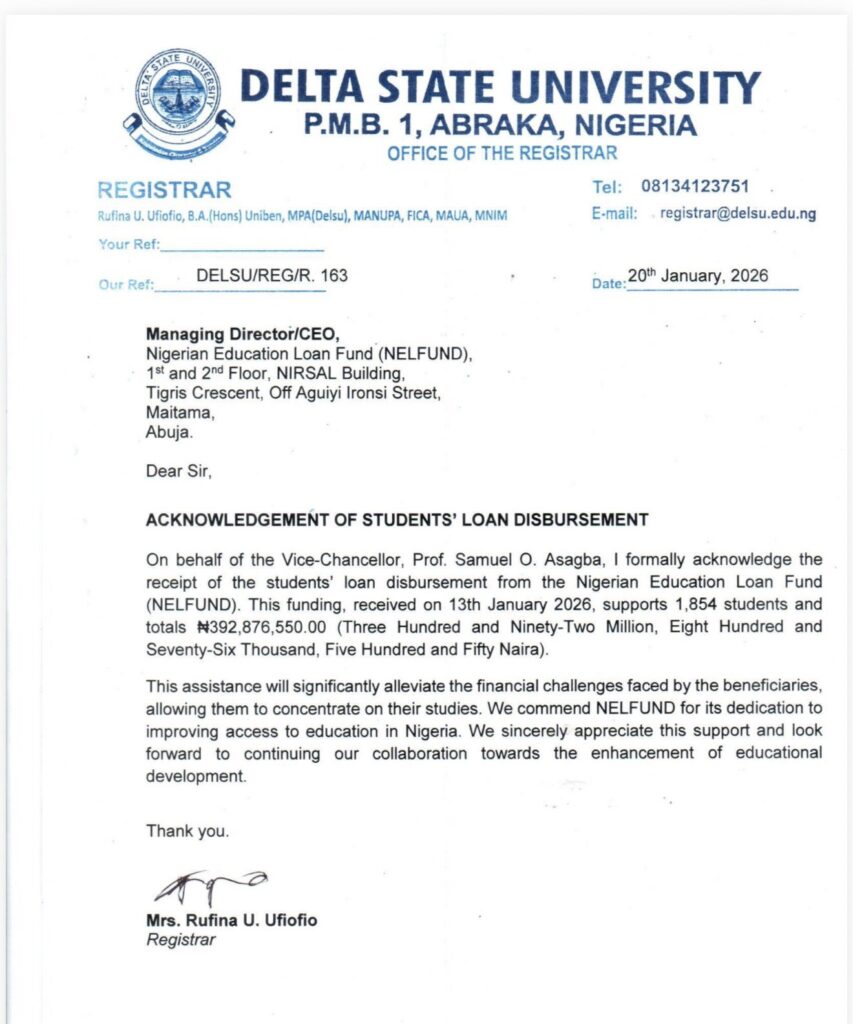

Multiple tertiary institutions across Nigeria have acknowledged the disbursement of tuition support funds by the Nigerian Education Loan Fund (NELFUND), marking a significant milestone in the federal government’s student loan initiative aimed at easing the financial burden on undergraduates amid rising tuition fees.
According to information shared by beneficiaries and institutional sources, the disbursements cover tuition payments for the 2025/2026 academic session and have already enabled thousands of students to continue their academic activities without immediate financial constraints. The development was announced through official communications and subsequently circulated on social media platforms, where it drew widespread attention and mixed reactions.
Among the institutions that reportedly received funds is Nnamdi Azikiwe University (UNIZIK), Awka, which was paid a total of ₦85,012,500 on January 13, 2026, covering tuition fees for 850 students in what was described as the second batch of beneficiaries. Similarly, the Lagos State University of Science and Technology (LASUSTECH) received ₦223,144,000 on January 22, 2026, to support 2,766 students.
Combined, the two disbursements reportedly impacted 3,616 undergraduates, allowing them to resume lectures, laboratory work, and other academic engagements without the immediate worry of tuition payment. Supporters of the programme have described the intervention as timely, particularly in the context of increasing tuition fees across public universities and polytechnics.
Related News

Prof. Ursula Ngozi Akanwa Appointed First Female Vice-Chancellor of Michael Okpara University of Agriculture
Professor Ursula Ngozi Akanwa has been named the seventh Vice-Chancellor of the Michael Okpara University of Agriculture, Umudike, becoming the…

Lagos Governor Sanwo-Olu Hands Over Seat to Student Esther Etiyemonu as One-Day Governor
Lagos State Governor Babajide Sanwo-Olu temporarily handed over the reins of leadership to student Esther Etiyemonu after she emerged winner…
NELFUND Debunks Reports on Immediate Student Loan Repayment, Warns Against Fake Circulars
The Nigerian Education Loan Fund (NELFUND) has dismissed reports claiming that beneficiaries of its student loan scheme have been instructed…
NELFUND was established to provide financial assistance to students through structured loan arrangements, with the aim of improving access to higher education. The recent disbursements appear to signal the operational rollout of the scheme after months of policy discussions and public scrutiny.
However, the initiative has also generated controversy and debate. Some commentators questioned disparities in the amounts disbursed to different institutions. Particular attention was drawn to Olabisi Onabanjo University (OOU), which reportedly received approximately ₦1.2 billion. Critics argued that the figure appeared disproportionately high when compared to allocations received by other schools.
In response, defenders of the programme explained that the allocation was based on the number of beneficiaries and the prevailing tuition fees at each institution. They noted that OOU reportedly had over 5,000 student beneficiaries and relatively higher tuition costs, factors that significantly influenced the total disbursement amount.
Beyond allocation concerns, broader questions have been raised about the scope and sustainability of the student loan scheme. Some stakeholders argue that the programme currently covers only a fraction of students affected by recent tuition hikes, estimating coverage at less than 10 percent of the total student population in higher institutions.
Others have expressed concerns about the long-term implications of student loans in a country with low average income levels and high living costs. Drawing comparisons with countries like the United States, critics warned that excessive reliance on student loans could saddle graduates with long-term debt, potentially affecting their quality of life and economic productivity.
There have also been calls for greater transparency in the administration of the scheme, including clearer application procedures, consistent communication channels, and equitable disbursement processes. Some parents and prospective beneficiaries have publicly asked for guidance on how students can apply, particularly those awaiting admission into tertiary institutions.
Despite the criticisms, many parents and students have welcomed the disbursements, describing them as a relief in difficult economic times. For some families, the funds represent the difference between continuing education and dropping out due to financial hardship.
As NELFUND continues its rollout, education stakeholders are closely watching how the programme evolves, particularly in terms of coverage expansion, accountability, and whether it will eventually incorporate grants or bursaries alongside loans to ensure broader and more sustainable access to higher education.