Outrage as 2012 Tweet by Simi About Four-Year-Old Resurfaces Amid Online Controversy
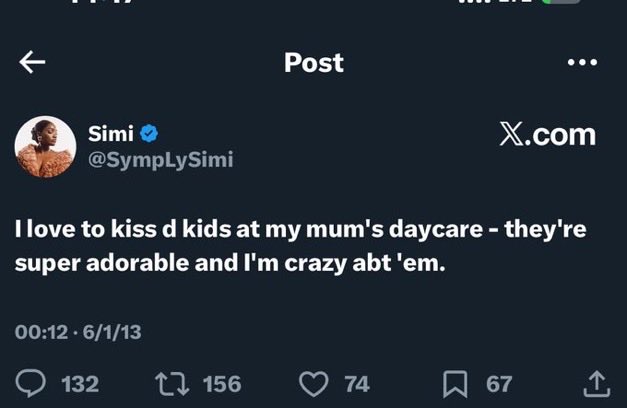

Nigerian singer and songwriter Simi, born Simisola Bolatito Kosoko, has come under renewed scrutiny after a tweet she posted in 2012 resurfaced and began circulating widely across social media platforms.
The tweet, dated March 14, 2012, referenced a four-year-old boy identified as David and described him as having a “crush” on her. In the post, she wrote about the child coming close to her, appearing as though he wanted to kiss her, and resting his head on her lap, before jokingly asking whether she should “give him a chance,” while noting his age.
The resurfaced tweet quickly drew criticism from some users, who described the language as inappropriate and questioned why terms typically associated with romantic or adult relationships were used in reference to a young child.
Several social media users expressed outrage, with some calling for further scrutiny and others accusing the singer of hypocrisy, particularly in light of her recent public comments condemning sexual violence and rape culture.
Context of Renewed Attention
The controversy emerged during an ongoing online debate triggered by a now-discredited rape allegation made by a TikTok user known as Mirabel. The allegation, initially shared in a viral video, generated widespread public reaction before later being admitted as fabricated.
Amid that controversy, Simi had posted messages on social media condemning rape and urging accountability, which led to criticism from some individuals who argued that public discussions of sexual violence should also address false accusations.
Following the revelation that the allegation was fabricated, online users began revisiting past statements and posts made by public figures involved in the broader debate. It was in this context that Simi’s 2012 tweet resurfaced and began trending.
Related News

Apple Unveils MacBook Air M5 Using Fela Anikulapo Kuti’s “Let’s Start”
Tech giant Apple has unveiled its next-generation MacBook Air powered by the new M5 chip, with a campaign featuring Fela…

Simi Addresses Backlash Over Resurfaced 2012 Tweets About Children
Nigerian singer Simi has responded to public criticism following the resurfacing of tweets she posted in 2012 referencing children at…
Court Adjourns ₦2 Billion Assault Suit Against Odumodublvck to April 2026
A Federal Capital Territory High Court in Abuja has adjourned the ₦2 billion assault and battery case filed against rapper…
Social media activist VeryDarkMan was among those who commented publicly on the Mirabel case, further amplifying online discussions that subsequently broadened to include unrelated historical content.
Divided Public Reaction
Public reaction to the resurfaced tweet has been sharply divided.
Critics argue that references to “crush” and “lock lips” in connection with a child are inappropriate regardless of intent. Some users suggested that similar language used by a male celebrity about a young girl would have generated even stronger backlash, framing the issue as one of gender double standards.
Others, however, contend that the tweet was likely intended as a lighthearted remark reflecting common playful language adults sometimes use when describing children’s innocent affection. Supporters have pointed out that social media culture in the early 2010s differed significantly from today’s standards, and that posts made more than a decade ago should be interpreted within their historical context.
Some defenders also noted that many individuals have old social media posts that may appear insensitive or poorly worded when judged by contemporary norms.
As of the time of reporting, Simi has not issued a detailed public statement specifically addressing the resurfaced tweet. However, online discussions have continued to trend, with hashtags and commentary spanning platforms including X (formerly Twitter) and Instagram.
Broader Debate on Digital Footprints
The incident has reignited conversations about digital permanence and evolving social norms. Experts frequently caution that online posts — even those made casually or jokingly — can resurface years later and be interpreted through a different cultural lens.
In Nigeria and globally, several public figures have faced reputational challenges after historical social media posts were rediscovered and recirculated.
Observers note that the rapid spread of screenshots and archived content underscores how digital footprints remain accessible long after original contexts fade.
As debate continues, the episode highlights the increasingly complex intersection between celebrity culture, online accountability, and shifting societal expectations regarding language and boundaries.