A Look Back at the 2017 PDP Convention and the Political Figures Who Shaped It
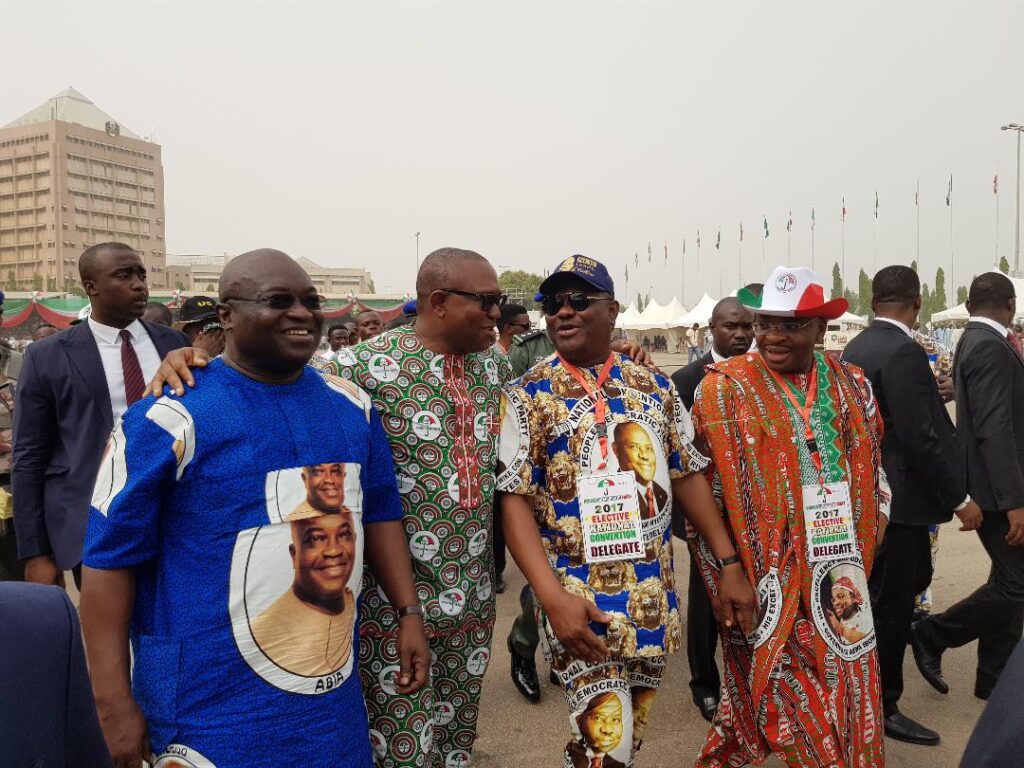

A throwback photograph from the 2017 Peoples Democratic Party (PDP) elective convention has resurfaced online, drawing renewed attention to four prominent figures who would go on to shape political debates, alignments, and rivalries in Nigeria: Peter Obi, Nyesom Wike, Okezie Ikpeazu, and Udom Emmanuel. The image, which shows the leaders in visibly lighter, more relaxed moods, has become a talking point as Nigerians revisit the political journey each of them has taken since that moment.
At the time, the PDP was rebuilding from a turbulent period marked by internal wrangling, leadership crises, and an urgent need to reposition ahead of the 2019 general elections. In that environment, Peter Obi—then still within the PDP fold—appeared alongside three influential governors: Rivers State’s Nyesom Wike, Abia State’s Okezie Ikpeazu, and Akwa Ibom State’s Udom Emmanuel. The convention was more than a routine gathering; it served as a strategic regrouping for a party seeking to reclaim national relevance.
Today, that single image functions almost as a political time capsule. For many Nigerians, the most striking contrast is the transformation of Nyesom Wike. Online commenters highlighted how healthy and vibrant he appeared in 2017, compared to what they described as his visibly slimmer, more strained appearance in recent years. Some users attributed the change to the pressures of national politics, while others speculated on health, lifestyle, and stress. A recurring thread suggested that Wike’s move from state to national politics—and his controversial alliances—may have weighed heavily on him.
Related News
Wike Says FCT Poll Shows Voters Rejected ‘Groundnut Politics,’ Takes Swipe at Obi, Amaechi
FCT Minister Nyesom Wike has said the outcome of the recent area council elections in Abuja proves that voters rejected…
Peter Obi Says Nigeria Rich in Talent but Held Back by Poor Leadership
Former presidential candidate Peter Obi has stated that Nigeria’s greatest challenge is not a lack of talent but a failure…
Controversy Trails Shettima’s Kwara Visit as Reports Claim Devastated Woro Community Was Not Reached
A fresh controversy has emerged following Vice President Kashim Shettima’s condolence visit to Kwara State after a deadly terrorist attack…
Beyond physical changes, commenters also pointed to how drastically political alignments have shifted. Peter Obi, who stood in the photo as a member of the PDP, is now the national figurehead of the Labour Party, having contested the 2023 presidential election and dramatically reshaped Nigeria’s political discourse. Many users noted that he, too, shows signs of aging—something natural after eight years of political battles, extensive travel, and the intensity of a presidential campaign.
Conversations about Okezie Ikpeazu and Udom Emmanuel were more muted but still pointed. Both have completed their tenures as governors, and while they remain active political actors, their roles today differ significantly from their positions of influence during the 2017 convention.
The comments section quickly grew into a broader critique of Nigeria’s political environment. Some users described the PDP as a party that has struggled to retain cohesion, accusing internal betrayals, personal vendettas, and factional battles of weakening it over time. Others argued that the decline in camaraderie among its key figures reflects deeper structural problems within Nigerian politics—where alliances form and collapse quickly, often with lasting consequences.
One commenter revisited allegations that Wike was poisoned in 2018, a narrative that resurfaced amid discussions about his health. While such claims remain publicly unverified, they sparked heated exchanges about political hostility, party infighting, and the psychological toll associated with holding power in Nigeria.
Another thread focused on the broader trajectory of the PDP. Users argued that today’s factional disputes—particularly involving Wike, Makinde, and other influential figures—trace their origins back to unresolved tensions that were already present in 2017. Some lamented how the party has struggled to maintain ideological coherence, suggesting that individual ambitions have often overshadowed collective vision.
Despite the political nostalgia surrounding the throwback image, the debates it sparked are anything but sentimental. The photo has instead become a lens through which Nigerians reflect on the evolution of their political class, the volatility of political loyalty, and the human toll of leadership in a system where pressure is constant and alliances are fragile.