Eight Suspected Phone Snatchers Arrested in Early-Morning Raid on Mile 2 Pedestrian Bridge
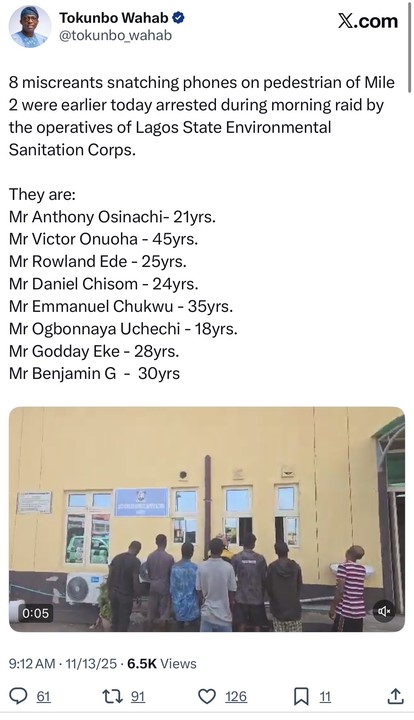

The Lagos State Environmental Sanitation Corps has arrested eight individuals suspected of snatching mobile phones from commuters on the pedestrian bridge at Mile 2. The arrests were made during an early-morning raid carried out on Wednesday as part of intensified efforts to curb street-level crime across the state.
According to the agency, the operation was in response to multiple reports from pedestrians who frequently use the bridge and have complained about persistent harassment, theft, and violent snatching incidents. The suspects were taken into custody without major resistance and are expected to be transferred to the appropriate authorities for further investigation and prosecution.
The individuals arrested were identified as:
– Anthony Osinachi, 21
– Victor Onuoha, 45
– Rowland Ede, 25
– Daniel Chisom, 24
– Emmanuel Chukwu, 35
– Ogbonnaya Uchechi, 18
– Godday Eke, 28
– Benjamin G., 30
An update on the arrest was shared by Lagos State Commissioner for Environment and Water Resources, Tokunbo Wahab, who has overseen several recent enforcement operations aimed at improving safety and reducing nuisance activities around pedestrian walkways and public infrastructure.
Public reactions to the arrest, especially on social media, have been mixed. Many Lagos residents welcomed the development, describing the arrests as timely and necessary given rising concerns about safety on pedestrian bridges. Several commentators praised the Lagos State government for what they described as a more proactive approach to addressing minor but widespread urban crime.
Related News

Many Feared Dead as Boko Haram Fighters Overrun Military Base and IDP Camp in Borno
Suspected militants from the Islamic State West Africa Province launched a coordinated early-morning assault on a military base and an…
Gun Attack on ADC Leaders in Edo Raises Fears of Violent Election Season
A gun attack on African Democratic Congress leaders in Benin City, including Peter Obi and Chief John Oyegun, has heightened…

Nigeria Issues Travel Advisory as Israel-US and Iran Conflict Escalates in Gulf Region
The Federal Government of Nigeria has issued a travel advisory urging Nigerians in Iran and neighbouring Gulf states to exercise…
Others, however, questioned the publication of the suspects’ names, arguing that such disclosures could lead to stigmatization, especially if investigations later clear any of the accused. A few commenters expressed concerns about potential profiling and the possibility of inflaming ethnic tensions, as conversations online quickly devolved into tribal arguments.
Some users criticized the tendency for public discussions about crime to shift into ethnic rhetoric, urging restraint and caution. They warned that amplifying tribal divisions over criminal incidents could undermine broader efforts to maintain peace in an already diverse city.
On the other hand, supporters of the naming-and-shaming approach argued that public identification of suspects deters crime and assists law enforcement, especially in cases where community members can provide additional information. They pointed to practices in other states where lists of wanted or arrested persons are sometimes made public for security reasons.
A few voices emphasized deeper socioeconomic factors contributing to the rise in petty crime. In these comments, users blamed unemployment, rising living costs, and economic instability for pushing some young people toward criminal behavior. Others rejected this explanation, insisting that economic hardship cannot justify theft and pointing to Lagos residents who take up menial jobs rather than resorting to crime.
The broader conversation also touched on policing models. Several contributors advocated for increased local or state-level policing, asserting that more community-driven approaches would lead to quicker identification of criminal hotspots and more effective response strategies.
The arrest of the eight suspects comes amid a series of enforcement activities by Lagos authorities, which have targeted street trading, environmental violations, and petty theft in several parts of the city. Government officials say these operations aim not only to improve security but also to restore orderliness and reduce the daily hazards faced by commuters.
As investigations continue, the suspects are expected to be screened and processed. Authorities have not yet released further details on any recovered items or the specific charges to be filed.
The incident underscores the challenges of urban security in Lagos, where population density, economic strain, and complex social dynamics often intersect. It also highlights how issues of crime can quickly become entangled with broader political and ethnic narratives, reflecting the need for measured dialogue as law enforcement agencies work to improve public safety.