Enugu Earmarks ₦32 Billion for Pensions, Gratuities in 2026 Budget as Labour Leaders Praise Governor Mbah
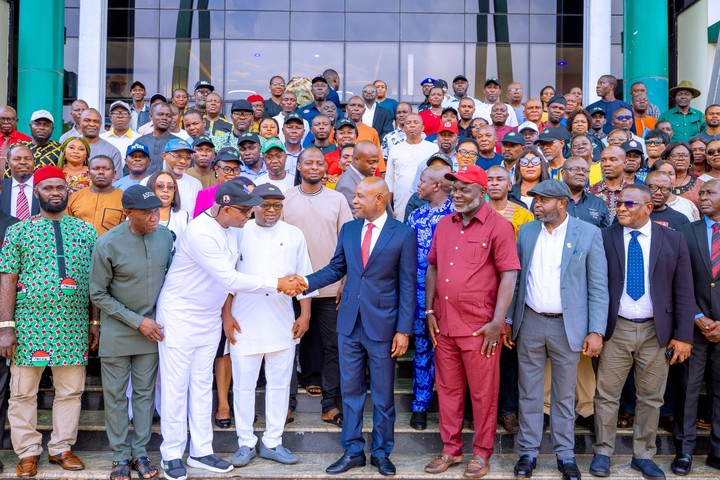

Labour leaders in Enugu State have expressed strong support for Governor Peter Mbah following a consultative meeting that resulted in new welfare commitments for civil servants and pensioners, including a ₦32 billion provision for pensions and gratuities in the state’s 2026 fiscal framework.
The meeting, held at the Government House in Enugu, brought together the governor and leaders of organised labour. It reportedly concluded on an emotional note, with union officials rendering spontaneous songs in appreciation of what they described as decisive and solution-oriented leadership.
Addressing journalists after the engagement, the Head of Service, Dr. Godwin Anigbo, characterized the discussions as strategic and mutually beneficial. According to him, the governor approved requests presented by labour leaders, particularly those relating to workers’ welfare and productivity.
“We just came out from a strategic engagement between the government of Enugu State and the leadership of organised labour. His Excellency, in a very pragmatic manner, approved all their requests, which bordered on workers’ welfare and creating an enabling environment for productivity,” Anigbo stated.
Among the measures announced was an immediate review of consequential salary adjustments arising from the implementation of the new minimum wage. The administration also reaffirmed its commitment to manpower development, including plans to upgrade the existing Staff Development Centre into a full-fledged Public Service Training Institute — described as the first of its kind in Nigeria.
On infrastructure, Anigbo disclosed that the governor approved the completion of Wing C of the New State Secretariat and the renovation of Blocks A and B to improve workplace conditions for civil servants.
A key highlight of the meeting was the confirmation that ₦32 billion has been earmarked in the 2026 budget specifically for the payment of pensions and gratuities, including inherited liabilities. According to the Head of Service, the allocation underscores the administration’s pro-worker stance and commitment to financial obligations owed to retirees.
Related News
CBN Retirees Seek Presidential Intervention Over Alleged Pension Arrears and Disparities
Retirees of the Central Bank of Nigeria have appealed to President Bola Tinubu to intervene in what they describe as…
Delayed Pension Payments Deepen Hardship for Abia Retirees as Concerns Escalate
Retirees in Abia State have raised fresh alarm over delayed gratuities and pension arrears, warning that the prolonged hardship has…
“These are some of the things that informed the excitement expressed by organised labour. In Enugu, we enjoy industrial harmony because of the mutually beneficial relationship between government and workers,” he added.
The Chairman of the Nigeria Labour Congress (NLC), Enugu State Chapter, Comrade Fabian Nwigbo, described the engagement as unprecedented. He noted that beyond discussions, the meeting produced specific commitments and timelines for implementation.
“All the requests we placed before him, he agreed to address them and gave timelines. We have never had it this rosy, not just coming to talk to the governor, but going home with solutions,” Nwigbo said.
He singled out the approval of a ₦32,000 minimum pension as a significant intervention aimed at improving retirees’ welfare. According to him, pensioners who previously received extremely low stipends would now benefit from the new minimum threshold.
Nwigbo also recalled that outstanding pension arrears were cleared within two months of the governor’s assumption of office, adding that gratuity payments have now been institutionalised within the state’s annual budget structure.
The Chairman of the Trade Union Congress of Nigeria (TUC) in Enugu State, Comrade Ejikeme Akaeme, echoed similar sentiments. He said the spontaneous display of appreciation by labour leaders reflected genuine satisfaction with the meeting’s outcome.
“The song you heard was spontaneous. It radiated the joy and satisfaction we got. We thought it would be a brief meeting, but the governor took his time and rekindled our faith and hope,” Akaeme stated.
He added that the governor’s approvals covered key issues affecting both serving workers and pensioners, including consequential adjustments and retirement benefits. Akaeme further noted that improved welfare measures and prompt salary payments had strengthened morale within the public service.
The development has generated reactions among members of the public, with some praising the administration’s commitment to workers’ welfare, while others questioned whether the new minimum pension adequately addresses current economic realities. Supporters, however, argue that institutionalising pension and gratuity payments within the annual budget framework represents a structured approach to long-standing challenges.
As the state prepares its 2026 budget, the administration maintains that sustained engagement with labour will remain central to governance, with a focus on industrial harmony and workforce productivity.