Federal Government Launches Large-Scale Tractor Deployment to Accelerate Agro-Industrial Growth
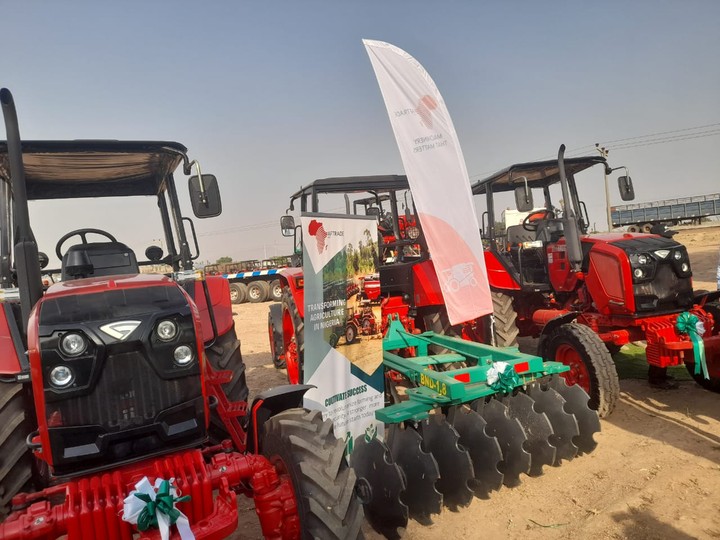

The Federal Government of Nigeria has commenced the rollout of 2,000 tractors and 9,000 agricultural implements across the country in a major push to modernise farming and stimulate agro-industrial growth. The initiative, positioned as part of a broader strategy to strengthen food production and economic diversification, introduces a structured and finance-backed mechanisation model designed to improve efficiency and sustainability in Nigeria’s agricultural sector.
Unlike previous distribution programmes that focused on direct allocation of equipment to individuals or political constituencies, the current scheme adopts a commercial service-based framework. Under this model, tractors are allocated to certified Mechanisation Service Providers (MSPs) operating on a lease-to-own arrangement. The approach aims to ensure proper utilization of equipment, financial sustainability, and wider access for farmers who may not have the resources to purchase machinery outright.
Officials say the programme is structured to create a shared agricultural service economy. Instead of tractors being privately owned and potentially underused, they will function as shared productivity assets, providing services to multiple farmers within communities. Many of the MSPs selected for participation are youth- and women-led enterprises, introducing an entrepreneurial component intended to generate employment and strengthen rural economies.
The government has partnered with the Bank of Agriculture and Heifer International to establish financing structures supporting the mechanisation programme. These arrangements include leasing and hire-purchase options, service aggregation systems, and performance-based eligibility criteria designed to ensure accountability and operational efficiency.
In addition to equipment deployment, the government has introduced a ₦50 billion catalytic seed fund through the Bank of Industry to stimulate agro-industrial investments. Authorities also disclosed that ₦250 billion has been mobilised for the current farming season to support approximately one million smallholder farmers cultivating an average of one hectare each in 2026.
Analysts say the layered financing structure reflects an integrated strategy: mechanisation to increase production capacity, credit to expand cultivation, and industrial funding to process and add value to agricultural output. If implemented effectively, the coordinated approach could address longstanding structural challenges that have hindered productivity in Nigeria’s agricultural sector.
To mitigate risks associated with equipment deterioration and poor maintenance—issues that have affected past initiatives—each tractor deployed under the programme will come with two years of free service support. The government also plans to deploy 36 mobile service trucks nationwide to provide rapid technical assistance, while seven mega mechanisation service centres are scheduled for establishment across strategic zones.
According to the Minister of Agriculture and Food Security, Abubakar Kyari, maintenance is central to ensuring long-term value and productivity from the assets. He noted that mechanisation without proper servicing often leads to wasted expenditure, whereas structured maintenance systems convert such investments into sustainable productivity tools.
The programme also includes plans to support the development of a large-scale tractor assembly plant with an annual production capacity of between 2,000 and 4,000 units. If realised, the facility is expected to reduce reliance on imported equipment, build local technical expertise, and stimulate related industries such as steel fabrication, spare-parts manufacturing, and mechanical engineering services.
For investors and agribusiness operators, the mechanisation drive is seen as a policy signal that Nigeria intends to scale agricultural production through structured, finance-supported frameworks. The Ministry of Agriculture and Food Security will oversee standards, lifecycle asset management, performance monitoring, and quality assurance to strengthen investor confidence and reduce implementation risks.
Early demand indicators appear strong, with more than 100,000 applications reportedly received for the first phase of the programme. Stakeholders believe that improved access to mechanised services, combined with expanded financing and processing capacity, could unlock opportunities in input supply, storage infrastructure, logistics, and export-oriented agriculture.
Agriculture currently contributes roughly a quarter of Nigeria’s gross domestic product and employs a large share of the workforce, yet productivity remains constrained by limited mechanisation and fragmented infrastructure. Authorities say that if the current initiative is executed effectively, it could increase national crop output, reduce production costs per hectare, and help moderate food inflation.
The programme is also expected to generate employment in rural communities through equipment operations, maintenance services, and logistics. However, observers note that its long-term success will depend on transparent governance, disciplined asset management, and sustained financing support.
As tractors begin to reach farming clusters nationwide, industry stakeholders will be monitoring implementation closely to assess whether the initiative delivers measurable improvements in productivity, rural income, and agro-industrial development.