Kano State Unveils Neighbourhood Watch Corps to Strengthen Community Security
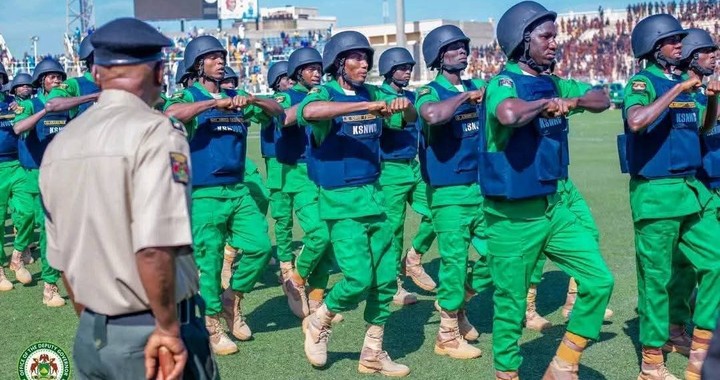

The Kano State Government has inaugurated a new security outfit known as the Neighbourhood Watch Corps (NWC) as part of efforts to enhance community safety and curb the growing threat of banditry, gang violence, and other criminal activities within the state.
The official launch took place on Tuesday at the Sani Abacha Stadium in Kano, where Governor Abba Kabir Yusuf announced the formal integration of the corps into the state’s security framework. According to the governor, the initiative is designed to complement the operations of federal security agencies while providing a community-based response to crime, particularly in areas where conventional policing has been overstretched.
Governor Yusuf disclosed that the first batch of the Neighbourhood Watch Corps consists of 2,000 personnel, comprising 1,870 men and 130 women. He noted that the selection process prioritised local knowledge and familiarity with neighbourhoods, with the aim of improving intelligence gathering and rapid response to security threats.
To support the operational capacity of the new outfit, the state government commissioned a fleet of 88 Hilux patrol vehicles and 440 motorcycles. These assets are to be deployed across all 44 local government areas of Kano State, ensuring the presence of the corps in both urban centres and remote communities.
The governor stated that the Neighbourhood Watch Corps would work in close collaboration with the Nigeria Police Force and other federal security agencies. He added that officers would be equipped with appropriate weapons and tools to confront major crimes, especially banditry and violent attacks reported in rural and semi-urban areas of the state.
Related News
Many Feared Dead as Boko Haram Fighters Overrun Military Base and IDP Camp in Borno
Suspected militants from the Islamic State West Africa Province launched a coordinated early-morning assault on a military base and an…

Gun Attack on ADC Leaders in Edo Raises Fears of Violent Election Season
A gun attack on African Democratic Congress leaders in Benin City, including Peter Obi and Chief John Oyegun, has heightened…

Nigeria Issues Travel Advisory as Israel-US and Iran Conflict Escalates in Gulf Region
The Federal Government of Nigeria has issued a travel advisory urging Nigerians in Iran and neighbouring Gulf states to exercise…
Beyond rural insecurity, the government identified urban crime as a major concern prompting the establishment of the corps. In recent months, Kano has witnessed a sharp rise in phone snatching and street robbery, crimes that have increasingly turned violent. Authorities say many of these attacks are carried out by criminal gangs operating under the guise of commercial tricycle operators.
According to security briefings, suspects often lure unsuspecting passengers into tricycles before diverting to isolated locations, where victims are robbed at knifepoint. In several reported cases, victims sustained serious stab injuries, raising public alarm and prompting calls for stronger community-level surveillance.
State officials believe the Neighbourhood Watch Corps will help address this challenge by increasing visibility, routine patrols, and intelligence sharing within neighbourhoods. The corps is expected to operate at the grassroots level, gathering real-time information and responding swiftly to suspicious activities before they escalate.
Governor Yusuf emphasised that the initiative is not intended to replace existing security agencies but to strengthen them. He described the NWC as a preventive and early-response mechanism that bridges the gap between communities and law enforcement authorities.
The launch of the Neighbourhood Watch Corps has generated mixed reactions among residents and observers. Supporters have welcomed the move as a proactive step towards addressing insecurity, particularly at a time when states across Nigeria are exploring alternative security structures amid calls for state policing.
However, critics have raised concerns about oversight, training standards, and the potential overlap of responsibilities with existing bodies such as Hisbah. Others have expressed fears that without strict regulation and proper screening, the outfit could be misused or infiltrated by criminal elements.
In response to such concerns, the Kano State Government assured that the corps would operate under clear legal guidelines, with defined roles, accountability mechanisms, and coordination protocols with federal agencies.
As insecurity continues to pose challenges nationwide, Kano’s Neighbourhood Watch Corps represents the state’s latest attempt to assert greater control over internal security, while contributing to the broader national debate on decentralised policing and community-based security solutions.