Nigerian Lawyer Sparks Debate With Claim That Anyone Can Legally Take Over an Abandoned House After 12 Years


A video posted online by a Nigerian lawyer has triggered widespread controversy after he explained what he described as a legal pathway to “acquire a house for free” in Nigeria. The lawyer, whose identity has not been officially confirmed, used a casual social media video format to teach viewers about a legal concept he claimed could transfer ownership of abandoned property to an occupant after a decade of continuous living.
In the video, he told viewers that if they found a visibly abandoned house in any neighbourhood, they could move in, begin living there, and—after 10 to 12 years—claim legal ownership through a principle known as adverse possession. According to him, “Just be there. After ten to twelve years, the house is now your own.” He added that this would only hold if the original owner did not reappear within that period to assert their rights.
He further stated that if the owner returned after the 10–12 year period, the occupant could still “plead adverse possession” in court. “Once the court hears adverse possession, the court will tell the person sorry, the land now belongs to you,” he asserted confidently.
The lawyer, however, added a humorous but cautionary remark: “If you are doing this kind of thing, make sure you have JuJu, and your JuJu is strong. Because if the owner comes back and the court tells him the land is no longer his, he may not want to leave your matter for the law. He might take the case to another ‘court.’ And we lawyers don’t operate in that other court.”
Related News

Prof. Ursula Ngozi Akanwa Appointed First Female Vice-Chancellor of Michael Okpara University of Agriculture
Professor Ursula Ngozi Akanwa has been named the seventh Vice-Chancellor of the Michael Okpara University of Agriculture, Umudike, becoming the…

Lagos Governor Sanwo-Olu Hands Over Seat to Student Esther Etiyemonu as One-Day Governor
Lagos State Governor Babajide Sanwo-Olu temporarily handed over the reins of leadership to student Esther Etiyemonu after she emerged winner…
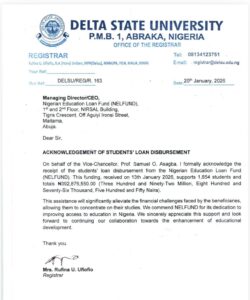
Higher Institutions Confirm Receipt of Tuition Support Funds from NELFUND
Several Nigerian higher institutions have confirmed the receipt of tuition support funds disbursed by the Nigerian Education Loan Fund (NELFUND)…
His comments quickly went viral and sparked an avalanche of reactions, ranging from amusement to outrage. Many online users questioned his professionalism, accuracy, and motives. A top comment asked sarcastically how many houses the lawyer himself had acquired for free using this strategy. Others dismissed him as a content creator rather than a legal professional.
A significant portion of commenters condemned the idea outright, calling it unethical and dangerous. “If you succeed in acquiring someone’s house for free, you are a thief,” one user wrote, arguing that legality and morality were not always aligned. Another warned that attempting such a move could lead to violent retaliation, particularly in communities where property disputes often escalate quickly.
Some commenters used humour to deflate the topic. One joked that trying this with his property would introduce the trespasser to “diverse versions of this world.” Another said any attempt to take over an abandoned house in Nigeria could result in spiritual attack: “Dem go use spiritual level kpai you.”
Even legal-minded users weighed in, criticising the lawyer’s explanation as misleading, incomplete, or entirely wrong. Some questioned whether adverse possession, particularly in the form described, applies straightforwardly to residential buildings in Nigeria, given the nation’s complex land tenure system, documentation requirements, and the influence of local authority structures.
Others raised concerns about the potential for misinterpretation. “Is he saying legal documents are irrelevant?” one commenter asked, pointing out that property transfer in Nigeria involves formal processes that cannot simply be bypassed by squatting.
A few users took a political angle, linking the claim to broader issues of land grabbing, forced displacement, and communal conflict in parts of the country. One person even highlighted how violent occupation has historically been used to seize land, indicating that legality and brute force often intersect in troubling ways.
The video remains widely shared as users debate whether the lawyer’s claim has any legitimate legal basis or is simply another online gimmick designed to attract attention. Regardless of its accuracy, the clip has ignited a fresh conversation about property rights, land law, and the risks involved in attempting to exploit perceived loopholes in Nigeria’s legal system.
The lawyer’s light-hearted warning about needing “strong JuJu” has also become a meme, with many joking that anyone who tries his method may end up in the “other court” he referenced—one where legal degrees offer no protection.