Orji Uzor Kalu Sparks Debate, Says Otti’s Four-Month Allocation Exceeds His Eight Years as Abia Governor
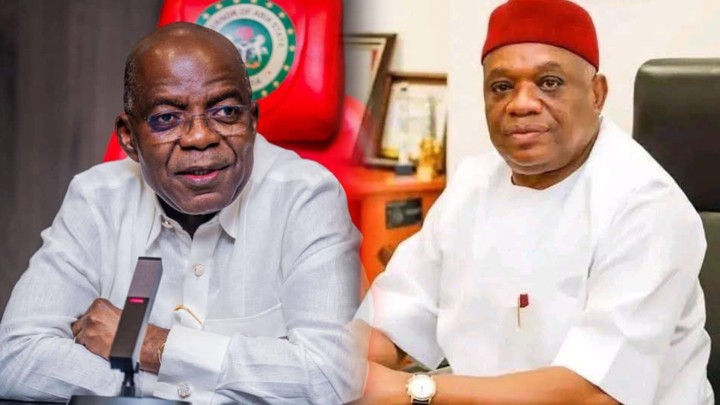

Former Abia State Governor and Senator representing Abia North, Senator Orji Uzor Kalu, has stirred public debate following his assertion that the current governor of Abia State, Dr. Alex Otti, received more funds within four months than he did throughout his eight years in office as governor.
Kalu made the statement on Thursday while addressing journalists during a press conference at his country home in Igbere, Abia State. According to the former Senate Chief Whip, the scale of financial allocations currently available to Abia State far exceeds what was accessible during his administration, and this reality, he argued, should be taken into account when evaluating governance outcomes.
“The money Governor Alex Otti received in four months is what I received in eight years,” Kalu said, insisting that comparisons between his tenure and the present administration must consider the differing fiscal environments.
The former governor further argued that much of what he has observed under the current administration involves the rehabilitation or repainting of infrastructure that, according to him, was originally executed during his time in office. He maintained that he had yet to see large-scale new road projects comparable to those undertaken by his administration.
Related News
Wike Says FCT Poll Shows Voters Rejected ‘Groundnut Politics,’ Takes Swipe at Obi, Amaechi
FCT Minister Nyesom Wike has said the outcome of the recent area council elections in Abuja proves that voters rejected…

Peter Obi Says Nigeria Rich in Talent but Held Back by Poor Leadership
Former presidential candidate Peter Obi has stated that Nigeria’s greatest challenge is not a lack of talent but a failure…
Controversy Trails Shettima’s Kwara Visit as Reports Claim Devastated Woro Community Was Not Reached
A fresh controversy has emerged following Vice President Kashim Shettima’s condolence visit to Kwara State after a deadly terrorist attack…
“What I see mostly is the repainting and rebuilding of roads constructed during my administration. I have not seen major new roads of the scale we undertook,” Kalu stated.
Defending his legacy, Kalu insisted that his record in office remains verifiable and should not be dismissed. He noted that his administration implemented policies that provided free education and healthcare services for Abia residents during his tenure as governor, describing these initiatives as landmark achievements.
Beyond his years as governor, Kalu also highlighted his performance in the National Assembly, asserting that his legislative contributions, particularly in rural development, were unmatched. He cited the construction of new farmland and rural access roads across communities in Abia North as evidence of his impact as a senator.
“I am in the Senate, and the roads I am doing are brand new farmland roads. In two years, I have done what many people thought was impossible,” he said.
However, Kalu’s remarks have drawn widespread reactions, particularly from members of the public who question the validity of comparing allocations across different time periods without adjusting for inflation, currency depreciation, and rising costs of governance. Critics argue that the value of the naira during Kalu’s tenure as governor was significantly stronger than it is today, making direct comparisons misleading.
Others have pointed to changes in minimum wage, construction costs, and overall cost of living as factors that fundamentally alter the purchasing power of government allocations. Some commentators argue that while allocations may be higher in nominal terms today, their real value may be lower when measured against current economic realities.
Supporters of Governor Otti, on the other hand, insist that governance should be assessed not by the volume of funds received but by transparency, efficiency, and the tangible impact of policies and projects on citizens’ lives. They maintain that Abia residents are already witnessing improvements under the current administration.
The exchange has once again brought to the fore longstanding debates in Nigerian politics over how to measure performance in public office, whether by financial inputs or developmental outcomes. As the discussion continues, many observers note that public scrutiny of governance records—past and present—reflects growing citizen interest in accountability and effective leadership.