South-West Leaders Call for Indigenous Security Solutions as Lagos Hosts Zonal Summit
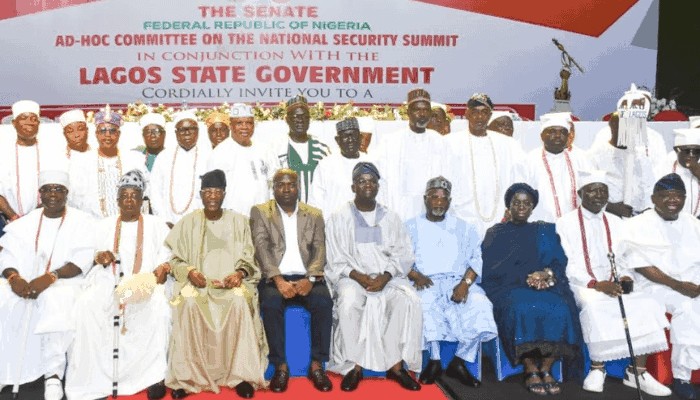

Nigeria’s worsening security situation took center stage on Friday as leaders, policymakers, traditional rulers, and civil society groups across the South-West gathered in Lagos to push for indigenous solutions and stronger regional collaboration. The South-West Zonal Security Summit — convened by the Senate Ad-Hoc Committee on National Security in partnership with the Lagos State Government — became a major platform for determined calls to restructure policing, adopt community-driven strategies, and deploy modern technology to counter threats ranging from kidnapping to armed banditry.
The meeting, held in Ikeja, brought together an extensive list of stakeholders, including Governor Babajide Sanwo-Olu (represented by Ayodele Ogunsan, Executive Secretary of the Lagos State Security Trust Fund), senators led by Senator Adetokunbo Abiru, representatives of South-West states, heads of security agencies, former public officials, civil society leaders, traditional rulers, and religious figures. The convergence underscored the gravity of insecurity in Nigeria and the region’s growing insistence on practical, homegrown responses.
Governor Sanwo-Olu reaffirmed Lagos State’s commitment to strengthening regional cooperation and enhancing the capacity of local security structures. He emphasised that the survival of the region’s economy depends on stability and warned that spiralling insecurity threatens markets, farmlands, infrastructure, and investment flow.
According to him, “Security is not just about keeping the peace; it is about ensuring our economic survival. A region that cannot promise safety cannot promise prosperity either.” He reiterated the need to evolve the Amotekun Corps into a unified, technologically empowered force capable of intelligence sharing and coordinated operations across state boundaries.
Sanwo-Olu also highlighted the central role of traditional rulers and community leaders — individuals he described as custodians of grassroots intelligence. He urged stronger early-warning systems, improved surveillance, and more efficient communication networks linking youth groups, transport unions, vigilante networks, farmers, and civil society organisations.
Related News
Many Feared Dead as Boko Haram Fighters Overrun Military Base and IDP Camp in Borno
Suspected militants from the Islamic State West Africa Province launched a coordinated early-morning assault on a military base and an…
Gun Attack on ADC Leaders in Edo Raises Fears of Violent Election Season
A gun attack on African Democratic Congress leaders in Benin City, including Peter Obi and Chief John Oyegun, has heightened…

Nigeria Issues Travel Advisory as Israel-US and Iran Conflict Escalates in Gulf Region
The Federal Government of Nigeria has issued a travel advisory urging Nigerians in Iran and neighbouring Gulf states to exercise…
The governor pledged Lagos State’s full cooperation with the Senate Ad-Hoc Committee and neighbouring governments to “secure the present and protect the future of the South-West.”
In his opening remarks, Senator Adetokunbo Abiru — chair of the 10th Senate’s regional hearings on national security — stressed that Nigeria must treat insecurity as an existential threat requiring unified action. While acknowledging that the South-West has been spared the worst forms of terrorism, he warned that rising kidnapping, violent robbery, farmland invasions, and the recent Lakurawa incursion into parts of Kwara and Kogi are clear signs of imminent danger.
“We must not allow the South-West to become a sanctuary for criminality,” Abiru said. He urged stronger intelligence coordination, technological investment, and a deliberate effort to ensure communities remain vigilant and cooperative with security agencies. He also appealed to the media to promote unity and avoid narratives that inflame ethnic or religious tensions.
Other contributors echoed the need for structural changes. Senator Ibrahim Jimoh argued that terrorism now requires non-conventional tactics blending military and civilian capacities. Senator Gbenga Daniel called for collective responsibility among all levels of government and society.
Lagos State Commissioner of Police, Moshood Jimoh, praised the state government’s logistical support for security agencies but stressed that solutions must remain local because “security challenges are often local and require local responses.”
Traditional rulers, represented by the Alara of Ilara, Oba Olufolarin Ogunsanwo, demanded community policing, advanced surveillance tools, stronger joint task forces, expanded recruitment, and improved funding for security agencies. He further emphasised the importance of taming youth unemployment, which fuels restiveness and criminality.
The Aare Onakakanfo of Yorubaland, Iba Gani Adams, was direct: Nigeria needs state police. Civil society, religious leaders, and women and youth representatives also pushed for better welfare for security operatives to ensure professionalism and reduce compromise.
Public reactions that trailed the report ranged from scepticism to strong support. Some criticised perceived political theatrics; others argued that funding Amotekun remains the real test of commitment. Several commenters insisted that Nigeria must “show doings” rather than recycle speeches, while many welcomed the region’s readiness to take responsibility for its safety.
The summit closed with a shared understanding: insecurity can no longer be addressed with old strategies. The South-West must adopt solutions rooted in its communities, powered by technology, and backed by political will.