Soyinka Criticises Heavy Armed Security Surrounding Seyi Tinubu in Lagos
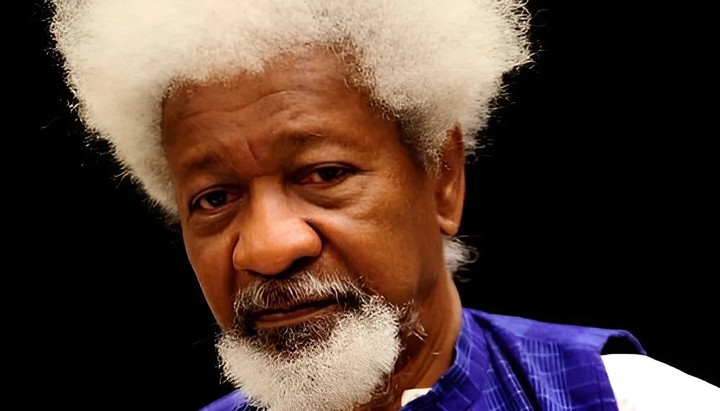

Renowned Nigerian writer and Nobel Laureate, Professor Wole Soyinka, has publicly criticised the scale of armed security attached to Seyi Tinubu, the son of President Bola Tinubu, following an encounter in Lagos. Soyinka said he was taken aback by the number of heavily armed security personnel accompanying the president’s son during a public appearance at a hotel in the Ikoyi area of Lagos State.
According to Soyinka, the incident occurred on Tuesday during an event organised by the Wole Soyinka Centre for Investigative Journalism, where an honorary award was presented to veteran poet and activist, Odia Ofeimun. While reflecting on the occasion in his remarks, Soyinka revealed that he observed what he estimated to be “15 or so heavily armed to the teeth” security operatives escorting Seyi Tinubu at the venue. The sight, he said, left him astonished and deeply concerned.
In a moment that mixed satire with criticism, Soyinka remarked that instead of deploying Nigerian soldiers and air force assets to counter the recent attempted coup in Benin Republic, President Tinubu might as well have sent his son with his visibly formidable security detail to quell the uprising. The comment, while delivered with humour, underscored Soyinka’s deeper concern about the use and visibility of armed state security in civilian spaces.
Related News
Many Feared Dead as Boko Haram Fighters Overrun Military Base and IDP Camp in Borno
Suspected militants from the Islamic State West Africa Province launched a coordinated early-morning assault on a military base and an…
Gun Attack on ADC Leaders in Edo Raises Fears of Violent Election Season
A gun attack on African Democratic Congress leaders in Benin City, including Peter Obi and Chief John Oyegun, has heightened…

Nigeria Issues Travel Advisory as Israel-US and Iran Conflict Escalates in Gulf Region
The Federal Government of Nigeria has issued a travel advisory urging Nigerians in Iran and neighbouring Gulf states to exercise…
Soyinka further disclosed that he formally reported the incident to the National Security Adviser, Nuhu Ribadu, expressing his dissatisfaction over what he perceived as an excessive and alarming display of armed protection around a private citizen. The writer did not accuse the presidency of illegality but questioned the optics, implications, and broader message such a security presence sends to the Nigerian public at a time of widespread insecurity.
The remarks triggered intense reactions across social and political platforms. While some Nigerians applauded Soyinka for what they described as speaking truth to power, others dismissed his comments as politically motivated, untimely, or even insensitive. Critics accused the elder statesman of selective outrage, while supporters argued that his intervention highlighted deeper issues of inequality in security deployment and elite privilege.
Some commentators pointed out that under Nigeria’s constitution and security protocols, the president’s immediate family is entitled to state security protection. However, even among those who accepted the legality of such protection, questions were raised about the scale of the armed presence and whether it aligns with the federal government’s recent directive on reducing police protection for VIPs across the country.
Others used the incident to draw attention to Nigeria’s broader security challenges, particularly the ongoing struggles with kidnapping, banditry, and insurgency in different parts of the country. They argued that the visibility of heavy security around political families stands in sharp contrast to the vulnerability faced by ordinary Nigerians in many communities.
On the opposing side, some voices defended Seyi Tinubu’s security arrangement on the grounds of rising political tension, personal safety risks, and the reality of threats faced by families of top political figures. They maintained that public appearances by prominent individuals naturally attract enhanced security and that such measures should not automatically be interpreted as abuse of power.
Soyinka’s criticism also revived long-standing debates about the role of first families in Nigerian politics and public life. Over several decades, children of sitting presidents have often drawn public attention for their perceived influence, visibility, and access to state resources. The current controversy has once again placed that tradition under public scrutiny.
Despite the mixed reactions, the episode has reinforced Soyinka’s enduring image as an outspoken public intellectual unafraid to criticise authority, regardless of political alignment. It has also reopened broader national conversations about accountability, symbolism, and fairness in the management of Nigeria’s security resources.