Subtle Vote Buying Allegations Emerge in Anambra Governorship Election
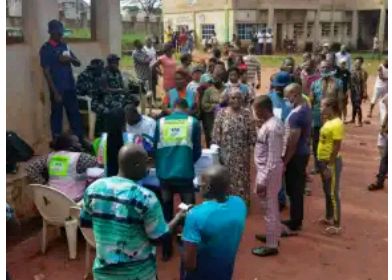

The 2025 Anambra Governorship Election — intended to showcase Nigeria’s democratic progress — has been overshadowed by renewed allegations of vote-buying, this time carried out more subtly than ever before.
Reports from multiple polling units across Awka, Amawbia, Abagana, and Nteje suggest that political party agents engaged in covert transactions with voters, allegedly exchanging cash for votes under tight surveillance.
Although officers of the Independent Corrupt Practices and Other Related Offences Commission (ICPC) and police operatives were stationed at strategic points to deter malpractice, residents claimed that the practice simply evolved — becoming more discreet, organized, and harder to trace.
How the Alleged Vote-Buying Worked
At Polling Unit 02, Amawbia Primary School, one female voter, who spoke on condition of anonymity, confirmed receiving cash after revealing her preferred candidate.
“Before we voted, they quietly asked who we wanted to vote for. If your choice matched their candidate, you were given money,” she said. “No one was stopped from voting, but only those who picked the ‘right’ candidate got paid.”
Another voter, Tochukwu, described the scheme as “coded” compared to previous elections.
“Unlike before, when they handed out money openly, this time they waited until accreditation was done. Someone would approach you, ask who you’re voting for, and even walk with you to confirm your choice before giving you the money.”
At Polling Unit 006, despite heavy police presence, witnesses alleged that party agents still managed to distribute money quietly to those who proved their loyalty.
An off-duty police officer, speaking anonymously, said the Force was prioritizing peace and compliance with directives from the Inspector-General of Police, insisting that the Command had maintained neutrality.
BVAS Praised Amid Controversy
Despite the irregularities, many voters and election officials praised the Bimodal Voter Accreditation System (BVAS) for improving efficiency. Accreditation and voting reportedly began early at most units, with minimal technical glitches.
Related News
Peter Obi Vows to Contest 2027 Presidential Election Despite APC’s 30 Governors
Former Anambra State Governor and 2023 presidential candidate Peter Obi has declared his intention to contest the 2027 presidential election,…
INEC Releases Revised Timetable for 2027 General Elections
The Independent National Electoral Commission (INEC) has announced a revised timetable for Nigeria’s 2027 general elections, shifting the presidential poll…
INEC Under Pressure to Deregister ADC, Labour Party, Others – Igbokwe
Raphael Igbokwe, Chairman of the Board of Trustees of the National Forum of Former Legislators, has alleged that the Independent…
Observers from civil society groups and international monitoring teams commended the smooth logistics and calm conduct of voters but noted concerns about lingering “inducement culture.”
One INEC official at Amuda Village Square, Nteje Ward 1 confirmed that voting began around 8:00 a.m., and most polling units had finished by mid-day. Sorting and counting were completed without major disruptions.
Voters Speak: “I Was Paid to Vote”
A 21-year-old first-time voter, Chinyere Aniwetalu, admitted she was paid to vote — though she refused to disclose the amount.
“I was paid to vote,” she said in Igbo, smiling. “But I’m still happy I finally exercised my civic right. I couldn’t vote in 2023 because I didn’t have my PVC, but this year I got it.”
Her confession underscores the persistent tension between civic participation and electoral corruption. For many Nigerians struggling economically, the temptation of quick cash on election day remains difficult to resist — a reality that has fueled voter inducement for decades.
Security and Neutrality
The Nigeria Police Force, led in Anambra by DIG Benjamin Okolo, maintained that operations across all 21 LGAs were “firm, impartial, and effective.”
SP Ikenga Tochukwu, the Police PRO, reiterated that officers were positioned at polling units, waterways, and borders to prevent violence.
“The Command assures all citizens that we remain committed to neutrality and professionalism. Our goal is a peaceful and credible election,” he said.
While no major violence was recorded, reports of “psychological intimidation” surfaced. A youth corps member serving as an INEC ad-hoc staff claimed that party agents were subtly monitoring voters.
“They stood around, asking who people voted for. If you chose their candidate, they gave you a stipend. Their presence scared others who didn’t want to be marked or attacked later,” he explained.
Wider Implications
The allegations once again expose the fragility of Nigeria’s electoral integrity. Despite reforms, sensitization campaigns, and legal threats against offenders, vote-buying remains deeply rooted — evolving in sophistication as authorities tighten surveillance.
Online reactions ranged from outrage to resignation. Some users on social media mocked the term “subtle vote buying,” insisting that corruption cannot be beautified with vocabulary.
“It’s vote buying or nothing,” one commenter wrote. Another joked, “They say one gala per vote — na democracy buffet be that.”
Still, others stressed that while the system is imperfect, participation remains vital. As one observer put it, “The bigger danger isn’t vote-buying — it’s when citizens stop voting altogether.”
As counting continues and results are awaited, questions linger about the true cost of democracy — and whether the will of the people can ever be separated from the weight of poverty and political influence in Nigeria’s elections.