Tinubu Presses Security Chiefs for Measurable Results as Insecurity Persists Nationwide
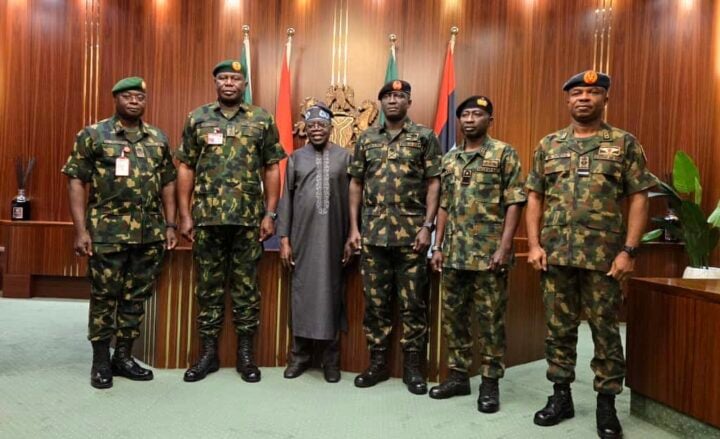

In a renewed push to address Nigeria’s worsening security landscape, President Bola Ahmed Tinubu on Tuesday convened an extended closed-door meeting with the nation’s top military and intelligence chiefs, directing them to intensify operations and deliver visible, measurable improvements in the fight against insecurity.
The meeting took place shortly after the president unveiled the 2026 Armed Forces Remembrance Day emblem at the Presidential Villa in Abuja, underscoring the administration’s stated commitment to supporting the military while demanding increased accountability.
Present at the briefing were the nation’s top security officials:
-
General Olufemi Oluyede, Chief of Defence Staff (CDS);
-
Lieutenant General Wahidi Shaibu, Chief of Army Staff;
-
Air Marshal Sunday Aneke, Chief of Air Staff;
Related News
Many Feared Dead as Boko Haram Fighters Overrun Military Base and IDP Camp in Borno
Suspected militants from the Islamic State West Africa Province launched a coordinated early-morning assault on a military base and an…

Gun Attack on ADC Leaders in Edo Raises Fears of Violent Election Season
A gun attack on African Democratic Congress leaders in Benin City, including Peter Obi and Chief John Oyegun, has heightened…

Nigeria Issues Travel Advisory as Israel-US and Iran Conflict Escalates in Gulf Region
The Federal Government of Nigeria has issued a travel advisory urging Nigerians in Iran and neighbouring Gulf states to exercise…
-
Inspector-General of Police Kayode Egbetokun;
-
Adeola Ajayi, Director-General of the Department of State Services (DSS); and
-
Mohammed Mohammed, Director-General of the National Intelligence Agency (NIA).
The session, which lasted over an hour, focused on reviewing ongoing counter-terrorism and internal security operations across multiple regions, including the North-East, North-West, North-Central, and the expanding fronts of kidnapping and rural banditry in several southern states.
Speaking after the meeting, Chief of Defence Staff Olufemi Oluyede described the discussion as “very engaging”, noting that the president outlined new strategic directives intended to fast-track results. Although specific details of the directives were not disclosed, Oluyede said the orders were aimed at improving tactical coordination, intelligence sharing, and operational efficiency among the various security agencies.
According to him, the Armed Forces and other security bodies are “working more closely than before” to ensure citizens experience improved safety, particularly ahead of the yuletide season when travel, gatherings, and economic activities traditionally increase.
Tinubu’s renewed demands come at a time of heightened public anxiety. Cases of mass abductions, rural killings, highway kidnappings, and cross-border banditry have continued to dominate public discourse. Recent kidnapping incidents, including the abduction of Catholic school children, have provoked widespread anger, with many Nigerians expressing frustration over what they describe as insufficient progress despite repeated security meetings and public assurances.
Public reactions, especially on social platforms and forums, reflect a divided sentiment. While some commenters express hope that the president’s pressure on service chiefs may yield results, others criticise what they perceive as repetitive meetings without tangible improvement. Comparisons have also resurfaced between Tinubu and past administrations, especially former President Muhammadu Buhari, whose tenure was marked by frequent security briefings and persistent insurgency challenges.
Critics argue that without clear timelines, transparent policy shifts, and structural reforms—especially within the police and intelligence frameworks—such directives may result in limited impact. Some security analysts have likewise emphasised that Nigeria’s insecurity problem is deeply rooted in socio-economic factors, local power networks, and internal sabotage within security formations, requiring solutions beyond kinetic force.
Despite public scepticism, the presidency maintains that the ongoing reforms, combined with the president’s pressure on top commanders, will soon produce measurable outcomes. As the festive season approaches, Nigerians continue to watch closely, hoping that the renewed urgency from the presidency translates into safer roads, more secure communities, and meaningful progress in the nation’s longstanding fight against insecurity.