U.S. Travel Ban Will Not Affect Permanent Residents and Green Card Holders – Immigration Expert Clarifies
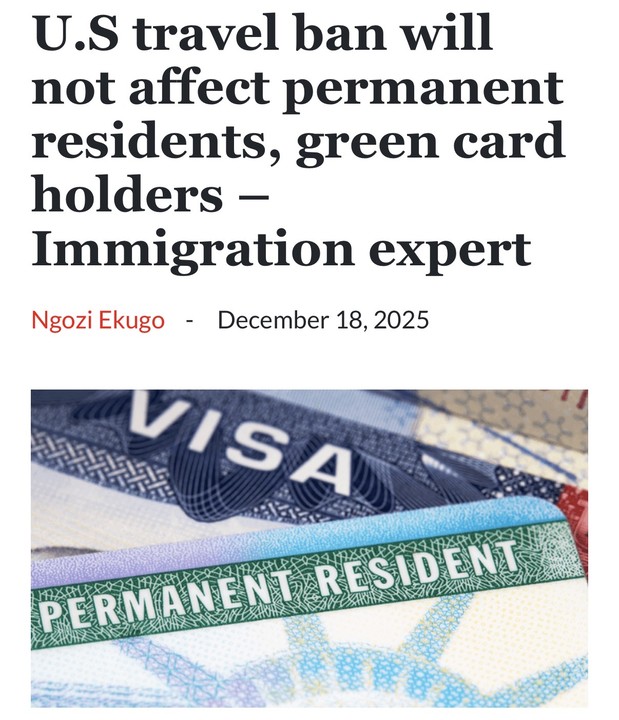

Amid growing anxiety over the United States’ recent decision to impose a partial travel ban on Nigeria and several other countries, a U.S.-based immigration expert has clarified that the new restrictions will not affect Nigerians who are permanent residents or green card holders. The clarification comes as confusion and concern continue to spread among students, business travellers, families, and prospective migrants with ties to the United States.
Andrew Thomas, a Massachusetts-based immigration attorney, explained that the scope of the presidential proclamation has been widely misunderstood, particularly on social media and online forums. Speaking during a televised interview, Thomas stressed that lawful permanent residents of the United States remain protected under U.S. immigration law and are not subject to the entry restrictions outlined in the new policy.
According to Thomas, Nigerians who already hold green cards are free to travel in and out of the United States without being affected by the ban. “If you are a citizen of one of the listed countries and you are already a green card holder, you can go and come as you please,” he said. “If you’re already admitted into the United States, this proclamation does not affect you.”
He further noted that certain categories of parolees and waiver-eligible applicants may also be exempt from the restrictions, provided they return to the United States before the policy officially takes effect on January 1, 2026. Thomas advised such individuals to exercise caution and ensure compliance with all travel timelines to avoid complications at ports of entry.
Related News

Enugu Air Expands Fleet with Three Additional Embraer Aircraft to Boost Regional Connectivity
Enugu Air has announced plans to expand its fleet with three additional Embraer aircraft, a move aimed at strengthening operational…
How to Apply Online for a UK Visa from Nigeria in 2025
A clear and updated 2025 guide explaining how Nigerians can apply for a UK visa online, detailing the new VFS…

Air Peace Commends Tinubu’s Aviation Reforms as Fares Drop from $13,000 to $3,000
Air Peace CEO Allen Onyema has credited President Bola Tinubu’s aviation reforms for enabling the airline’s London route and cutting…
The travel restrictions, announced by the U.S. government and published in an official White House statement, impose limitations on several non-immigrant visa categories for Nigerian nationals. These include B1 and B2 visas used for business and tourism, as well as F, M, and J visas, which cover academic studies, vocational training, and exchange programmes. The decision has sparked concern among Nigerian students, professionals, and families who rely on these visa pathways for education, commerce, and cultural exchange.
U.S. authorities have justified the policy by citing national security considerations, challenges related to identity verification, and concerns over passport integrity in affected countries. The proclamation also referenced Nigeria’s prolonged security challenges and the activities of extremist groups as contributing factors behind the policy shift.
Thomas explained that the administration is relying on long-standing provisions of U.S. immigration law to implement the restrictions. Specifically, he noted that sections 212(f) and 215(a) of the Immigration and Nationality Act grant the U.S. president broad authority to suspend or restrict the entry of certain classes of non-immigrant visa holders when deemed necessary in the national interest.
One of the most critical implications of the new policy, Thomas warned, is that possession of a valid visa no longer guarantees entry into the United States. He emphasised that admission remains subject to inspection and discretion by U.S. Customs and Border Protection officers at the point of entry. “Even if you have a visa before January 1, 2026, entry is not guaranteed,” he said, adding that individuals could still be denied admission under the proclamation.
The restrictions apply not only to new visa applicants but also to individuals who already hold valid visas but are outside the United States and seeking entry after the policy comes into force. This aspect of the decision has heightened uncertainty among Nigerians who frequently travel for education, business, or family reasons.
Thomas also pointed out the broader international implications of the timing of the policy, noting that the United States is preparing to host major global events in the coming years. He suggested that the impact on international mobility and diplomatic engagement remains an area to watch closely.
Despite the current uncertainty, the immigration expert noted that such proclamations are not necessarily permanent. He explained that travel bans and similar executive actions are typically reviewed every 180 days, meaning they could be modified, lifted, or extended depending on diplomatic developments, security assessments, and potential legal challenges.
For now, the policy has introduced a new layer of complexity into U.S.–Nigeria travel and migration relations. While permanent residents and green card holders can take some reassurance from the clarification, students, tourists, and short-term visitors face an evolving and uncertain landscape, underscoring how swiftly immigration rules can change and how deeply they can affect lives across borders.