Nigerian Politicians Back Possible US Military Action Against Terrorists in Nigeria
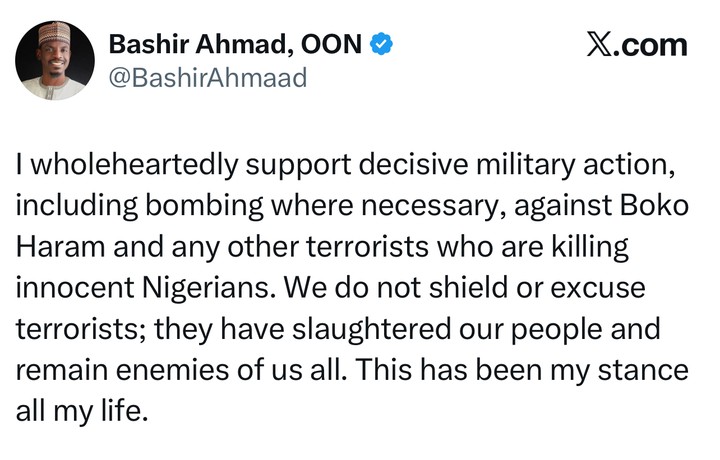

Several well-known Nigerian politicians and commentators have voiced support for possible U.S. military action against terrorist groups operating in Nigeria. The development follows renewed discussions online about the persistent wave of killings, kidnappings, and destruction caused by Boko Haram, bandits, and other insurgent groups across the northern region.
Former presidential aide Bashir Ahmad made his position clear in a recent post on X (formerly Twitter), stating that he “wholeheartedly supports decisive military action, including bombing where necessary, against Boko Haram and any other terrorists who are killing innocent Nigerians.” Ahmad emphasized that terrorists have continued to slaughter Nigerians and should not be protected or excused in any form.
Another prominent figure, Adamu Garba, also spoke strongly about the scale of devastation caused by terrorist attacks. Paraphrasing his remarks, he condemned the killings of defenceless villagers, describing the situation as “pure genocide.” His statement drew widespread attention and fueled the conversation about whether international intervention could help address Nigeria’s worsening insecurity.
Related News
DSS Tells Court Kaduna Man’s Tweets Could Drag Nigeria into Israel–Iran Conflict
Nigeria’s domestic intelligence agency, the Department of State Services (DSS), has told a court that social media posts allegedly made…
Nigeria Begins Evacuation of Citizens from Iran Amid Escalating Middle East Conflict
The Nigerian government has started evacuating its citizens from Iran as tensions in the Middle East intensify.
Nigeria Surpasses India in Number of People Living in Poverty – Report
New data shared by Statisense suggests that Nigeria now has a higher number of people living below the poverty line…
Similarly, an X user identified as Faarees expressed support for the idea of U.S. involvement, even calling on the American government to pressure Nigeria into banning open grazing and clearing forest hideouts where armed groups often take refuge.
However, these endorsements have triggered sharp divisions online. Many Nigerians have criticized what they perceive as hypocrisy from individuals who once defended government narratives downplaying insecurity in the North. Commenters argued that those who previously dismissed reports of mass killings are now conveniently supporting foreign military involvement.
On popular Nigerian forums, reactions were mixed. Some users expressed relief that politicians were finally acknowledging the crisis, while others mocked the sudden shift in tone. One commenter wrote: “What will Tinubu supporters now say when the people they’re trying to impress have switched their stance?” Another added that many who once labeled IPOB as terrorists are now silent about the same label being applied to extremist groups in the North.
Others, however, backed the pro-intervention stance. “Every sincere Nigerian will support the killing of terrorists,” one user declared, reflecting a widespread frustration with the government’s inability to end the violence.
Meanwhile, some Nigerians cautioned against allowing any foreign power to invade the country under the guise of fighting terrorism. They warned that such interventions often come with hidden agendas and long-term consequences for national sovereignty.
In the United States, reports suggest that some Republican lawmakers may be showing interest in authorizing military involvement if former President Donald Trump returns to office. Political observers note that figures like Senator Ted Cruz have voiced concern over global terrorism and could influence Trump’s position.
The debate remains polarized: should Nigeria welcome foreign military help, or insist on solving its own security problems internally? For many citizens tired of endless attacks, the answer seems simple—whoever can end the bloodshed is welcome. But for others, the fear of becoming another foreign military experiment looms large.