Former President Goodluck Jonathan Clarifies Use of Ivorian Aircraft After Visit to Guinea Bissau
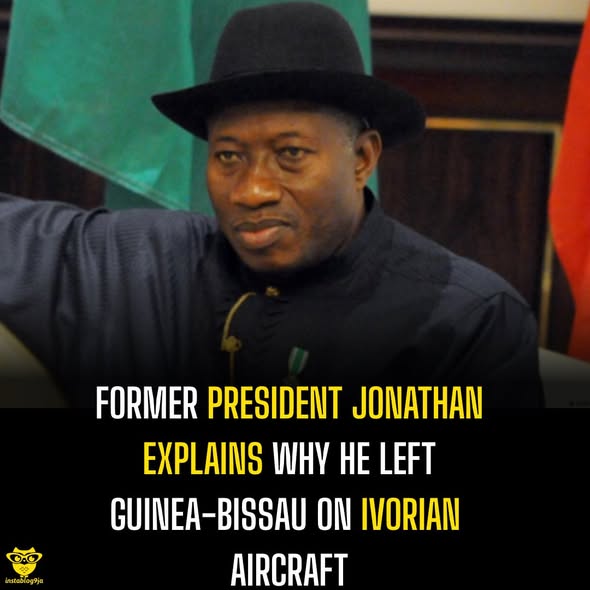

Former Nigerian President Goodluck Jonathan has addressed public speculation surrounding his recent departure from Guinea Bissau, clarifying why he travelled out of the country aboard an aircraft provided by Côte d’Ivoire rather than one from Nigeria. The explanation followed several hours of intense online debate, political interpretations, and mixed reactions from members of the public who questioned the circumstances of his exit and its broader diplomatic implications.
Jonathan, who was in Guinea Bissau for an official engagement, stated that both President Bola Tinubu of Nigeria and President Alassane Ouattara of Côte d’Ivoire had offered to send aircraft to convey him after the event. According to him, the choice of aircraft was not influenced by politics or by any form of preferential treatment, but rather by a combination of logistical realities and regional diplomatic protocols.
Speaking on the matter, Jonathan explained that geographic proximity played a key role in determining which aircraft arrived first. Côte d’Ivoire, being significantly closer to Guinea Bissau than Nigeria, was able to dispatch a plane more quickly. He further highlighted that Côte d’Ivoire’s established diplomatic ties with Lusophone countries enabled it to obtain the required landing and operational clearances faster than Nigeria. These bureaucratic details, he noted, often determine the speed with which such diplomatic aircraft can be deployed.
Related News

DSS Tells Court Kaduna Man’s Tweets Could Drag Nigeria into Israel–Iran Conflict
Nigeria’s domestic intelligence agency, the Department of State Services (DSS), has told a court that social media posts allegedly made…

Nigeria Begins Evacuation of Citizens from Iran Amid Escalating Middle East Conflict
The Nigerian government has started evacuating its citizens from Iran as tensions in the Middle East intensify.

Nigeria Surpasses India in Number of People Living in Poverty – Report
New data shared by Statisense suggests that Nigeria now has a higher number of people living below the poverty line…
Jonathan’s remarks were intended to put an end to rumours suggesting that he had been stranded, neglected, or improperly supported by Nigerian authorities. He stressed that both President Tinubu and the Nigerian government had made provisions for his safe return. However, once it became clear that the Ivorian aircraft had already secured clearance and arrived, he communicated to Nigerian officials that their aircraft was no longer required. He described the decision as one based purely on timing, convenience, and established diplomatic channels.
Despite the clarification, public reactions across online discussion platforms remained varied. Some commenters thanked Jonathan for addressing the issue directly, noting that his statement helped dispel the political tension that had already begun to build around the incident. This group emphasised that misinformation had fueled unnecessary arguments and personal attacks among supporters of different political interests.
Others, however, viewed the situation through a more partisan lens, questioning whether the episode reflected broader concerns about Nigeria’s diplomatic agility or regional influence. A few commenters argued that the incident might have been handled differently by past administrations, while others suggested that the debate surrounding the aircraft was itself an overreaction to a standard diplomatic practice.
A separate group used the moment to express broader frustrations about political discourse in Nigeria, observing that minor incidents often become catalysts for divisive conversations online. Several commenters criticised what they saw as a pattern of individuals using unverified information to attack political opponents, noting that Jonathan’s intervention had helped to calm tensions and redirect the conversation toward facts rather than speculation.
There were also more neutral voices that focused on the cross-border cooperation between West African states, pointing out that such logistical support is common within the region. They argued that Côte d’Ivoire’s assistance demonstrated ongoing collaboration between West African governments, regardless of language blocs or political affiliations.
Jonathan’s statement ultimately emphasised the importance of clarity and responsible communication in public affairs. By providing factual details about the landing permits, regional protocols, and travel arrangements, he aimed to ensure that the incident would not be misinterpreted or politicised beyond its actual significance.
As discussions continue, the former president’s explanation has been broadly acknowledged as a welcome intervention that helped reduce speculation and provide a transparent account of the events surrounding his departure from Guinea Bissau.