ICPC Confirms Receipt of Dangote’s Petition Against NMDPRA Chief
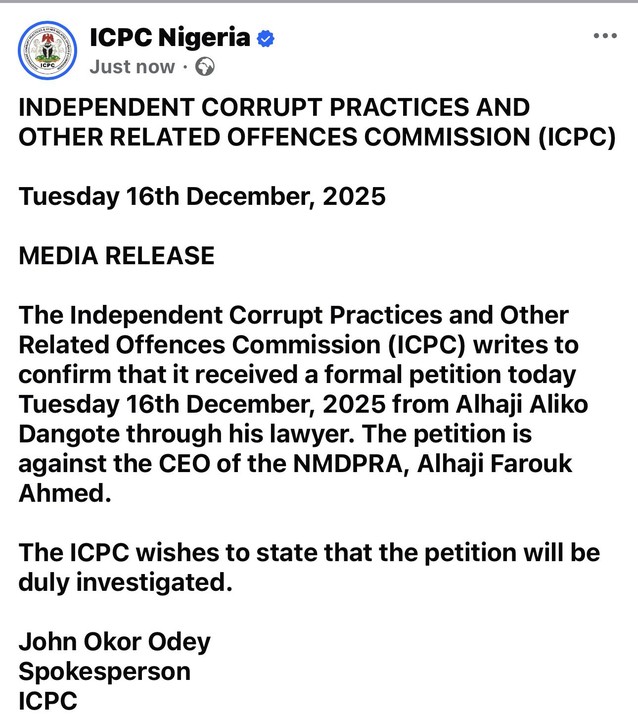

The Independent Corrupt Practices and Other Related Offences Commission (ICPC) has officially acknowledged the receipt of a petition submitted by Nigerian industrialist and billionaire businessman, Alhaji Aliko Dangote, against the Chief Executive Officer of the Nigerian Midstream and Downstream Petroleum Regulatory Authority (NMDPRA), Alhaji Farouk Ahmed. The confirmation was made public on Tuesday, December 16, 2025, through a formal media release issued by the commission.
According to the ICPC, the petition was received earlier the same day through Dangote’s legal representatives. While the commission did not disclose the full details of the allegations contained in the petition, it confirmed that the complaint centers on claims of corruption against the head of the petroleum regulatory agency. The ICPC stated clearly that the petition would be subjected to due process and investigated in accordance with the law.
In the brief statement signed by the commission’s spokesperson, Mr John Okor Odey, the ICPC emphasized its commitment to impartiality and transparency. “The Independent Corrupt Practices and Other Related Offences Commission confirms that it received a formal petition today, Tuesday, December 16, 2025, from Alhaji Aliko Dangote through his lawyer. The petition is against the CEO of the NMDPRA, Alhaji Farouk Ahmed. The ICPC wishes to state that the petition will be duly investigated,” the statement read.
Related News

Rights Group Accuses Police of Judicial Persecution Over Remand of Blogger Maureen Badejo
The Committee for the Defence of Human Rights (CDHR) has accused the Nigeria Police Force of engaging in judicial persecution…

Enugu Government Declares 90-Day Amnesty for Buildings Without Approved Plans
The Enugu State Government has introduced a 90-day amnesty period for property owners whose buildings lack approved plans, offering them…
China to Remove Tariffs on Most African Imports Starting May 1, Says Xi Jinping
China has announced plans to eliminate tariffs on imports from nearly all African nations beginning May 1, a move President…
The confirmation has further intensified public attention around the ongoing dispute involving the Dangote Group and the leadership of the NMDPRA, particularly within Nigeria’s highly sensitive oil and gas sector. In recent weeks, the controversy has drawn widespread debate, with opinions sharply divided over whether the allegations represent a genuine anti-corruption effort or are linked to broader commercial and regulatory tensions within the petroleum industry.
Alhaji Aliko Dangote, who owns the Dangote Petroleum Refinery and Petrochemicals complex, has been vocal about what he describes as regulatory challenges facing domestic refining operations. His decision to formally petition the ICPC has elevated the matter beyond public commentary into the realm of institutional investigation, placing significant pressure on the anti-graft agency to demonstrate credibility and independence.
On the other hand, supporters of the NMDPRA leadership have argued that regulatory authorities must be allowed to perform their duties without intimidation, regardless of the stature or influence of those raising complaints. They insist that allegations, no matter the source, should be carefully examined and proven before conclusions are drawn.
Legal and governance analysts note that the ICPC’s confirmation of receipt does not amount to a finding of guilt but merely signals the beginning of an investigative process. Under Nigerian law, individuals accused of corruption are presumed innocent until proven otherwise, and any investigation must follow established procedures, including the evaluation of documentary evidence and possible interviews with relevant parties.
The development has also renewed calls for greater transparency in Nigeria’s oil and gas regulatory framework, an industry long plagued by allegations of mismanagement and corruption. Many observers believe the outcome of the ICPC’s investigation could have far-reaching implications, not only for the individuals involved but also for investor confidence and regulatory credibility in the sector.
As of the time of this report, neither the NMDPRA nor Alhaji Farouk Ahmed has issued an official response to the ICPC’s confirmation. The commission has assured the public that updates will be provided as appropriate, following the conclusion of preliminary reviews and investigations.
With the stakes high and public interest intense, all eyes are now on the ICPC as it navigates what many see as a critical test of its independence, professionalism, and commitment to fighting corruption without fear or favour.