Court Orders Federal Government to Publish NDDC Forensic Audit, Affirms Commission’s Independence
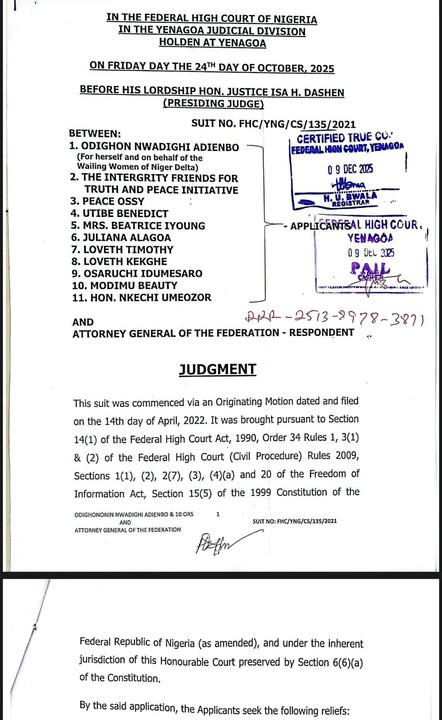

In a landmark ruling that could reshape the governance and accountability framework of the Niger Delta Development Commission (NDDC), the Federal High Court in Yenagoa has ordered the Federal Government to immediately publish the forensic audit report of the commission. The court also ruled that the NDDC must function as an independent agency, free from the supervision or control of any ministry or government department.
The judgement, delivered by the Federal High Court, represents a major victory for civil society groups and Niger Delta stakeholders who have long demanded transparency over the management of funds allocated to the interventionist agency. The forensic audit, which was commissioned by the Federal Government to probe years of alleged financial mismanagement and corruption within the NDDC, has remained unpublished despite repeated public assurances.
In its ruling, the court made four far-reaching orders. First, it directed the Federal Government to publish the NDDC forensic audit report in full, making it accessible to the Nigerian public. According to the court, withholding the report undermines transparency, accountability, and the right of citizens—particularly those of the Niger Delta—to know how public resources meant for regional development were utilized.
Second, the court declared that the NDDC should operate as an independent statutory agency, not subject to the supervision or control of any ministry or government body. This pronouncement directly challenges years of executive interference in the commission’s affairs, which critics argue has weakened its institutional autonomy and contributed to persistent governance failures.
Related News

Supreme Court Affirms Seven-Year Jail Term for Former Senator Albert Bassey
The Supreme Court of Nigeria has affirmed the conviction and seven-year prison sentence of former senator Albert Bassey over a…

FIFA and UEFA Presidents Named in ICC Complaint Alleging Complicity in Settlement Activities
Presidents Gianni Infantino and Aleksander Ceferin have been accused of aiding war crimes in a complaint submitted to the International…

Court Sentences Cleric to Death Over Killing of University of Uyo Final-Year Student in Akwa Ibom
An Akwa Ibom State High Court has sentenced Prince Emmanuel Umoh, a cleric, to death by hanging for the 2020…
Third, the court issued a perpetual injunction restraining the Federal Government from appointing or constituting any form of sole administrator or interim management arrangement for the NDDC. The ruling effectively outlaws the practice of placing the commission under sole administratorship, a governance model that has been heavily criticized for concentrating power in one individual and eroding institutional checks and balances.
Fourth, the court ordered that all sole administrators who have managed the NDDC—from the tenure of Professor Nelson Brambaifa to date—must render a public account of all funds allocated to and accrued by the commission during their respective periods in office. This aspect of the judgement underscores the court’s insistence on retrospective accountability and public disclosure of financial records.
The suit was instituted by Barrister Odighonin Adienbo, acting for herself and on behalf of a group known as the Wailing Women of the Niger Delta, alongside the Integrity Friends for Truth and Peace Initiative (TIFPI), led by activist Livingstone Wechie and other concerned parties. The respondents in the case were the Attorney General of the Federation and the Niger Delta Development Commission.
The applicants argued that prolonged secrecy surrounding the forensic audit report and repeated use of sole administrators violated the NDDC Act and undermined the commission’s mandate to deliver sustainable development to oil-producing communities. They maintained that transparency and institutional independence were essential to restoring public trust in the agency.
Reactions to the ruling have been swift and mixed. Many Niger Delta residents and advocacy groups welcomed the decision, describing it as a long-overdue step toward exposing entrenched corruption and mismanagement within the commission. Others expressed cautious optimism, noting that previous revelations about the NDDC have often failed to translate into prosecutions or meaningful reforms.
Critics of the NDDC have long described it as one of Nigeria’s most corruption-prone institutions, citing repeated reports of abandoned projects, inflated contracts, and elite capture. Supporters of the ruling argue that making the forensic audit public could finally reveal the scale of financial abuse and help chart a new course for development in the region.
While the Federal Government has yet to issue an official response, legal analysts note that the judgement places a clear obligation on authorities to act. Failure to comply, they warn, could amount to contempt of court and further erode public confidence in governance reforms.
As attention now turns to implementation, many Nigerians will be watching closely to see whether the forensic audit is finally released and whether the court’s orders mark a genuine turning point in the troubled history of the NDDC.