Buildings Set Ablaze in Tehran as Cost-of-Living Protests Spread Across Iran
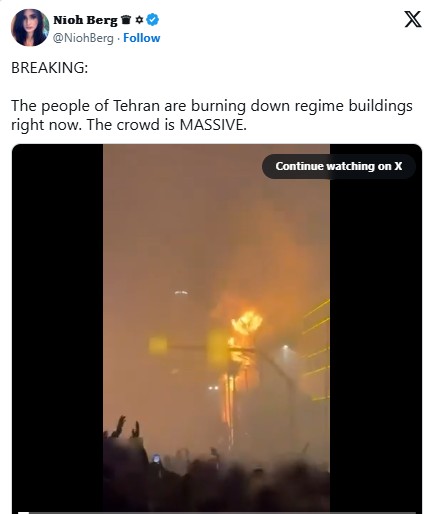

Buildings were set ablaze in Iran’s capital, Tehran, as large-scale anti-government protests intensified across the country, reflecting deep public anger over worsening economic conditions and the sharp decline of the national currency. Verified footage circulating on social media and confirmed by BBC Persian shows fires burning in several locations in Tehran, including mosques in the Gholhak and Sa’adat Abad neighbourhoods, as crowds gathered in defiance of authorities.
The unrest marks the twelfth consecutive day of nationwide demonstrations, with protests reported in more than 100 cities and towns across all 31 provinces of Iran, according to human rights groups monitoring the situation. What began as scattered protests over rising prices has evolved into a broader expression of frustration with economic mismanagement, inflation, unemployment, and long-standing political grievances.
Iran’s economy has been under intense pressure for years, strained by international sanctions, reduced oil revenues, currency devaluation, and structural weaknesses. The Iranian rial has lost significant value, eroding purchasing power and pushing basic necessities beyond the reach of many households. For millions of Iranians, wages have failed to keep pace with inflation, creating mounting hardship that has now spilled onto the streets.
Related News
El-Rufai Says He Would Have Joined Peter Obi’s ‘Occupy NASS’ Protest Over Electronic Transmission of Results
Former Kaduna State governor Nasir El-Rufai has said he would have joined former presidential candidate Peter Obi at the “Occupy…
‘Sack Wike Now’: Protesters Storm APC National Headquarters in Abuja
A group of protesters on Friday besieged the national headquarters of the All Progressives Congress (APC) in Abuja, calling on…
Retired Police Officers Protest in Abuja: “We Have Been Turned to Beggars After 35 Years of Service”
After decades of service to Nigeria, retired police officers have taken to the streets of Abuja to demand payment of…
Videos from Tehran show large crowds chanting slogans, blocking roads, and confronting security forces as fires burned in prominent buildings. While the full extent of the damage remains unclear, the images signal a sharp escalation in tactics compared to earlier demonstrations, which were largely peaceful but persistent. Authorities have yet to release an official assessment of the incidents or provide detailed casualty figures.
The protests are not confined to the capital. Reports from across the country indicate similar scenes of unrest, including clashes with security personnel, arrests, and disruptions to daily life. Human rights organizations have accused Iranian authorities of responding with force in several locations, raising concerns about the potential for further violence as tensions rise.
Government officials have largely blamed external pressures, particularly sanctions, for the economic crisis, while critics argue that domestic mismanagement, corruption, and lack of accountability have played a central role. Protesters, for their part, appear increasingly unwilling to accept official explanations, directing their anger at state institutions and symbols of authority.
Analysts note that Iran has experienced waves of protests in recent years, often triggered by fuel price hikes, subsidy cuts, or political flashpoints. However, the scale and geographic spread of the current demonstrations suggest a deeper and more sustained level of public discontent. The participation of diverse social groups, including workers, traders, and young people, underscores the breadth of the economic pain being felt across society.
As night fell in Tehran, security forces were reportedly deployed to key areas, and internet disruptions were observed, a measure frequently used by authorities during periods of unrest to limit the spread of information. Despite this, images and videos continued to emerge, highlighting the challenge facing the government in containing both the protests and public perception.
The coming days are likely to be critical. Whether the demonstrations subside, intensify, or evolve into a broader political movement will depend on the government’s response, economic developments, and the willingness of protesters to sustain pressure despite the risks involved. For now, the burning buildings in Tehran stand as a stark symbol of a nation grappling with deep economic distress and an increasingly volatile social climate.