Sanwo-Olu, Ezekwesili Trade Words Over Makoko Demolitions as Rights and Safety Debate Deepens
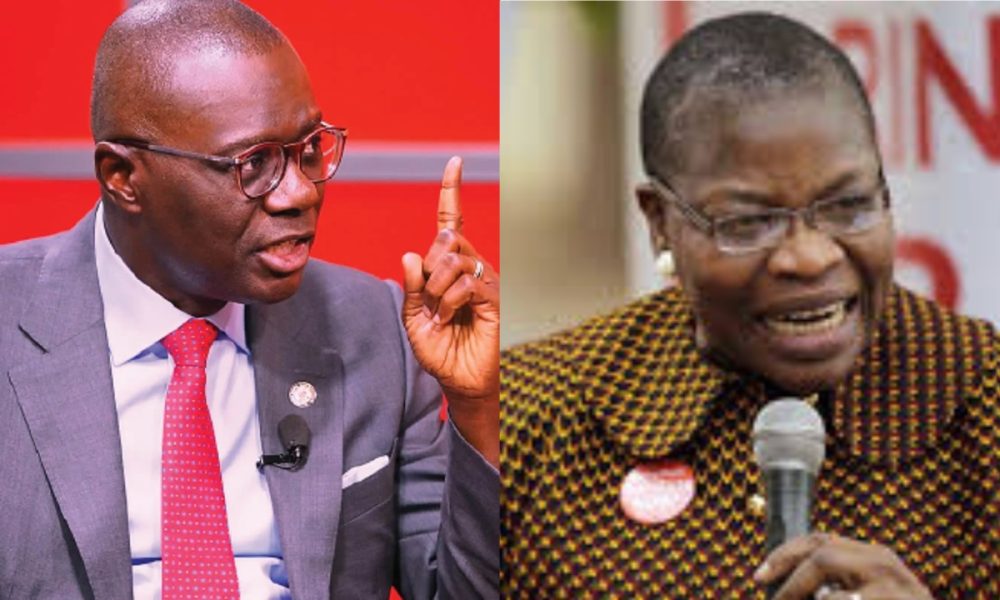

A public exchange has erupted between Lagos State Governor, Babajide Sanwo-Olu, and former Minister of Education, Mrs Oby Ezekwesili, following the recent demolition of structures in the Makoko area of Lagos. The disagreement has reignited long-standing debates around urban renewal, safety enforcement, human rights, and the treatment of vulnerable communities in Nigeria’s rapidly expanding cities.
Ezekwesili strongly criticised both the Federal Government and the Lagos State Government over the demolition exercise, describing it as unconstitutional, inhumane, and an example of state-backed oppression against economically disadvantaged citizens. In a detailed memorandum addressed to President Bola Ahmed Tinubu and Governor Sanwo-Olu, she accused the authorities of abusing state power under the guise of safety concerns and urban development.
Raising broader questions about governance and citizenship, Ezekwesili asked whether Lagos operates as a city of equal citizens or as a space where economic value outweighs human dignity. She further questioned whether Nigeria’s democratic framework truly protects all citizens or primarily serves those with economic privilege.
According to the former minister, residents of Makoko—many of whom depend on fishing, informal trading, and small-scale businesses—are not illegal occupants but Nigerian citizens whose rights have been persistently undermined because of their socioeconomic status. She argued that years of neglect and repeated demolition exercises have created a pattern where poverty is effectively treated as a basis for exclusion from full citizenship rights.
Ezekwesili, who founded the School of Politics, Policy and Governance (SPPG), also alleged that the most recent demolition contradicted earlier assurances given by Lagos State officials. She said community leaders were initially informed that only structures located within a 30 to 50-metre safety buffer around high-tension power lines would be affected. Based on this understanding, residents reportedly cooperated with authorities.
However, she claimed that the scope of the demolition later expanded far beyond the agreed limits, extending hundreds of metres and affecting homes, schools, clinics, and sources of livelihood that did not pose any immediate safety threat. According to her, altering agreed conditions mid-operation amounted to an abuse of authority rather than lawful enforcement.
Related News
Lagos Government Asked Landlord to Pay ₦400,000 to Unseal Her House Despite Having Complete Documents
A Lagos landlord shared a shocking experience after returning home to find her newly built house sealed by officials despite…
Lagos Ready for State Police, Says LNSA Chief Ifalade
Lagos State has declared its readiness for the establishment of state police in Nigeria, with the leadership of the Lagos…
Lagos State Holds Nigeria’s Largest Subnational Domestic Debt at ₦1.05 Trillion, Data Shows
New data from Nigeria’s Debt Management Office indicates that Lagos State holds the largest domestic debt among all states, standing…
Ezekwesili further alleged that the demolition exercise resulted in fatalities and described the operation as a form of forceful land seizure designed to benefit elite interests. She argued that the justification of safety and urban planning was being used to mask what she termed “class cleansing” of poor communities from valuable waterfront locations.
She warned that the exercise had triggered a humanitarian emergency, displacing thousands of families, disrupting children’s education, and exposing already vulnerable groups to hunger, disease, and insecurity. According to her, once government action leads to homelessness, the state has an immediate constitutional and moral obligation to provide care, protection, and resettlement.
In response to these allegations, Governor Sanwo-Olu rejected the accusations and defended the state government’s actions. Speaking to journalists, the governor maintained that the demolition was necessary to protect lives, particularly due to the dangers posed by illegal structures erected beneath high-tension power lines.
Sanwo-Olu also shifted attention to the role of certain local and international non-governmental organisations involved in the matter. He alleged that some NGOs were exploiting the situation for financial gain and promised that the state government would present evidence to support its claims.
“We are aware that some local and international NGOs are attempting to profit from this situation. We are monitoring them and will provide evidence,” the governor said.
According to him, some organisations had received significant funding from international donors in the name of supporting affected communities but failed to deliver meaningful assistance. He suggested that the intense criticism directed at the Lagos State Government was partly driven by attempts to deflect attention from those failures.
“That is why some people are protesting louder than those directly affected. We are prepared to confront these issues and explain why certain decisions had to be taken,” Sanwo-Olu added.
The clash has sparked widespread reactions across social and political circles, with opinions sharply divided along lines of governance, ethnicity, urban planning, and social justice. While some argue that demolitions are a routine aspect of city management and safety enforcement, others insist that such actions must be accompanied by transparency, fair notice, adequate compensation, and resettlement plans to protect vulnerable populations.
As the debate continues, the Makoko demolitions have once again placed Lagos at the centre of a national conversation on how governments balance development, safety, and the rights of the urban poor in a rapidly urbanising Nigeria.