US State of Georgia Grants IPOB Leader Nnamdi Kanu Honorary Citizenship
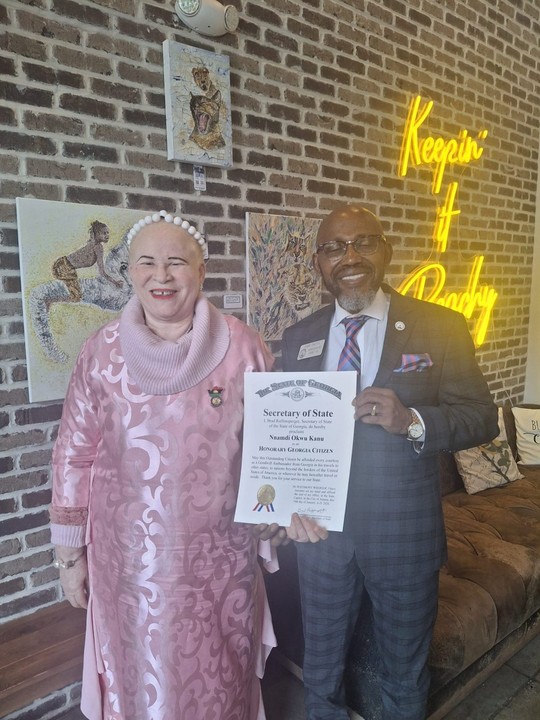

The government of the US state of Georgia has granted honorary citizenship to Nnamdi Kanu, the detained leader of the Indigenous People of Biafra (IPOB), a separatist group seeking the independence of Nigeria’s south-east region. The announcement has drawn widespread attention and mixed reactions, given Kanu’s current legal status in Nigeria and the long-running controversy surrounding his activism.
According to official documents, Kanu was declared an “Honorary Georgia Citizen” through a proclamation signed by Georgia Secretary of State Brad Raffensperger. The proclamation is dated January 16, 2026, and also designates Kanu as a goodwill ambassador from the state of Georgia.
At the time of the announcement, Kanu remains incarcerated in Nigeria, where he is reportedly serving a life sentence at Sokoto Prison following his conviction on terrorism-related charges brought by the Federal Government. Nigerian authorities have consistently maintained that Kanu’s actions and broadcasts amounted to incitement and threats to national security, allegations his supporters continue to dispute.
The proclamation was formally received in the United States by Uche Ajulu, a former Nigerian ambassador to South Africa, who accepted the document on Kanu’s behalf during a presentation in Georgia. The event has since been circulated widely online, fuelling intense public debate both within Nigeria and among members of the Nigerian diaspora.
Related News

Rights Group Accuses Police of Judicial Persecution Over Remand of Blogger Maureen Badejo
The Committee for the Defence of Human Rights (CDHR) has accused the Nigeria Police Force of engaging in judicial persecution…

Enugu Government Declares 90-Day Amnesty for Buildings Without Approved Plans
The Enugu State Government has introduced a 90-day amnesty period for property owners whose buildings lack approved plans, offering them…

China to Remove Tariffs on Most African Imports Starting May 1, Says Xi Jinping
China has announced plans to eliminate tariffs on imports from nearly all African nations beginning May 1, a move President…
In the proclamation, Raffensperger stated: “I, Brad Raffensperger, Secretary of State of the State of Georgia, do hereby proclaim Nnamdi Okwu Kanu as an Honorary Georgia Citizen.” The document further called on authorities and institutions to accord Kanu “every courtesy as a Goodwill Ambassador from Georgia” during his travels, whether within the United States or beyond its borders.
The statement concluded by thanking Kanu for what it described as “service to our state,” and was officially sealed at the Georgia State Capitol in Atlanta.
Honorary citizenship in US states is largely symbolic and does not confer legal rights such as residency, voting privileges, or diplomatic immunity. However, such recognitions are often used to highlight advocacy causes, cultural ties, or political solidarity, particularly by subnational officials.
Supporters of Kanu have welcomed the announcement as a significant international gesture that could draw renewed attention to his detention and the broader agitation for self-determination in Nigeria’s south-east. Some believe the recognition may strengthen calls for diplomatic engagement or international mediation over his case.
Others, however, have dismissed the move as symbolic at best, arguing that it has no direct legal impact on Kanu’s incarceration or ongoing legal situation in Nigeria. Critics have also questioned the appropriateness of granting honorary citizenship to an individual convicted of terrorism-related offences by his home country.
The development has further polarised public opinion, with reactions ranging from praise and celebration to condemnation and scepticism. While some view the proclamation as a moral boost for Kanu and his supporters, others see it as an empty gesture that does little to address the underlying legal and political issues surrounding his detention.
As of now, there has been no official response from the Nigerian government regarding the honorary citizenship, nor any indication that the proclamation will alter diplomatic relations between Nigeria and the United States. Observers note that, in practice, matters involving criminal convictions and national security remain firmly within the jurisdiction of sovereign states.
The honorary citizenship nonetheless adds a new international dimension to an already complex and emotionally charged case, ensuring that the situation surrounding Nnamdi Kanu continues to attract both domestic and global attention.