Court Orders 48 Individuals to Report to SSS Over Alleged Fraud and Illegal Financial Transactions
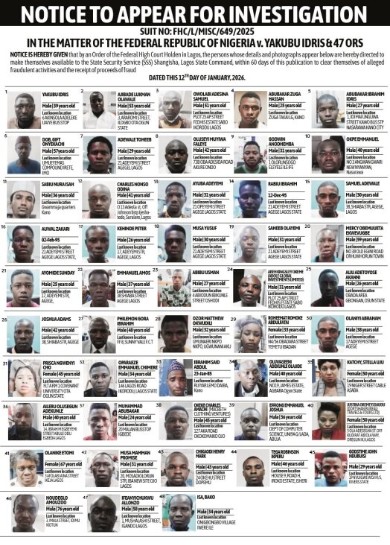

A Federal High Court sitting in Lagos has ordered 48 individuals to report to the Lagos Command of the State Security Service (SSS) over allegations of fraud and the illegal receipt of money. The directive forms part of an ongoing investigation in a case instituted by the Federal Republic of Nigeria against Yakubu Idris and 47 other defendants.
The court order, which was issued on January 12, 2026, requires the named individuals to present themselves at the SSS office located in Shangisha, Lagos, within 60 days from the date of public notice. According to the court, compliance with the directive is mandatory, as it is tied to an official legal process under Suit No: FHC/L/MISC/649/2025.
Court documents indicate that the order was made to enable the SSS to properly investigate allegations bordering on fraud and the unlawful receipt of funds. The affected individuals are expected to cooperate fully with security authorities by making themselves available for questioning and providing relevant information that may assist in determining the facts of the case.
Related News

Supreme Court Affirms Seven-Year Jail Term for Former Senator Albert Bassey
The Supreme Court of Nigeria has affirmed the conviction and seven-year prison sentence of former senator Albert Bassey over a…

FIFA and UEFA Presidents Named in ICC Complaint Alleging Complicity in Settlement Activities
Presidents Gianni Infantino and Aleksander Ceferin have been accused of aiding war crimes in a complaint submitted to the International…

Court Sentences Cleric to Death Over Killing of University of Uyo Final-Year Student in Akwa Ibom
An Akwa Ibom State High Court has sentenced Prince Emmanuel Umoh, a cleric, to death by hanging for the 2020…
The list of those ordered to report spans several states across the country, reflecting the wide geographical spread of the investigation. The individuals’ last known addresses are located in Abuja, Lagos, Ogun, Ondo, Oyo, Nasarawa, Kano, Imo, Delta, and Rivers states. This suggests that the alleged financial transactions under scrutiny may not be limited to a single state or region.
Notably, the individuals involved range in age from 24 to 76 years, highlighting the broad demographic scope of the investigation. Among the names listed in the court document are Yakubu Idris, Ajibade Lukman Olawale, and Owolabi Adesina Samuel, alongside dozens of others. The court did not specify the exact roles each individual allegedly played but emphasised that their appearance before the SSS is necessary to clarify their level of involvement, if any.
According to the court, the purpose of the order is not an automatic declaration of guilt but an opportunity for the individuals to respond to the allegations and clear their names where appropriate. The directive is part of preliminary investigative steps, and no convictions have been recorded at this stage.
Legal observers note that such court-ordered invitations are often used to compel cooperation in complex financial investigations, especially in cases involving multiple parties and cross-state financial flows. Failure to comply within the stipulated timeframe could expose the affected individuals to further legal consequences, including possible warrants or additional court actions.
The development has generated public discussion, particularly due to the number of individuals involved and the age range represented. While some commentators have expressed concern over the scale of the alleged fraud, others have pointed out that individuals may be listed simply because their accounts or identities were linked to suspicious transactions, even if unknowingly.
The State Security Service has not issued a separate public statement detailing the nature of the alleged fraud or the sums involved. However, sources familiar with the matter indicate that the investigation is aimed at establishing the legitimacy or otherwise of funds received by the listed individuals.
As the 60-day window runs, attention will be on whether all the affected persons comply with the court order and how the investigation unfolds. The case underscores the growing focus by Nigerian authorities on financial crimes and the use of legal mechanisms to ensure accountability and cooperation in ongoing probes.