INEC Releases Revised Timetable for 2027 General Elections
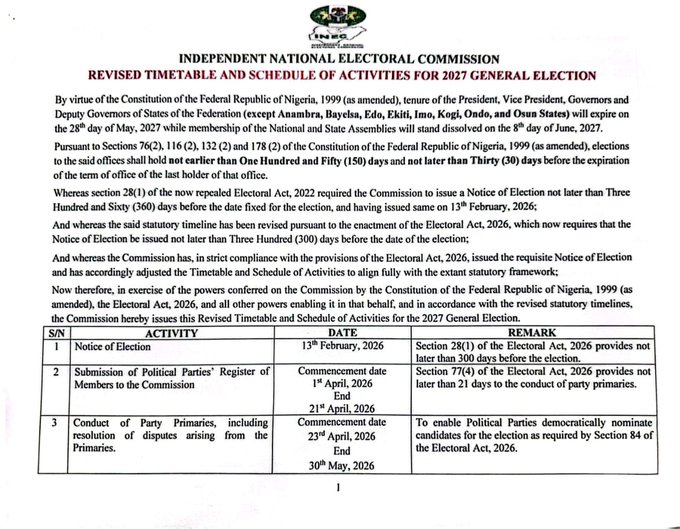

The Independent National Electoral Commission (INEC) has officially unveiled a revised timetable and schedule of activities for Nigeria’s 2027 general elections, introducing new dates for both presidential and governorship polls.
According to the updated schedule released via INEC’s official communication channels and signed by its Chairman, Professor Joash Amupitan, the Presidential and National Assembly elections will now take place on January 16, 2027. Meanwhile, the Governorship and State Houses of Assembly elections have been rescheduled for February 6, 2027.
The development marks a shift from the commission’s earlier timetable, which had initially fixed the Presidential and National Assembly elections for February 20, 2027, and the Governorship and State Assembly elections for March 6, 2027.
Why the Dates Were Changed
The original election dates drew objections from some Muslim stakeholders who noted that the scheduled period overlapped with Ramadan, a significant religious observance marked by fasting and prayers. Concerns were raised that holding national elections during the holy month could affect voter participation and logistical planning in certain parts of the country.
Following the concerns, the Nigerian Senate amended Clause 28 of the Electoral Act Amendment Bill. The amendment reduced the mandatory notice period required before an election from 360 days to 300 days. This legislative adjustment provided INEC with the legal flexibility needed to revise the election dates.
Observers say the move reflects ongoing efforts to balance constitutional requirements with social and religious considerations in a diverse country like Nigeria.
Key Highlights of the Revised Schedule
Under the updated timetable:
-
Presidential and National Assembly elections: January 16, 2027
Related News
Peter Obi Vows to Contest 2027 Presidential Election Despite APC’s 30 Governors
Former Anambra State Governor and 2023 presidential candidate Peter Obi has declared his intention to contest the 2027 presidential election,…
INEC Under Pressure to Deregister ADC, Labour Party, Others – Igbokwe
Raphael Igbokwe, Chairman of the Board of Trustees of the National Forum of Former Legislators, has alleged that the Independent…
Apathy, Vote Buying Allegations and Isolated Violence Mar FCT Council Elections
Low voter turnout, allegations of vote buying, and reports of intimidation overshadowed Saturday’s area council elections in the Federal Capital…
-
Governorship and State Houses of Assembly elections: February 6, 2027
INEC is also expected to outline detailed timelines for party primaries, submission of candidates’ names, campaigns, and other pre-election activities in line with the new framework.
The compressed timeframe resulting from the amendment means political parties will have a shorter window to conduct primaries and resolve internal disputes before submitting candidates to the electoral body.
Political Reactions and Early Permutations
The announcement has already sparked conversations within political circles. Some commentators noted that the shortened schedule could significantly influence party strategies, especially among opposition coalitions.
Within the African Democratic Congress (ADC), discussions are reportedly intensifying over potential presidential aspirants, including figures such as Atiku Abubakar, Peter Obi, and Rotimi Amaechi. Political analysts suggest that a tighter primary season may test the organizational readiness of parties seeking to mount strong campaigns.
On social media platforms, reactions have ranged from support for the adjustment to criticism over what some perceive as swift responsiveness to religious concerns while other national challenges remain unresolved.
Others, however, argue that accommodating religious observances in electoral planning is a pragmatic decision in a pluralistic society, especially when it can help improve voter turnout and public confidence in the process.
Implications for the Electoral Process
Election experts say the revised timetable underscores the importance of early preparation by political parties, civil society organizations, and electoral observers. With the new dates now confirmed, stakeholders are expected to recalibrate their strategies to align with the updated schedule.
INEC has reiterated its commitment to conducting free, fair, and credible elections in 2027. The commission is also expected to intensify voter education campaigns, technology deployment planning, and logistical coordination in the lead-up to the polls.
As Nigeria moves closer to another electoral cycle, attention will likely remain fixed on how effectively institutions manage timelines, candidate selection processes, and campaign regulations under the revised framework.
The 2027 general elections are widely anticipated to shape the country’s political trajectory significantly, making adherence to the new timetable a critical factor in ensuring stability and democratic continuity.