EFCC Hands Over Recovered ₦279 Million to Wole Soyinka Centre for Culture and Creative Arts
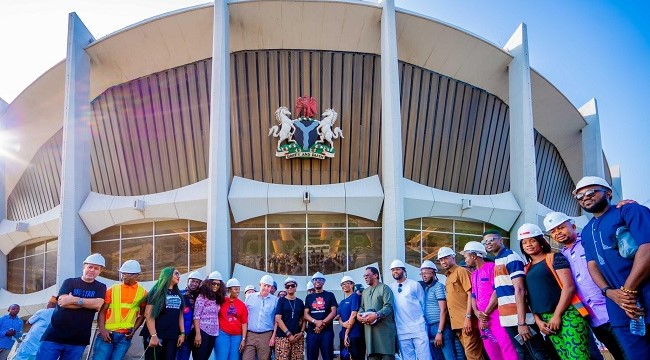

The Economic and Financial Crimes Commission (EFCC) has handed over the sum of ₦279 million recovered from a corruption case to the Wole Soyinka Centre for Culture and the Creative Arts in Lagos.
The handover ceremony took place on Friday at the EFCC Lagos Zonal Directorate 2 office located in Ikoyi, marking a significant step in the commission’s ongoing efforts to recover misappropriated public funds and return them to their rightful institutions.
According to a statement released by EFCC spokesperson Dele Oyewale, the recovery followed an investigation that began after a petition submitted in 2009 by Kabir Yusuf, the former General Manager and Chief Executive Officer of the National Theatre.
The petition alleged financial irregularities involving a contract valued at ₦299,707,828 awarded through the Federal Ministry of Tourism, Culture and National Orientation to Techno Exportstroy Nigeria Limited. The contract was intended for the construction of five gates, sand filling, and reclamation works at the National Theatre complex in Lagos.
Investigations conducted by the EFCC revealed that Yusuf Ahmed Atai, who served as Acting General Manager of the National Theatre at the time, approved the release of ₦334,229,794.24 to the contractor. This payment exceeded the original contract value by ₦34,521,966.
Further findings by investigators showed that the contractor only carried out work valued at ₦55,910,744. The large gap between the payment and the actual work executed resulted in an outstanding amount of ₦243,799,132.25 in uncompleted or unexecuted work.
In addition to the unexecuted portion of the project, the contractor also failed to refund the excess payment made beyond the original contract sum.
Following the completion of the investigation, the EFCC charged the suspect in court. During the course of the legal proceedings, a total sum of ₦279 million was eventually recovered from the defendant on behalf of the complainant.
Related News

EFCC Arraigns Investment Firm Boss Ufoma Joseph Immanuel Over Alleged $1.5 Million Fraud
Nigeria’s anti-graft agency, the Economic and Financial Crimes Commission (EFCC), has arraigned businessman Ufoma Joseph Immanuel, the chief executive of…
EFCC Files Terrorism Financing and Money Laundering Charges Against Bauchi State Officials
Court documents and official records reviewed by investigators reveal an extensive off-the-books cash disbursement system allegedly operated by Bauchi State…
ADC Accuses EFCC of Politically Targeting Malami Over Kebbi Governorship Ambition
The African Democratic Congress has alleged that the Economic and Financial Crimes Commission revoked the bail of former Attorney-General of…
Speaking during the handover ceremony, the EFCC Chairman Ola Olukoyede, represented by Assistant Commander of the EFCC and Acting Zonal Director of Lagos Zonal Directorate 2, Bawa Usman Kaltungo, reiterated the commission’s commitment to ensuring accountability in the management of public funds.
He emphasised that the recovered funds must be used strictly for their intended purpose and warned that the commission would closely monitor how the money is utilized.
“We cannot suffer to recover this money for you and then have it used for purposes other than what it is meant for after receiving it from us,” Kaltungo said during the ceremony.
He added that the EFCC had already requested details from the centre regarding how the recovered funds would be used and stressed that the agency would conduct periodic inspections to ensure transparency and proper implementation.
“Our eagle eyes will be watching the pace of work. Do not tamper with the recovered funds. Use them for the benefit of Nigeria and all of us,” he stated.
The funds were formally received by Jatto Kabiru, Head of Finance and Accounts at the Wole Soyinka Centre for Culture and Creative Arts. Kabiru expressed appreciation to the EFCC for successfully recovering the money and assured the commission that the funds would be used responsibly.
He described the EFCC as one of Nigeria’s most effective law enforcement agencies and praised the commission’s role in safeguarding public resources.
The facility receiving the funds was formerly known as the National Theatre Lagos. In July 2024, President Bola Ahmed Tinubu approved the renaming of the landmark cultural institution in honour of Nobel Laureate Wole Soyinka.
The transformation and renovation of the complex have been supported by the Central Bank of Nigeria in partnership with the Bankers’ Committee. The project aims to reposition the centre as a hub for Nigeria’s growing creative and cultural industries.
Officials say the facility is expected to serve as a major platform for artists, filmmakers, performers, and cultural entrepreneurs while also preserving Nigeria’s artistic heritage.
The Federal Ministry of Arts, Culture and Creative Economy continues to provide policy guidance and oversight for the redevelopment project, ensuring that the centre contributes to the broader goal of strengthening Nigeria’s creative economy.
The EFCC noted that returning recovered funds to the institutions affected by corruption is part of its broader strategy to ensure that stolen public resources are redirected toward national development.