Aerial Footage Shows Progress on Sokoto–Badagry Super Highway Construction
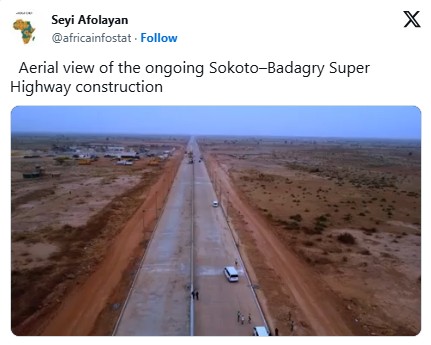

Recent aerial footage shared online has offered a glimpse into the ongoing construction of the Sokoto–Badagry Super Highway, a massive road project intended to link northern and southwestern Nigeria. The project, which aims to connect Sokoto in the northwest to Badagry in Lagos, is one of the largest proposed highway developments in the country.
The aerial visuals, shared across social media platforms, show ongoing earthworks and construction activities along sections of the planned corridor. The footage has drawn attention from Nigerians online, with many expressing curiosity about the scale of the project and the pace of construction.
The Sokoto–Badagry Super Highway is designed to serve as a major economic corridor connecting several states across Nigeria. When completed, the highway is expected to facilitate faster movement of goods and people between northern agricultural zones and major southern commercial centres.
Supporters of the project believe the highway could significantly reduce transportation costs, shorten travel time and improve inter-state trade. Improved road connectivity is also expected to benefit farmers, traders and logistics operators who rely heavily on road transport to move agricultural produce and other goods across the country.
Some commentators have noted that the concept of the Sokoto–Badagry corridor is not entirely new. The master plan for the highway reportedly dates back to the 1980s but was abandoned by successive administrations before construction activities began again in recent years.
Many supporters have therefore described the ongoing construction as the revival of a long-delayed national infrastructure plan.
Related News
Kaduna State Government Takes Over Ahmadu Bello Stadium, Begins Major Reconstruction
The Kaduna State Government has officially taken over ownership of the iconic Ahmadu Bello Stadium from the Federal Government, following…
Umahi Inspects Ongoing Rehabilitation of Lagos–Ota–Abeokuta Expressway
Minister of Works David Umahi has inspected the rehabilitation of the Lagos–Ota–Abeokuta Expressway, describing the project as a priority infrastructure…
Lagos Completes 9km Rehabilitation on Lekki–Ajah Corridor, Finishes Ahead of Schedule
The Lagos State Government has announced the completion of a 9-kilometre stretch of road rehabilitation from Chevron to Admiralty along…
However, the project has also generated significant debate among members of the public. While some Nigerians view the highway as a strategic investment in national infrastructure, others have questioned whether it should be prioritised at a time when the country faces multiple economic and security challenges.
One of the concerns frequently raised in public discussions is the issue of security. Critics argue that building long highway corridors across remote regions could present security risks if adequate protection measures are not implemented.
They warn that highways passing through sparsely populated areas could potentially become vulnerable to criminal activities such as banditry or kidnapping unless strong security infrastructure is developed alongside the road.
Another debate surrounding the project focuses on economic priorities. Some observers believe the government should prioritise improving electricity supply and rehabilitating existing road networks before embarking on new large-scale highway projects.
Nigeria’s power sector has struggled with persistent challenges for decades, and many citizens argue that stable electricity would have a more immediate impact on economic productivity than additional highways.
Others have suggested that maintaining and upgrading existing highways across the country could deliver faster economic benefits than constructing entirely new corridors.
Supporters of the highway, however, argue that the project could play an important role in strengthening national integration and supporting long-term economic growth. By connecting northern and southern markets more efficiently, the road could enhance supply chains and improve distribution networks for goods produced in different parts of the country.
Transportation experts have also noted that road infrastructure remains the backbone of Nigeria’s domestic logistics system, with the majority of goods transported by road rather than rail or waterways.
As construction progresses, Nigerians are likely to continue debating the project’s economic value, strategic importance and potential impact on national development.
For now, the aerial footage showing the early stages of construction has renewed public interest in one of the country’s most ambitious infrastructure plans.