Dangote Refinery Achieves 50 Million Litres Daily Fuel Offtake, Signals Shift Toward Domestic Energy Stability
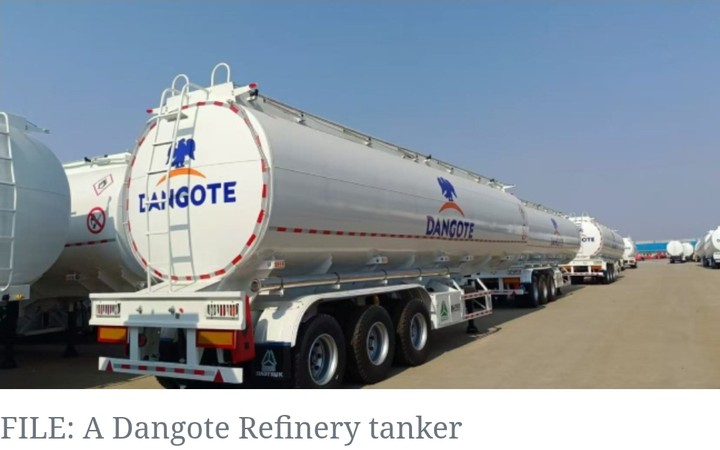

Dangote Petroleum Refinery Plc has disclosed that it has successfully achieved a daily fuel offtake of 50 million litres of Premium Motor Spirit (PMS), a development described as a significant milestone in Nigeria’s quest for energy security and reduced dependence on imported refined petroleum products.
The announcement was made by the newly appointed Managing Director of the refinery, David Bird, during a press briefing in Lagos on Wednesday. According to Bird, the refinery’s performance was evident during the recent Christmas and New Year period, when it supplied fuel seamlessly across the country without the shortages that have traditionally accompanied festive seasons.
Bird explained that the milestone reflects not only the refinery’s production capacity but also its ability to evacuate and distribute refined products efficiently. He noted that the facility has consistently handled over 1,000 trucks daily, allowing it to match production levels with market demand. While acknowledging that fuel offtake can fluctuate—particularly during weekends due to reduced demand—he expressed confidence that the refinery can sustain or even exceed the 50 million litres daily mark when required.
“If demand drops locally, we can export excess volumes,” Bird said, emphasizing the refinery’s flexibility in responding to both domestic and international markets.
Related News
IEA Announces Record Release of 400 Million Barrels of Oil to Stabilize Markets Amid Iran War
The International Energy Agency (IEA) has announced the largest emergency oil release in its history, unlocking 400 million barrels from…
Petrol Price Could Reach ₦2,000 Per Litre If Middle East Conflict Persists – PETROAN
The Petroleum Products Retail Outlets Owners Association of Nigeria (PETROAN) has warned that petrol prices in Nigeria could surge to…
IPMAN Urges Federal Government to Cut Crude Oil Price for Dangote Refinery
The Independent Petroleum Marketers Association of Nigeria (IPMAN) has called on the Federal Government to reduce the cost of crude…
He further highlighted that the refinery’s operations are contributing to broader economic stability, including support for the naira, partly through stable fuel supply and lower price volatility. According to him, Nigeria is now consuming world-class fuels produced to Euro 5 standards, with significantly lower sulphur content. The refinery currently exports gasoline to Europe and jet fuel to markets such as Dubai, underscoring the global competitiveness of its output.
Bird criticized the historical practice of dumping substandard fuel products in West Africa, describing Dangote Refinery’s output as a major public health and environmental improvement. He said the refinery’s impact goes beyond volume, as cleaner fuels reduce emissions and long-term health risks associated with poor fuel quality.
On expansion plans, Bird revealed that the company is investing further in refining capacity and petrochemical production, particularly polypropylene. The existing polypropylene plant has a capacity of 800,000 tonnes, which will increase to 1.2 million tonnes with the addition of a new Propane Dehydrogenation (PDH) unit. Long-term expansion plans aim to raise capacity to 2.4 million tonnes, supporting domestic manufacturing and reducing import dependence.
The Managing Director dismissed claims by some industry stakeholders that the refinery’s petrol price of ₦739 per litre is anti-competitive, stating that pricing remains market-driven and that consumers retain the freedom to choose suppliers. He also called for regulatory reforms to better reflect market realities.
Addressing fuel distribution, Bird disclosed that about 4,000 trucks are currently on-site and that the final step before full-scale rollout is the deployment of a computerized security system to ensure accurate volume delivery to customers.
He also commented on the crude-for-naira programme, noting that between 30 and 40 percent of the refinery’s crude supply currently comes through the initiative. According to him, the programme has played a role in stabilizing the naira and could be expanded further in Nigeria’s long-term economic interest.
Head of Communications for the Dangote Group, Anthony Chiejina, added that domestic refining is critical to shielding Nigeria from global oil price shocks, explaining that heavy reliance on imports exposes the country to external volatility.
As the refinery enters a stabilization phase, management says steel structures for further expansion are expected to begin rising before the end of 2026. While public reactions remain mixed—particularly regarding fuel pricing—the achievement of 50 million litres daily offtake marks a turning point in Nigeria’s downstream oil narrative, signaling progress toward fuel abundance, improved quality, and long-term energy resilience.