Jigawa LG Chairman Confirms Direct Federal Allocations, Signals Shift Toward Local Government Autonomy
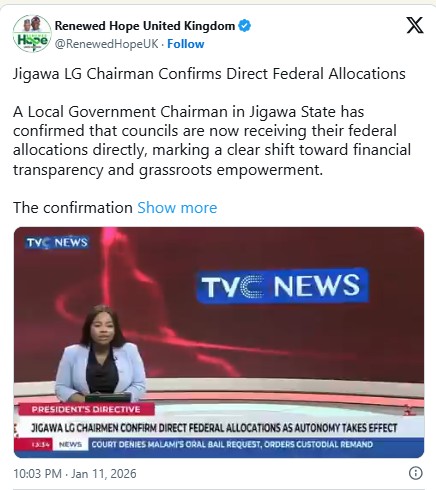

A major development in Nigeria’s long-standing debate over local government autonomy has emerged from Jigawa State, where a Local Government chairman has confirmed that councils are now receiving their federal allocations directly from the Federation Account Allocation Committee (FAAC). The confirmation has sparked nationwide attention, as it signals a potential shift away from decades of state government dominance over local government finances.
The confirmation was made by Shuaibu Hambali, Executive Chairman of Taura Local Government Area in Jigawa State, who disclosed that funds meant for local councils are now being paid directly into local government accounts without routing through state governments. This development aligns with recent policy directions and strong warnings issued by President Bola Ahmed Tinubu at meetings of the National Economic Council (NEC), where he insisted that allocations meant for local governments must reach them without diversion or political interference.
President Tinubu had previously cautioned state governors and other political actors against tampering with local government funds, stressing that grassroots development cannot be achieved if councils are financially strangled. According to the president, empowering local governments financially is central to his administration’s broader reform agenda, which prioritizes accountability, fiscal discipline, and inclusive development.
For many observers, the confirmation from Jigawa represents a practical demonstration of those directives taking effect. Historically, local government funds were often managed through joint state-local government accounts, a system that critics argue enabled widespread diversion, reduced transparency, and weakened service delivery at the grassroots level. Local councils frequently complained of receiving only a fraction of their statutory allocations, limiting their ability to execute projects or meet basic administrative obligations.
Related News

DSS Tells Court Kaduna Man’s Tweets Could Drag Nigeria into Israel–Iran Conflict
Nigeria’s domestic intelligence agency, the Department of State Services (DSS), has told a court that social media posts allegedly made…

Nigeria Begins Evacuation of Citizens from Iran Amid Escalating Middle East Conflict
The Nigerian government has started evacuating its citizens from Iran as tensions in the Middle East intensify.

Nigeria Surpasses India in Number of People Living in Poverty – Report
New data shared by Statisense suggests that Nigeria now has a higher number of people living below the poverty line…
With the reported direct disbursement of funds, expectations are rising that local governments will now play a more active and visible role in development. Proponents argue that councils, being closest to the people, are best positioned to address local needs such as primary healthcare, basic education, rural roads, sanitation, and community security initiatives. Direct access to funds, they say, could accelerate development in rural areas and reduce rural–urban migration.
Supporters of the reform have described the development as a practical step toward restructuring Nigeria’s governance system without the need for constitutional amendments. They view it as a reinforcement of federal principles, where each tier of government operates with a degree of independence while remaining accountable to the law.
However, the development has also generated cautious reactions. Some stakeholders have raised concerns about oversight and accountability at the local government level, noting that financial autonomy must be matched with strong monitoring mechanisms. Critics warn that without effective checks, local government chairmen could misuse the funds, replacing one layer of financial abuse with another.
There are also questions about the consistency of implementation across the country. While Jigawa’s confirmation is seen as encouraging, analysts note that Nigeria has 774 local government areas, and uniform compliance will be critical for the reform to have nationwide impact. Some have called for clearer federal guidelines and independent auditing systems to ensure transparency and prevent backdoor arrangements that could undermine the spirit of the reform.
Additionally, legal experts have pointed out that some states previously enacted laws requiring local governments to remit portions of their allocations to state governments. Whether such laws remain enforceable under the new federal stance remains a subject of debate and may ultimately require judicial clarification.
Despite these concerns, many see the Jigawa confirmation as a landmark moment in Nigeria’s governance evolution. If sustained, direct federal allocations could redefine the role of local governments, strengthen democracy at the grassroots, and improve service delivery to millions of Nigerians.
As implementation unfolds, attention will likely shift to how local government leaders utilize the funds, the transparency of their spending, and the federal government’s ability to enforce compliance nationwide. For now, the development marks a significant test case in the Tinubu administration’s push to reform governance structures and restore confidence in public finance management at the grassroots level.