Lagos Government Issues Fresh Update on Great Nigeria Insurance Building Fire, Confirms Demolition Plan
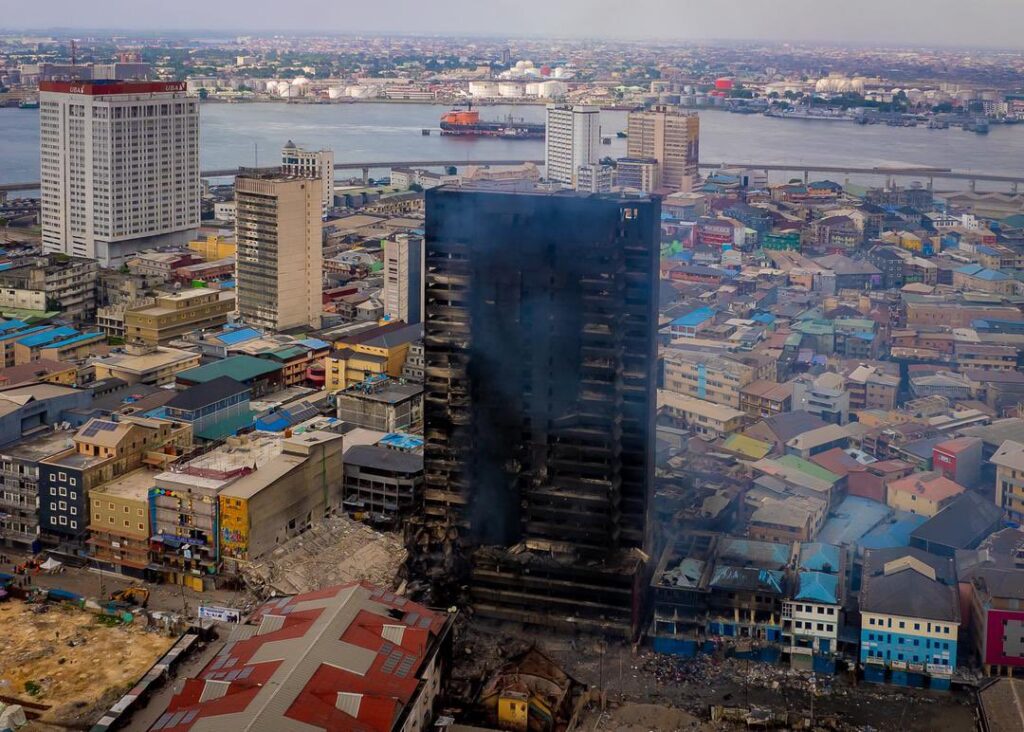

The Lagos State Government has released a comprehensive update on the devastating fire incident at the Great Nigeria Insurance (GNI) Building, as emergency operations and recovery efforts continue at the site. The update, issued by the Lagos State Fire and Rescue Service, follows a second on-site assessment conducted by Governor Babajide Sanwo-Olu on January 2, 2025.
According to the state government, the scale and complexity of the incident have necessitated a highly cautious and technical approach. In response, the government has constituted a Technical Recovery and Demolition Committee to oversee the next phase of operations. The committee, chaired by the Honourable Commissioner for Special Duties and Inter-Governmental Relations, has been mandated to design and execute a controlled demolition plan for the affected building and its immediate environment in the safest and fastest manner possible.
Officials confirmed that emergency responders remain fully deployed at the scene, with the Lagos State Fire and Rescue Service working alongside sister agencies. However, the situation on ground remains volatile. Large volumes of rubble are still in place, and intermittent pockets of fire continue to burn beneath the debris.
Emergency officials clarified that these flare-ups are not originating from the building’s structural components but from combustible materials—mainly textiles and clothing—stored inside the premises before the incident. These materials are buried deep within the collapsed sections of the building, making direct access extremely dangerous without specialised planning and equipment.
Authorities stressed that while the remaining pockets of fire do not pose an immediate external threat, any rushed or uncoordinated removal of debris could destabilise the already weakened structure. The fire has severely compromised the building’s foundation, rendering it unsafe and unfit for any form of use. In some areas, the rubble itself is inadvertently providing support to the damaged structure, and disturbing it without a sequenced demolition plan could trigger further collapse, putting rescue personnel at serious risk.
Related News
Lagos Government Asked Landlord to Pay ₦400,000 to Unseal Her House Despite Having Complete Documents
A Lagos landlord shared a shocking experience after returning home to find her newly built house sealed by officials despite…
Lagos Ready for State Police, Says LNSA Chief Ifalade
Lagos State has declared its readiness for the establishment of state police in Nigeria, with the leadership of the Lagos…
Lagos State Holds Nigeria’s Largest Subnational Domestic Debt at ₦1.05 Trillion, Data Shows
New data from Nigeria’s Debt Management Office indicates that Lagos State holds the largest domestic debt among all states, standing…
For this reason, officials said all operations are being carried out strictly in line with international disaster response standards, where the safety of rescuers takes precedence. The government emphasised that incidents of this magnitude often require extended timelines to resolve, sometimes lasting weeks or even months.
As part of its public safety measures, the Lagos State Government has reiterated that the entire area remains unsafe for commercial or public activities. Markets and surrounding facilities remain closed, and access to the cordoned zone is restricted strictly to authorised emergency personnel. Residents and business owners have been urged to remain calm and cooperative, noting that public safety is directly tied to the safety of first responders.
To improve communication and transparency, an information centre has been established at the site to respond to enquiries from families, stakeholders, and members of the public.
On casualties, the state confirmed that eight fatalities have been recorded so far, with five victims identified and three yet to be identified. Thirteen individuals were rescued alive during earlier emergency operations. Search and recovery efforts are still ongoing in safer sections of the debris to ensure that no persons remain trapped.
Preliminary assessments have revealed significant fire safety violations within the building. These include severe overstocking of combustible materials from floor to ceiling with little or no ventilation, absence of standard fire safety infrastructure, and unsafe market practices. Authorities also cited hazardous activities such as the use of generators within enclosed spaces and the construction of shops around electrical transformers.
Experts explained that such conditions can generate excessive heat buildup, potentially leading to spontaneous ignition even without an external spark.
To place the situation in global context, emergency officials referenced similar large-scale fire recovery operations worldwide. The World Trade Center recovery in New York, for instance, took over 100 days to fully extinguish underground fires, with total recovery lasting several months. The comparison, they said, underscores the complexity and patience required in managing major structural fire disasters.
In conclusion, the Lagos State Fire and Rescue Service reassured residents that all actions being taken are deliberate, professional, and driven by safety considerations. Authorities pledged to continue operations until the site is fully secured, all risks eliminated, and the incident conclusively resolved.
The government expressed appreciation for the patience and cooperation of Lagosians, reiterating that public safety remains its top priority.