Sierra Leone High Court Jails Nigerian National for 30 Years Over Cocaine Trafficking
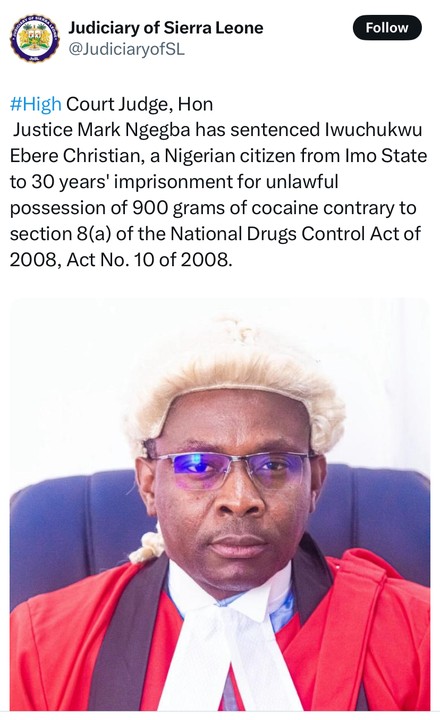

The High Court of Sierra Leone has handed down a 30-year prison sentence to a Nigerian national, Iwuchukwu Ebere Christian, after he was found guilty of unlawfully possessing 900 grams of cocaine. The verdict, delivered by Justice Mark Ngegba at the High Court in Freetown, marks one of the most severe penalties issued under the country’s National Drugs Control Act, 2008.
Christian, who initially pleaded not guilty, was arrested on 25 June 2025 at the Lungi International Airport in the North-West Region. Security personnel found him in possession of 46 pellets containing a white substance suspected to be cocaine. Investigators later confirmed that he had no legal authorization to possess or transport the drugs.
During trial, the prosecution presented evidence showing that the seized pellets were sent for laboratory analysis on 30 June 2025. ASP Joseph Stevens, a forensic specialist attached to the Transnational Organized Crime Unit (TOCU), testified that multiple tests confirmed the substance as pure cocaine weighing a total of 900 grams.
The court heard that Christian relied solely on a statement he had previously made to the police, offering no additional testimony or evidence in his defence. Justice Ngegba noted that the defendant had openly admitted to possessing the 46 pellets but failed to provide any lawful justification for handling the prohibited substance.
When allowed to speak before sentencing, Christian pleaded for mercy. He disclosed that he had transported the cocaine from Nigeria by road, planning to transit through Sierra Leone on his way to Ecuador. His motive, he said, was a promised payment of USD $5,000 upon successful delivery of the drugs. This admission, however, did little to sway the court.
Defence counsel C. I. Williams urged the judge to consider Christian’s personal circumstances, noting that he is a foreigner, a father, and the primary provider for his family. But State Prosecutor A. Jalloh argued that the seriousness of the crime, coupled with the international implications for Sierra Leone, required a stern response to deter future offenders.
In delivering the judgment, Justice Ngegba stated:
Related News

Supreme Court Affirms Seven-Year Jail Term for Former Senator Albert Bassey
The Supreme Court of Nigeria has affirmed the conviction and seven-year prison sentence of former senator Albert Bassey over a…

FIFA and UEFA Presidents Named in ICC Complaint Alleging Complicity in Settlement Activities
Presidents Gianni Infantino and Aleksander Ceferin have been accused of aiding war crimes in a complaint submitted to the International…

Court Sentences Cleric to Death Over Killing of University of Uyo Final-Year Student in Akwa Ibom
An Akwa Ibom State High Court has sentenced Prince Emmanuel Umoh, a cleric, to death by hanging for the 2020…
“The prosecution has provided sufficient evidence to warrant a guilty verdict. The defendant is hereby found guilty as charged and is accordingly sentenced to thirty (30) years’ imprisonment.”
The decision, he added, reflects Sierra Leone’s determination to clamp down on drug trafficking networks that exploit the country as a transit zone.
Online Reactions: Mixed Outrage, Sarcasm, and Debate
News of the sentencing triggered lively and often heated reactions across social media platforms. Some users expressed shock at the length of the sentence, describing 30 years as excessive for “ordinary cocaine.” Others argued that the punishment was justified, citing the need for African countries to protect themselves from drug cartels and maintain international credibility.
A number of commenters mocked the convicted man and used the case to criticize what they see as widespread criminality among some West African nationals involved in drug smuggling. Others shifted focus to broader conversations about online censorship, tribal sentiments, and the behaviour of internet communities.
Some users pointed out that several small African nations have grown stricter on drug trafficking—citing past cases in Singapore and elsewhere—arguing that harsh penalties reduce trafficking attempts over time.
However, a vocal group insisted that the Sierra Leonean judiciary lacks proportional sentencing standards, arguing that 30 years is equivalent to punishing violent crimes and far exceeds what many nations impose for similar drug offences.
Broader Implications
For Sierra Leone, the verdict sends a strong message: the country is tightening its borders and legal frameworks to prevent international traffickers from turning it into a drug corridor. Authorities say the ruling reinforces their commitment to combating transnational organized crime, protecting national security, and upholding the rule of law.
As Christian begins his three-decade sentence, the case stands as a cautionary tale for traffickers operating across West Africa—and a reminder that regional courts are increasingly unwilling to show leniency in drug-related cases.