Tinubu Meets Kwara Governor AbdulRazaq Over Deadly Terrorist Attack in Kaiama Communities
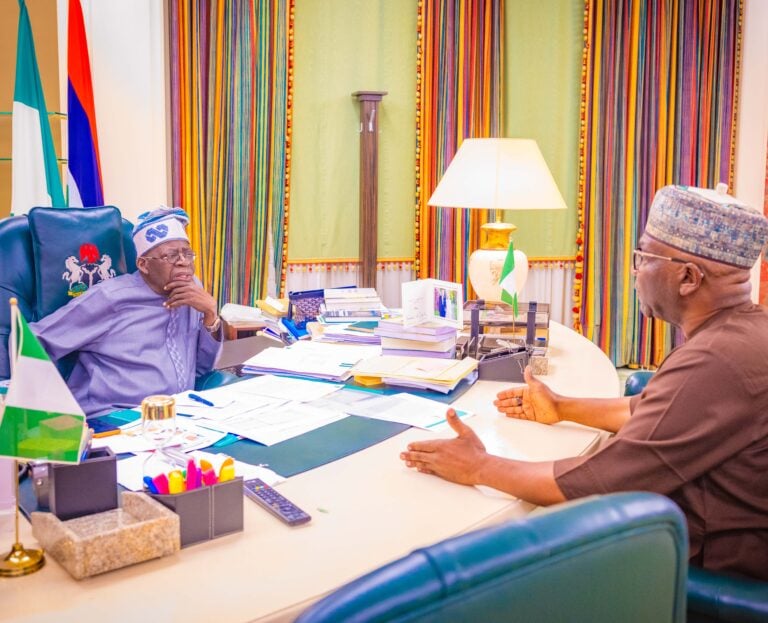

President Bola Ahmed Tinubu on Thursday met with Kwara State Governor AbdulRahman AbdulRazaq at the State House in Abuja following a deadly terrorist attack that reportedly claimed the lives of dozens of residents in the state.
The meeting came barely 24 hours after armed attackers stormed communities in Kaiama Local Government Area, leaving widespread destruction and significant loss of life. Reports indicate that at least 75 residents were killed during coordinated attacks on Nuku and Woro communities, while several houses were set ablaze, forcing survivors to flee their homes.
According to Rauf Ajakaye, Chief Press Secretary to the Kwara State Governor, the attackers targeted residents described as moderate Muslims who allegedly refused to conform to extremist ideologies being propagated by the assailants. He stated that the victims were attacked for refusing to surrender to extremist groups promoting what he described as a “strange doctrine.”
The scale of the violence has heightened concerns about the spread of insecurity into areas previously considered relatively stable. Eyewitness accounts and local sources suggest that the attackers moved across communities, carrying out arson and killings that left many residents displaced and traumatised.
Related News

Edo State Raises Alarm Over Growing Number of Widows and Orphans Linked to Cult Violence
The Edo State Government has expressed concern over the rising number of widows and fatherless children resulting from cult-related killings…

Controversy Trails Shettima’s Kwara Visit as Reports Claim Devastated Woro Community Was Not Reached
A fresh controversy has emerged following Vice President Kashim Shettima’s condolence visit to Kwara State after a deadly terrorist attack…

ADC Blames Tinubu Over Kwara Killings as Political Tensions Rise Nationwide
The African Democratic Congress (ADC) has blamed President Bola Tinubu’s administration for the recent mass killings in Kwara State, describing…
In response to the attack, President Tinubu ordered the immediate deployment of an army battalion to Kaiama Local Government Area to reinforce security operations and prevent further violence. The presidency also announced the creation of a new military command structure for the region under an operation named “Operation Savannah Shield.”
According to official statements, the operation is expected to coordinate military and security responses aimed at dismantling terrorist networks operating in the region and protecting vulnerable communities. Authorities say the initiative will involve enhanced surveillance, rapid-response patrols, and intelligence-driven operations to track down perpetrators and prevent future attacks.
The meeting between the president and the Kwara governor focused on assessing the security situation, reviewing intelligence reports, and discussing measures to stabilise affected communities. Sources familiar with the discussions indicated that both leaders expressed concern over the rising threat of terrorism and banditry spreading into parts of the north-central region.
Security analysts have warned that the attack highlights the evolving nature of extremist violence in Nigeria, with previously less-affected states increasingly experiencing incursions by armed groups. They note that the porous borders and rural terrain of some communities make them vulnerable to such attacks, especially where security presence is limited.
The latest incident has sparked renewed calls for stronger coordination among federal and state security agencies, as well as improved intelligence gathering at the community level. Residents in affected areas are reportedly calling for sustained military presence and humanitarian assistance for those displaced by the violence.
While the deployment of additional troops has been welcomed by some observers, others have emphasised the need for long-term strategies addressing the root causes of insecurity, including local collaboration, economic challenges, and the proliferation of arms.
As security forces move into the affected areas, authorities say efforts are ongoing to restore calm, provide relief to victims, and track down those responsible for the attack. The federal government has pledged to ensure that communities in Kwara and surrounding regions receive adequate protection against further terrorist incursions.