US Defense Secretary Praises Nigerian Government for Cooperation in Anti-Terror Airstrikes
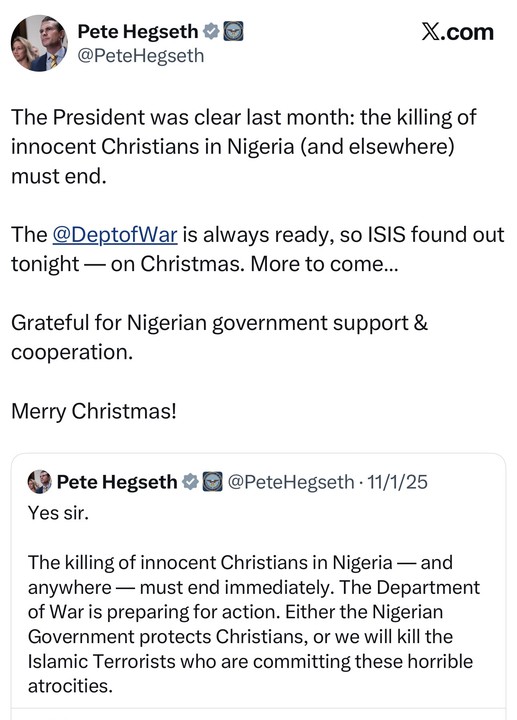

The United States Secretary of Defense has publicly acknowledged and commended the Nigerian government for its cooperation following a reported airstrike carried out against terrorist targets in Nigeria, an operation that took place on Christmas Day and was aimed at extremist elements linked to the Islamic State (ISIS).
In a statement released via official US government communication channels, the US Defense Secretary said the action was consistent with Washington’s commitment to combating terrorism and protecting innocent civilians, particularly Christian communities that have faced repeated attacks in parts of Nigeria and other regions. He noted that the operation demonstrated the readiness of the United States Department of Defense to respond decisively to terrorist threats, adding that extremist groups “found out” the consequences of continued violence during the Christmas period.
The US official further expressed gratitude to the Nigerian government for its support and cooperation, describing the collaboration as essential to the success of counterterrorism efforts. He concluded the message with Christmas greetings, framing the strike as both a security operation and a symbolic response to violence carried out during a major religious holiday.
The development has generated widespread reactions across Nigeria, especially on social media and online forums, where citizens expressed a mixture of approval, concern, and skepticism. Some commentators welcomed the reported airstrike, viewing it as a decisive blow against terrorist groups that have plagued communities for years. They argued that international cooperation, particularly with a country possessing advanced intelligence and military capabilities, could help weaken insurgent networks and disrupt their operations.
Related News

DSS Tells Court Kaduna Man’s Tweets Could Drag Nigeria into Israel–Iran Conflict
Nigeria’s domestic intelligence agency, the Department of State Services (DSS), has told a court that social media posts allegedly made…
Nigeria Begins Evacuation of Citizens from Iran Amid Escalating Middle East Conflict
The Nigerian government has started evacuating its citizens from Iran as tensions in the Middle East intensify.

Nigeria Surpasses India in Number of People Living in Poverty – Report
New data shared by Statisense suggests that Nigeria now has a higher number of people living below the poverty line…
Others, however, raised serious questions about Nigeria’s sovereignty and the extent of the government’s involvement in the operation. Several commentators demanded an official address from President Bola Ahmed Tinubu, stressing that Nigerians deserved a clear explanation of how and why a foreign military conducted strikes on Nigerian soil. Questions were also raised about whether the operation received legislative approval, including the involvement of the National Assembly, and whether due process was followed in granting consent.
Concerns were also expressed about transparency, with some critics suggesting that the Nigerian government was either slow to respond publicly or was informed only shortly before the strike occurred. This, they argued, raised doubts about the depth of cooperation being claimed by US officials. Comparisons were drawn with similar international military operations elsewhere, where host governments were reportedly informed shortly before strikes to prevent intelligence leaks.
Another strand of public reaction focused on Nigeria’s own military capacity. Some citizens questioned why the Nigerian Armed Forces have struggled for years to decisively neutralize terrorist strongholds, while a foreign power was reportedly able to carry out a successful strike within a short period. These comments reignited debates over intelligence gathering, equipment, internal sabotage, and the broader effectiveness of Nigeria’s security architecture.
There were also cautionary voices urging restraint. Analysts warned that while airstrikes may deliver short-term tactical gains, they do not address the deeper drivers of insecurity in Nigeria, including poor governance, economic hardship, unemployment, local conflicts, and weak institutions. They emphasized that sustainable peace would require a comprehensive strategy combining military action with political reforms, community engagement, economic development, and justice for victims of violence.
In addition, some Nigerians expressed concern about the potential consequences of foreign military involvement, including the risk of civilian casualties, displacement, and possible retaliatory attacks by terrorist groups. Others stressed the importance of ensuring that intelligence sharing and military cooperation do not undermine Nigeria’s long-term sovereignty or expose internal divisions within the country.
As of the time of reporting, official details from the Nigerian government regarding the scope, authorization, and outcome of the reported airstrike remained limited, further fueling public speculation and debate. Many observers have called on the federal authorities to provide a comprehensive briefing to clarify the nature of Nigeria’s cooperation with the United States and outline how such actions fit into the country’s broader counterterrorism strategy.
The incident has once again highlighted the complexity of Nigeria’s security challenges and the difficult balance between international cooperation and national control in addressing terrorism.