US Senators Criticise Iran War After Classified Briefing

Several members of the United States Senate have voiced strong criticism of the ongoing war between the United States and Iran after receiving a classified briefing from senior military and intelligence officials.
The closed-door meeting was held for the Senate Armed Services Committee, where lawmakers were given sensitive updates about the war and the administration’s strategic objectives. However, many senators who attended the briefing emerged frustrated, saying the government still has not provided clear answers about the purpose or long-term goals of the military campaign.
One of the most outspoken critics following the briefing was Chris Murphy, a Democratic senator representing Connecticut. In public comments after the meeting, Murphy said the briefing left him deeply concerned about the lack of a coherent strategy behind the war effort.
Murphy explained that while he could not reveal classified information discussed during the meeting, he could still share general concerns about the planning and objectives of the conflict.
According to him, one surprising revelation was that destroying Iran’s nuclear programme does not appear to be a central objective of the war. This contrasts with repeated public statements from Donald Trump, who has often cited Iran’s nuclear ambitions as a key reason for military action.
Murphy also noted that “regime change” in Iran was not listed as an official goal of the conflict either. This raised further questions among lawmakers about what exactly the war is meant to achieve if it is not intended to dismantle Iran’s nuclear capabilities or remove the current government from power.
The senator suggested that the primary military focus appears to be targeting Iranian missile systems, naval assets, and drone production facilities. However, he questioned the long-term effectiveness of such operations.
According to Murphy, officials struggled to answer what would happen once airstrikes stop and Iran resumes manufacturing weapons or military equipment.
“They hinted at more bombing,” Murphy said, warning that such a strategy could lead to an open-ended conflict without a clear endpoint.
Another major concern raised during the briefing involved the strategic importance of the Strait of Hormuz, one of the world’s most critical oil shipping routes. Murphy said officials were unable to clearly explain how the United States would respond if Iran successfully disrupted the passage of oil tankers through the strait.
Such a disruption could have severe consequences for global energy markets, as a large portion of the world’s oil supply passes through the narrow waterway each day.
Related News

Iran Warns US Tech Giants Like Google, Amazon Could Become “Legitimate Targets” in Expanding Regional War
Authorities in Iran have warned that infrastructure linked to major American technology companies may become “legitimate targets” as the regional…

DSS Tells Court Kaduna Man’s Tweets Could Drag Nigeria into Israel–Iran Conflict
Nigeria’s domestic intelligence agency, the Department of State Services (DSS), has told a court that social media posts allegedly made…

Nigeria Begins Evacuation of Citizens from Iran Amid Escalating Middle East Conflict
The Nigerian government has started evacuating its citizens from Iran as tensions in the Middle East intensify.
Other lawmakers echoed Murphy’s concerns after the briefing.
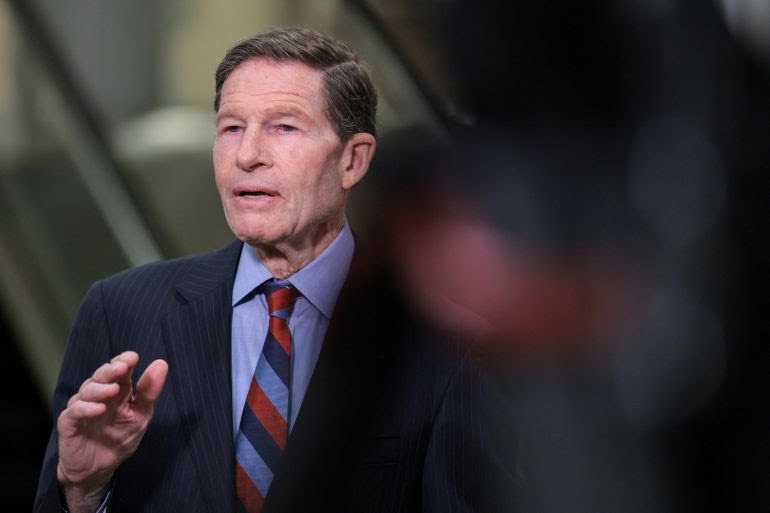
Richard Blumenthal, a Democratic senator from Connecticut, said he left the meeting feeling “dissatisfied and angry,” describing it as one of the most troubling briefings he has received in his 15 years in the Senate.
Blumenthal also raised concerns about the possibility that American troops could eventually be deployed on the ground in the Middle East, potentially in either Iran or neighbouring Iraq.
“I am left with more questions than answers, especially about the cost of the war,” he said.
Another prominent critic was Elizabeth Warren, the Democratic senator from Massachusetts. She argued that the administration has not clearly explained why the war began, what it hopes to accomplish, or how it plans to achieve those goals.
Warren also highlighted the enormous financial cost of the military campaign. Early estimates suggest that the first two days of the conflict alone may have cost more than $5.6 billion.
She contrasted those expenditures with recent cuts to domestic social programs, including healthcare subsidies that affected millions of Americans.
“While there is no money for 15 million Americans who lost their healthcare, there’s a billion dollars a day to spend on bombing Iran,” Warren said.
Bernie Sanders, an independent senator from Vermont, also criticised the conflict, saying US foreign policy should prioritise American interests rather than those of foreign allies.
“The US government must represent our interests, not Netanyahu’s,” Sanders wrote, referring to Benjamin Netanyahu, the prime minister of Israel.
Despite the criticism, efforts by Democratic lawmakers to halt the war have so far failed. Members of the Democratic Party recently attempted to pass a war powers resolution that would limit the president’s authority to continue the military campaign without congressional approval.
However, the measure was blocked after strong opposition from Republican lawmakers.
Under the War Powers Resolution of 1973, US presidents are required to obtain congressional authorisation for extended military operations. Without approval, military deployments must generally end within 60 to 90 days.
President Trump has argued that the current military actions fall within his constitutional authority as commander-in-chief.
As the conflict continues, pressure from lawmakers and the public is likely to intensify, particularly if the war expands or requires the deployment of US ground forces.