Venezuela Pushes Back Against U.S. Pressure as Vice President Warns Against ‘New Colonialism’
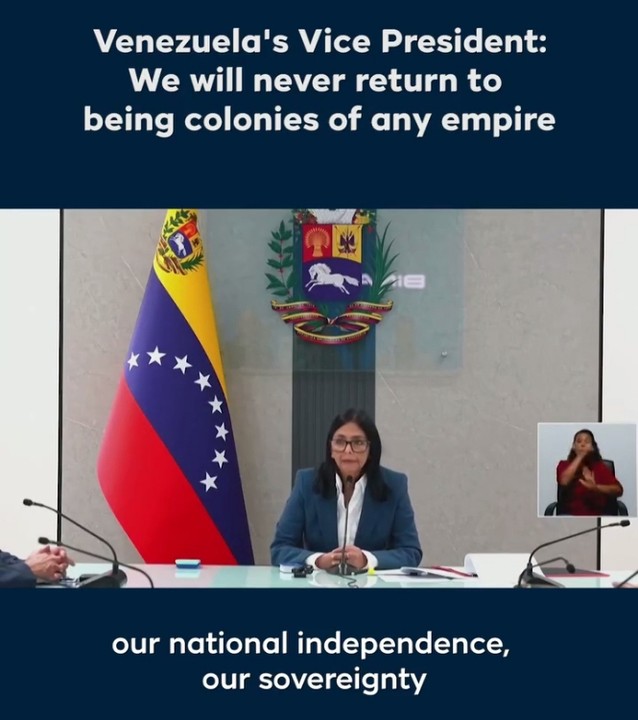

Venezuela’s Vice President, Delcy Rodríguez, has strongly rejected any form of foreign intervention in her country, declaring that Venezuela would “never again be a colony of any empire.” The statement, delivered amid heightened international tension and online speculation about U.S. actions against the Venezuelan government, underscores the Maduro administration’s long-standing position against American involvement in the nation’s political affairs.
Rodríguez’s remarks come at a time when Venezuela remains deeply polarized, both domestically and internationally. The United States and several of its allies have continued to question the legitimacy of President Nicolás Maduro’s government, citing concerns over electoral integrity, democratic backsliding, and human rights abuses. Washington has also maintained economic sanctions on Venezuela, targeting key sectors such as oil, finance, and government institutions.
In her statement, the vice president framed U.S. pressure as part of a broader historical pattern of imperial control in Latin America. She accused Washington of attempting to impose its will on sovereign nations under the guise of promoting democracy, arguing that Venezuela’s political future must be decided solely by its people. According to Rodríguez, any attempt to remove or undermine the current government through external force would amount to modern-day colonialism.
Related News
Rights Group Accuses Police of Judicial Persecution Over Remand of Blogger Maureen Badejo
The Committee for the Defence of Human Rights (CDHR) has accused the Nigeria Police Force of engaging in judicial persecution…
Six US Troops Killed in Iranian Strike on Kuwait Port, Says CENTCOM
The United States Central Command has confirmed that six American service members were killed following an Iranian strike on a…

Enugu Government Declares 90-Day Amnesty for Buildings Without Approved Plans
The Enugu State Government has introduced a 90-day amnesty period for property owners whose buildings lack approved plans, offering them…
These comments have sparked intense reactions across social media and public forums, including in Nigeria and other parts of Africa, where users have sharply divided opinions on the issue. Some commentators have praised Rodríguez’s stance as a bold defense of national sovereignty, while others have dismissed it as political rhetoric aimed at deflecting attention from internal governance failures.
Critics of the Maduro administration argue that the government has lost its moral authority by allegedly manipulating elections, suppressing opposition voices, and presiding over economic collapse. They point to claims that opposition candidates won the most recent presidential election, supported by independently collected polling station data, and accuse electoral authorities of altering official results in favor of the incumbent government. The administration has repeatedly denied these allegations.
Other critics go further, accusing senior figures within the Venezuelan government of involvement in drug trafficking and organized crime. While such claims have circulated for years and have been cited by U.S. officials in justifying sanctions and indictments, the Venezuelan government has consistently rejected them as politically motivated fabrications designed to justify regime change.
Supporters of the government, however, argue that U.S. actions toward Venezuela are driven less by concerns over democracy and more by strategic economic interests, particularly energy and currency dominance. They contend that Venezuela’s vast oil reserves and its engagement with non-Western powers threaten long-standing U.S. influence in global energy markets. Within this view, Washington’s actions are interpreted as efforts to maintain the dominance of the U.S. dollar in global oil trade and to prevent alternative economic alliances from gaining ground.
The debate also reflects broader global tensions, as countries such as Russia, China, and members of the BRICS bloc push for reduced reliance on the U.S. dollar in international trade. Venezuela’s alignment with these powers has further strained its relationship with Washington and reinforced U.S. skepticism about the Maduro government’s intentions.
Despite the heated rhetoric, the situation on the ground in Venezuela remains complex. The country continues to grapple with inflation, emigration, and infrastructure challenges, even as recent economic adjustments and limited sanctions relief have shown modest signs of recovery. Whether political dialogue, external pressure, or internal reform will shape Venezuela’s next chapter remains uncertain.
What is clear is that Rodríguez’s statement has once again placed Venezuela at the center of a global conversation about sovereignty, intervention, and the balance of power in a changing world. As international scrutiny continues, the clash between competing narratives—imperialism versus democracy, sovereignty versus accountability—shows no sign of easing.