Petrol Truck Diverted From Borno Intercepted in Kebbi: Customs Foil Attempt to Smuggle N60 Million Worth of Fuel
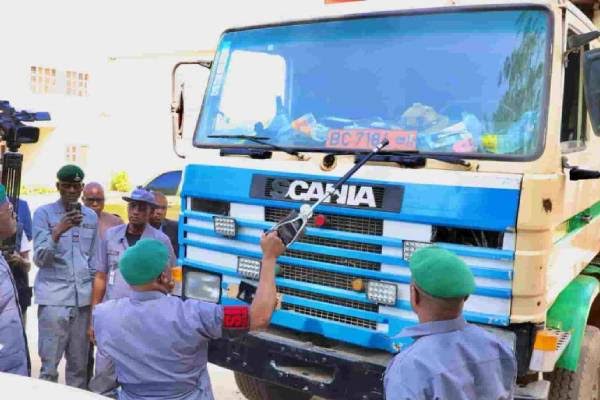

Authorities of the Nigeria Customs Service (NCS), under the special task force Operation Whirlwind, have intercepted a petroleum tanker allegedly diverted from its original destination in Borno State to the Kebbi border, where it was reportedly being prepared for illegal export.
The interception, which took place along the Kebbi border route, involved a 60,000-litre tanker of Premium Motor Spirit (PMS) valued at over ₦60 million. According to the Customs, the fuel was meant for legitimate discharge in Borno State but was diverted in a calculated attempt to smuggle it out of Nigeria, thereby sabotaging national economic interests.
The truck, registered as NSR26ZL, was seized following intelligence reports and surveillance operations by the Customs’ anti-smuggling unit. Speaking to journalists at the Customs Area Command headquarters in Birnin Kebbi, Comptroller Mahmoud Matawalle Ibrahim, who represented the National Coordinator of Operation Whirlwind, Assistant Comptroller General (ACG) Dr. Kola Oladeji, explained that the seizure was part of the Service’s ongoing crackdown on petroleum diversion and cross-border smuggling.
“Upon investigation, it was discovered that the product was originally scheduled for discharge in Borno State but was instead diverted toward Kebbi with the intent to smuggle it out of the country,” Ibrahim said. “The truck was detained at the Customs Area Command, and we are formally handing it over to the Nigeria Midstream and Downstream Petroleum Regulatory Authority (NMDPRA) for further investigation.”
Related News
Gunmen Attack ADC Leaders in Benin as Obi, Oyegun Allege Assassination Attempt
Tension rose in Benin City after gunmen attacked the African Democratic Congress (ADC) secretariat and the residence of former Edo…

NDLEA Arrests Lekki Real Estate Executive Kolapo Oladapo Over Alleged Drug Distribution Network
The National Drug Law Enforcement Agency has arrested Lekki-based real estate executive Kolapo Oladapo following the recovery of 89.2 kilograms…

Rising Phone Thefts and Scams Spark Fear at Lagos’ Ikeja Computer Village
Nigeria’s largest technology market, Ikeja Computer Village, is facing growing concerns over rising phone theft and scam activities.
During the official handover ceremony, the seized tanker was presented to Mr. Ali Ajimi, the Deputy Manager of the NMDPRA representing the State Coordinator for Kebbi and Sokoto. Comptroller Ibrahim reaffirmed that the operation reflects the Customs Service’s commitment to enforcing national policies on petroleum distribution and curbing economic sabotage.
He further emphasized that Operation Whirlwind was launched in response to the increasing cases of fuel smuggling and diversion across Nigeria’s borders — particularly in states like Kebbi, Sokoto, Katsina, and Borno, where proximity to neighboring countries has made illegal fuel trade a persistent challenge.
“The diversion of petroleum products poses a significant threat to our economy,” Ibrahim stated. “While Nigerians continue to grapple with rising fuel prices and supply challenges, smugglers and their collaborators exploit price disparities between Nigeria and neighboring nations to profit illegally. This will not be tolerated.”
The incident has reignited public discourse around the persistent issue of fuel smuggling in Nigeria. Despite the federal government’s removal of fuel subsidies, experts argue that the country’s fuel remains comparatively cheaper than in neighboring West African nations, creating a continuous incentive for smuggling activities.
Public reactions to the arrest have been mixed. Some Nigerians commended the Customs for their vigilance, describing the interception as a “good shot” in the fight against economic crimes. Others, however, expressed skepticism, suggesting that such arrests only scratch the surface of a deeply rooted problem that involves larger networks and official complicity.
One commentator on social media remarked, “The ones who settle go free; only those who fail to settle get caught.” Another criticized the recurring pattern of fuel diversion despite higher pump prices, arguing that it exposes loopholes in regulatory oversight and enforcement.
Analysts have called for greater coordination between the Customs Service, NMDPRA, and the Nigerian National Petroleum Company Limited (NNPCL) to track the movement of petroleum products from depots to their designated locations. They argue that digital tracking systems, fuel marking technology, and stricter penalties for diversion could help deter future occurrences.
As investigations continue, the intercepted truck remains in the custody of the NMDPRA pending a full audit of its loading documentation, ownership records, and intended discharge point. The Nigeria Customs Service reiterated its resolve to intensify border surveillance and ensure that every litre of fuel intended for domestic consumption reaches its rightful destination.