Gunmen Attack ADC Leaders in Benin as Obi, Oyegun Allege Assassination Attempt


Political tension escalated in Benin City, Edo State, following attacks by armed men on facilities linked to the African Democratic Congress (ADC), shortly after a high-profile political gathering attended by key opposition figures.
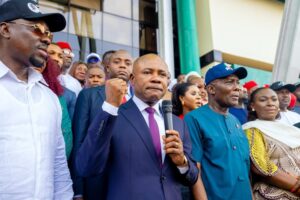
Among those present at the event were the 2023 Labour Party presidential candidate, Peter Obi, and former Edo State Governor John Odigie-Oyegun. The meeting reportedly involved the formal reception of former Nigerian Bar Association President and 2024 Labour Party governorship candidate, Olumide Akpata, into the ADC.
According to accounts from party officials, gunmen stormed the ADC secretariat on Ogbelaka Street, off Sokponba Road, shortly after the event concluded. Eyewitnesses reported that the attackers arrived in an unmarked Sienna bus and on a motorcycle, firing gunshots and vandalising property including chairs, canopies and banners. Some party members were said to have sustained injuries.
The attackers subsequently moved to Odigie-Oyegun’s residence on Reservation Road, where additional gunshots were reported. Video footage circulated online showed vehicles damaged and visible bullet holes in the gate of the property.
Obi described the incident as deeply troubling for Nigeria’s democracy. “It is time to speak up. It is time those in government act. They are not going to be there forever. What they allowed to happen in the country today will take its revenge on all of us and the country,” he said in a video recorded at the scene.
Odigie-Oyegun stated that the meeting at the secretariat had been cut short following an intelligence alert from a security agency warning of a possible attack. “Halfway through the proceedings, we got intelligence that the place was going to be attacked, so we should try to wind up,” he explained. He added that shortly after they departed, armed individuals allegedly arrived in multiple vehicles and opened fire.
Related News

Henry Seriake Dickson Defects from PDP to Newly Formed Nigeria Democratic Congress
Senator Henry Seriake Dickson has formally defected from the Peoples Democratic Party (PDP) to the newly registered Nigeria Democratic Congress…

Hon. Sarah Ivie Adidi Receives “Her Excellence Award” During International Women’s Day Event in Abuja
Reps aspirant Sarah Ivie Adidi has been honoured with the 2026 “Her Excellence Award” during an event marking International Women’s…
Governor Peter Mbah Urges Ndigbo to Return to Strategic Politics
Peter Mbah, Governor of Enugu State, has urged the Igbo political class to return to what he described as “strategic…
The former governor expressed concern over what he described as a lack of coordinated security response, questioning how attackers could allegedly operate without immediate intervention. He also referenced previous remarks attributed to state authorities suggesting that Obi’s security in Edo State could not be guaranteed without prior notification to the governor.
The Edo State Chairman of the ADC, Kennedy Odion, accused the ruling All Progressives Congress (APC) of masterminding the attack. He said the party had received prior information about a possible disruption and had reported the matter to the police. According to him, the Commissioner of Police visited the scene and promised a full investigation.
However, the Edo State Government and the APC rejected allegations of complicity. The State Commissioner for Information, Kassim Afegbua, attributed the incident to an ongoing internal crisis within the ADC, describing the violence as the “height” of factional disagreements.
Similarly, the Edo APC Chairman, Emperor Jarret Tenebe, denied any involvement, arguing that the conflict stemmed from internal disputes among ADC members. He questioned why the ruling party would be linked to what he described as a factional struggle.
Senator Rowland Owie dismissed claims of internal rivalry between himself and Odigie-Oyegun, stating that there was no rift within the party leadership. He criticized what he described as deteriorating security conditions in the state.
Olumide Akpata characterized the attack as a concerning development for democratic practice, stating that opposition parties must be allowed to operate without intimidation.
The Edo State Police Command confirmed that a political gathering was disrupted by suspected hoodlums. The Police Public Relations Officer stated that officers responded to the incident, noting that plastic chairs and canopies were damaged and that no casualties were officially reported. Security presence has since been reinforced at both the ADC secretariat and Odigie-Oyegun’s residence, with investigations ongoing.
Former Vice President Atiku Abubakar condemned the attack, describing it as unacceptable in a democratic society. He warned against inflammatory rhetoric and emphasized that political competition must not degenerate into violence.
The incident has intensified political debate in Edo State, with opposition figures warning of increasing intolerance, while the state government maintains that the disturbance arose from internal party tensions.
As investigations continue, the episode has raised broader questions about political security, opposition rights, and the health of democratic engagement in the state.