Coleman Wires Unveils Africa’s Largest Fibre Optic Cable Factory in Ogun State
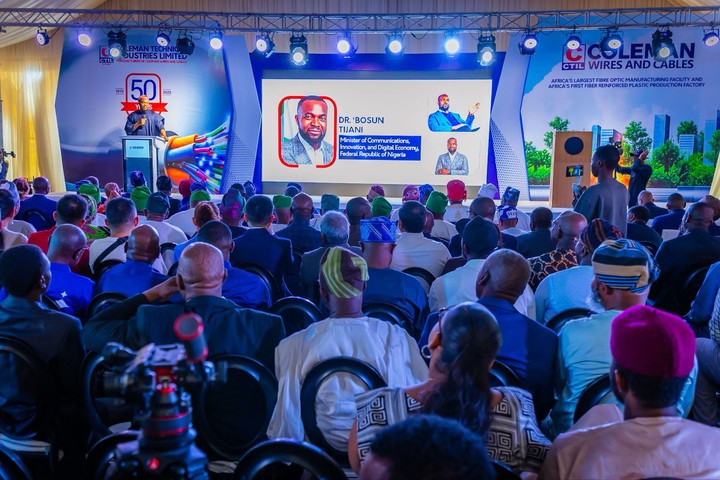

Nigeria has marked another major industrial milestone as Coleman Wires and Cables, a leading indigenous manufacturer, officially launched Africa’s largest fibre optic cable factory in Sagamu, Ogun State. The inauguration, which coincided with the company’s 50th anniversary, was attended by top government officials, business leaders, and key players in the nation’s technology and manufacturing sectors.
The new facility represents a major leap in Nigeria’s push toward digital transformation and industrial self-reliance. According to the Minister of Communications, Innovation, and Digital Economy, Dr. Bosun Tijani, who was present at the launch, the factory’s establishment marks a defining moment in Nigeria’s journey to becoming a continental hub for fibre optic production.
“This milestone could not have come at a better time,” Tijani said. “With our ongoing Project BRIDGE, which aims to deploy 90,000 kilometres of fibre optic network nationwide, having this component manufactured locally by a Nigerian company is a breakthrough in cost efficiency, job creation, and technological independence.”
The Minister described the facility as not only essential for Nigeria’s broadband expansion but also strategically important for the rest of Africa, adding that it positions the country to supply other nations engaged in similar digital infrastructure projects.
A Vision Realized After Five Decades
Founded in the 1970s by the Onafowokan family, Coleman Wires and Cables has grown from a modest operation into West Africa’s largest cable manufacturer. Over the years, the company has expanded its product lines from electrical cables to advanced fibre optic systems, serving both industrial and telecommunication markets.
The launch of the new fibre optic plant, capable of producing cables for high-speed internet connectivity, is a result of years of investment in research, innovation, and capacity development. Company executives stated that the factory has the capacity to meet local demand and export to multiple African countries, reducing reliance on imported fibre materials and strengthening regional supply chains.
“This is more than just a business expansion,” said George Onafowokan, Managing Director of Coleman Wires and Cables. “It’s a statement of what’s possible when local expertise meets long-term vision. We are building not just cables—but the infrastructure for Africa’s digital future.”
Related News

Senegal Government Acquires 10% Stake in Dangote Cement Senegal
The government of Senegal has acquired a 10 percent equity stake in Dangote Cement Senegal, becoming a minority shareholder in…

Apple Unveils MacBook Air M5 Using Fela Anikulapo Kuti’s “Let’s Start”
Tech giant Apple has unveiled its next-generation MacBook Air powered by the new M5 chip, with a campaign featuring Fela…

Dangote Elevates Daughters to Executive Leadership as Conglomerate Targets $100bn Valuation by 2030
African industrialist Aliko Dangote has appointed his three daughters to top executive roles across the Dangote Group, marking a major…
Support from Government and Private Sector
The Governor of Ogun State, Prince Dapo Abiodun (CON), commended Coleman for choosing Ogun as its base of operations, highlighting the state’s growing reputation as Nigeria’s preferred industrial destination. He assured continued government support in improving infrastructure, power, and road access to enhance the ease of doing business.
Abiodun also noted that the company’s success reflects the benefits of Ogun State’s proximity to Lagos—the country’s commercial capital—making it an attractive location for manufacturers and logistics hubs.
In recognition of the company’s milestone, the Minister, Dr. Tijani, praised the Onafowokan family and the Coleman management team for their resilience and contribution to national development. He also lauded President Bola Ahmed Tinubu (GCFR) for setting a bold target of transforming Nigeria into a $1 trillion economy, saying that ventures like Coleman’s fibre optic factory are essential to achieving that vision.
“A new Nigeria is emerging—one driven by innovation, production, and confidence in local capacity,” Tijani said. “Coleman’s achievement is proof that our nation can produce at a world-class standard.”
Reactions and Outlook
The launch has generated widespread public excitement and discussion online. Many Nigerians celebrated the development as a sign of progress and industrial confidence, while others urged continued support for indigenous firms to prevent the challenges that have crippled similar ventures in the past.
Industry experts have also emphasized that the availability of locally produced fibre optic cables could accelerate the rollout of high-speed internet across the country, reduce project costs, and attract more investors to Nigeria’s digital economy.
Coleman’s new factory is expected to create hundreds of jobs directly and thousands indirectly, from logistics and installation to maintenance and export operations. With the company’s expansion, Nigeria strengthens its claim as a key player in Africa’s industrial and technological advancement.
A Step Toward Technological Sovereignty
The inauguration of Coleman’s fibre optic plant represents more than an industrial success—it signals a step toward technological sovereignty for Nigeria. By manufacturing essential digital infrastructure locally, the nation moves closer to achieving both economic independence and sustainable growth.
As Dr. Tijani concluded during the ceremony:
“We must protect and promote the Nigeria that builds, innovates, and believes in itself. This is the foundation of the new Nigeria we are witnessing today.”