Barau Challenges Akpabio Over Trump Remarks in Fiery Senate Exchange
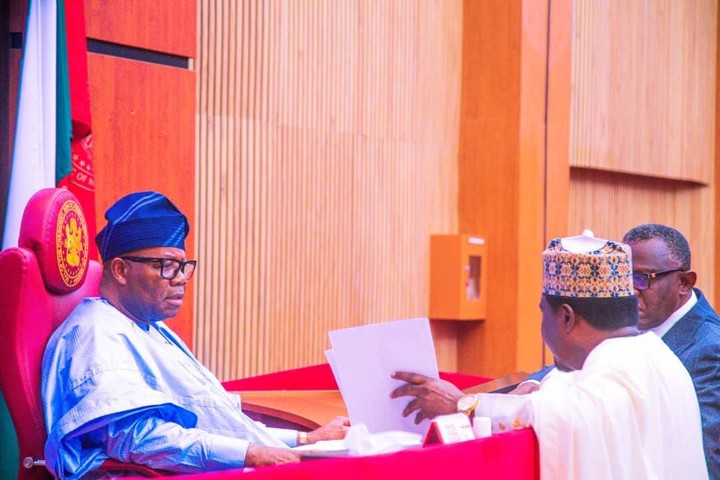

Tensions flared on Tuesday in the Nigerian Senate as Deputy Senate President Jibrin Barau publicly confronted Senate President Godswill Akpabio during plenary over comments concerning former U.S. President Donald Trump’s recent accusations against Nigeria.
The dispute followed Trump’s controversial declaration labeling Nigeria a “Country of Particular Concern,” alleging that the Nigerian government had failed to prevent “genocide against Christians.” The statement, which sparked widespread diplomatic outrage, prompted a heated debate among lawmakers about how Nigeria’s legislature should respond.
At the close of plenary, Senate President Akpabio informed lawmakers that Nigerians were anxiously awaiting the Senate’s reaction to Trump’s claims. However, he maintained that the chamber would refrain from issuing any official position until the Federal Government formally briefed it on the matter.
“Who am I to reply Trump?” Akpabio asked rhetorically. “The Senate will only deliberate on issues properly brought before it. Nigerians want us to respond, but we must wait for official communication before taking any position.”
His cautious tone, however, drew an immediate and bold reaction from his deputy, Jibrin Barau.
“Don’t be scared, I can say it. I am not scared of Trump,” Barau declared, his voice firm. “I am a Nigerian, a parliamentarian, and the Deputy Senate President of a sovereign nation. Trump is saying lies about our country, and we have every right to dispute it. Don’t be scared of Trump; he is not above Nigeria.”
Related News
Henry Seriake Dickson Defects from PDP to Newly Formed Nigeria Democratic Congress
Senator Henry Seriake Dickson has formally defected from the Peoples Democratic Party (PDP) to the newly registered Nigeria Democratic Congress…

DSS Tells Court Kaduna Man’s Tweets Could Drag Nigeria into Israel–Iran Conflict
Nigeria’s domestic intelligence agency, the Department of State Services (DSS), has told a court that social media posts allegedly made…
Nigeria Begins Evacuation of Citizens from Iran Amid Escalating Middle East Conflict
The Nigerian government has started evacuating its citizens from Iran as tensions in the Middle East intensify.
The chamber briefly descended into murmurs as Akpabio interjected. “I said I am not scared. How can the Senate President of the country be scared of Trump?” he retorted.
Akpabio went on to caution Barau against making statements not agreed upon by the Senate, emphasizing that responses to foreign comments must reflect Nigeria’s collective position. “Speak, but don’t allow people to ascribe what you did not say to you,” he added. “If you want me to say it now, I will. But I can only say what we discussed as a body.”
The exchange took another turn when Akpabio directed the Senate Clerk to strike Barau’s comments from the official record, describing them as “out of tune.” Witnesses said Barau, visibly unshaken, later approached Akpabio’s seat to engage in a brief private discussion before returning to his place.
The altercation highlighted growing divisions within Nigeria’s political elite over how to manage the fallout from Trump’s remarks. The former U.S. president’s statement, reportedly reinforced by U.S. Secretary of War Pete Hegseth on social media, hinted at potential “action” against Nigeria — a phrase that has been interpreted by analysts as a veiled military warning.
President Bola Ahmed Tinubu has since dismissed Trump’s allegations, insisting that Nigeria remains a secular democracy with constitutional guarantees for religious freedom and peaceful coexistence. The presidency further condemned the statement as “unwarranted interference in Nigeria’s internal affairs.”
Meanwhile, China has openly backed Nigeria, criticizing Trump’s comments as “irresponsible.” Beijing’s Foreign Ministry spokesperson, Mao Ning, said in a briefing that “no country should use religion or human rights as a pretext to interfere in another nation’s sovereignty.”
“The Chinese government firmly opposes any country using religion and human rights as an excuse to threaten others with sanctions or force,” Mao stated.
As the controversy continues to unfold, political observers note that the Senate’s internal disagreement underscores the delicate balance Nigeria faces in responding to international criticism — particularly from major global powers.
While Akpabio advocates for restraint and diplomacy, Barau’s fiery stance reflects a rising sentiment among some lawmakers who believe Nigeria must assert its sovereignty more forcefully on the world stage.
For now, the upper chamber awaits a formal briefing from the executive arm before issuing any collective statement — though the fiery exchange between its two most senior members may have already defined the tone of Nigeria’s legislative response to Trump’s provocation.