Akpabio Petitions Police, DSS Over Fake Report Linking Him to Trump Comments
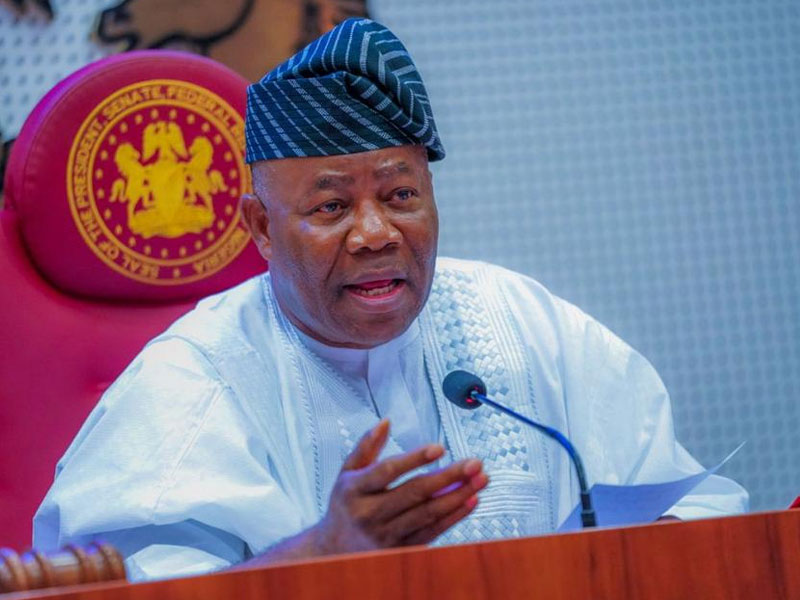

Senate President Godswill Akpabio has formally petitioned the Nigeria Police Force and the Department of State Services (DSS), calling for an investigation into the individuals responsible for circulating a fabricated report that falsely quoted him as attacking U.S. President Donald Trump.
Speaking to journalists, Akpabio condemned the incident, describing it as a deliberate attempt to incite diplomatic tensions and tarnish his reputation. He said the report not only misrepresented his position but also used doctored photos from an unrelated 2023 event in Port Harcourt to lend false credibility to the claims.
“Somebody will sit in the comfort of his room and produce a report, even fake pictures of 2023 when the Senate President with Senators visited Port Harcourt for a different event, and claim that I responded to President Trump. Who am I to answer President Trump?” Akpabio said.
The Senate President dismissed the report as “a concoction designed to cause a diplomatic row,” adding that only the Nigerian Presidency is constitutionally empowered to respond to foreign leaders on sensitive international matters.
“This time, the Senate President of Nigeria did not answer President Trump. The quotation was concocted to cause a diplomatic row. It is the Presidency that can respond officially to such matters,” he added.
Akpabio emphasized that such misinformation poses a real threat to Nigeria’s foreign relations and urged security agencies to act swiftly to identify and prosecute the culprits.
“I believe the Cybercrimes Unit of the Police, the DSS, and others should find that character out, because it is meant to cause friction and put the Nigerian Senate in disrepute,” he warned.
Related News
Henry Seriake Dickson Defects from PDP to Newly Formed Nigeria Democratic Congress
Senator Henry Seriake Dickson has formally defected from the Peoples Democratic Party (PDP) to the newly registered Nigeria Democratic Congress…

Hon. Sarah Ivie Adidi Receives “Her Excellence Award” During International Women’s Day Event in Abuja
Reps aspirant Sarah Ivie Adidi has been honoured with the 2026 “Her Excellence Award” during an event marking International Women’s…
Governor Peter Mbah Urges Ndigbo to Return to Strategic Politics
Peter Mbah, Governor of Enugu State, has urged the Igbo political class to return to what he described as “strategic…
The Deputy Senate President, Barau Jibrin, backed Akpabio’s petition, describing the publication as a malicious attack on Nigeria’s sovereignty and the dignity of its National Assembly.
“You didn’t say it, that’s correct. You shouldn’t be scared of saying it. I’m not scared of Trump. We are a sovereign nation. Nigerians must not be afraid to speak their minds,” Barau stated.
However, Akpabio clarified that the Senate had not yet deliberated on Trump’s alleged remarks about Nigeria, noting that any official response would only follow after a formal discussion at plenary.
“We have not discussed the comment of President Trump in chambers yet. When the Senate deliberates on it officially, only then can I speak,” he said.
The Senate President also appealed to citizens to verify information before sharing it online, stressing that the spread of unverified content can damage Nigeria’s image abroad and mislead the public.
“People must be careful not to circulate unconfirmed reports. One false publication can undermine our diplomatic efforts and create unnecessary friction between nations,” he noted.
The development has sparked widespread debate online, with some Nigerians accusing Akpabio of attempting to protect personal or political interests tied to the United States, while others defended his right to safeguard his reputation against false allegations.
Observers note that this incident underscores the growing problem of fake news and misinformation in Nigeria’s digital space, where social media posts can quickly go viral without verification.
Security analysts argue that Akpabio’s response represents a broader call for accountability in online communication, especially when misinformation threatens diplomatic relations or national institutions.
Meanwhile, the Inspector General of Police and the DSS have yet to issue official statements regarding the petition or ongoing investigations into the matter.
Akpabio’s case adds to a rising number of high-profile Nigerians targeted by fake news campaigns, raising concerns about the need for stronger digital accountability laws and better public awareness on responsible information sharing.