Governor Diri: “I Won’t Force My Deputy to Join APC” — Bayelsa Leader Preaches Dialogue Over Division
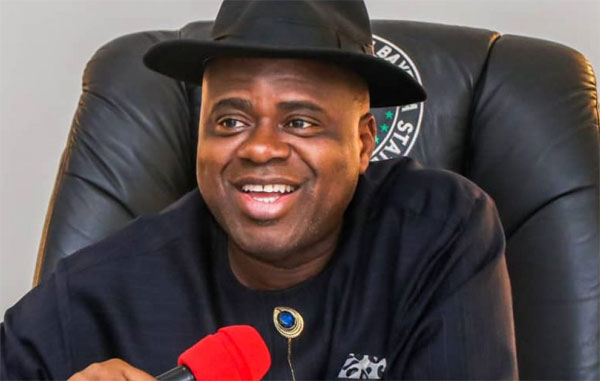

Governor Douye Diri of Bayelsa State has reaffirmed his commitment to political tolerance and dialogue, stating that he will not force his deputy, Senator Lawrence Ewhrudjakpo, to join him in the All Progressives Congress (APC).
The governor made this statement during the weekly State Executive Council meeting at the Government House in Yenagoa on Wednesday, with his deputy in attendance. His comments come amid growing speculation that Ewhrudjakpo, who remains a member of the Peoples Democratic Party (PDP), faces possible impeachment after Diri’s recent defection to the APC.
Governor Diri, who officially joined the APC on November 3 after resigning from the PDP in mid-October, explained that he believes in persuasion and peaceful dialogue rather than political confrontation. “As a matter of principle, I believe in engagement rather than confrontation. I will continue to discuss with my deputy,” he said.
He admitted that while operating under different political parties poses challenges, he remains hopeful that ongoing discussions will lead to understanding. “It is difficult for the governor to be on one side and the deputy on another,” Diri said. “But we will continue to talk, and we might end up in the same party tomorrow.”
The governor also disclosed that Ewhrudjakpo has withdrawn his case filed at a Federal High Court in Abuja seeking to restrain the Bayelsa State House of Assembly from proceeding with an alleged impeachment plot. According to Diri, the legal action was discontinued following their private discussions aimed at resolving the matter amicably.
Related News
Henry Seriake Dickson Defects from PDP to Newly Formed Nigeria Democratic Congress
Senator Henry Seriake Dickson has formally defected from the Peoples Democratic Party (PDP) to the newly registered Nigeria Democratic Congress…

Hon. Sarah Ivie Adidi Receives “Her Excellence Award” During International Women’s Day Event in Abuja
Reps aspirant Sarah Ivie Adidi has been honoured with the 2026 “Her Excellence Award” during an event marking International Women’s…
Governor Peter Mbah Urges Ndigbo to Return to Strategic Politics
Peter Mbah, Governor of Enugu State, has urged the Igbo political class to return to what he described as “strategic…
In his address, the governor urged Bayelsans to prioritize peace and unity over political rivalry. “Politics should be for the development of the state, not to fight one another,” he said. “We must not heat up the polity. We are done with violence in Bayelsa State. We are brothers and we are one.”
He also expressed gratitude to citizens for their participation in the state’s recent Thanksgiving Day celebration and for the “mammoth crowd” that attended his official defection rally. Diri further extended appreciation to President Bola Tinubu and Vice President Kashim Shettima, pledging his continued loyalty and collaboration toward improving the welfare of Bayelsans.
On reports of alleged armed men entering the state, Diri dismissed the claims as fake news but assured residents that security agencies were on alert. “Bayelsa remains one of the most secure states in Nigeria,” he said, urging citizens to report genuine security concerns to relevant authorities rather than spreading panic online.
During the meeting, Commissioner for Health, Prof. Seiyefa Brisibe, presented an award recognizing Bayelsa as the “Best State in Health Insurance Service Delivery” from the Nigeria Governors Forum. Commissioner for Sports, Dr. Daniel Igali, also presented Diri with a “Distinguished Governor Award for Outstanding Support to SWAN and Contribution to Sports Development in Nigeria.”
While the governor’s conciliatory tone has been praised by some as a sign of maturity, critics remain skeptical about the political dynamics at play. Online commentators have speculated that Diri’s approach is both strategic and self-preserving. One user noted, “He’s only being calculative — one leg in, one leg out.” Another added, “This is a planned game. Let’s continue to watch.”
Others, however, lauded Diri’s emphasis on peace. “That’s why I have always liked you,” one commenter wrote. “Peace comes first; continue to discuss with him.”
Still, some Bayelsans believe the governor’s political shift is motivated by self-interest rather than principle. “Governor Diri wan chop Tinubu money,” one user quipped, “see sure retirement package!”
Regardless of speculation, Diri’s message underscores a growing theme in Nigerian politics — one where shifting alliances are increasingly common, but unity, at least in rhetoric, remains a prized political ideal.