Ribadu Meets Top U.S. Defence Officials as Tensions Rise Over Trump’s Military Threat to Nigeria
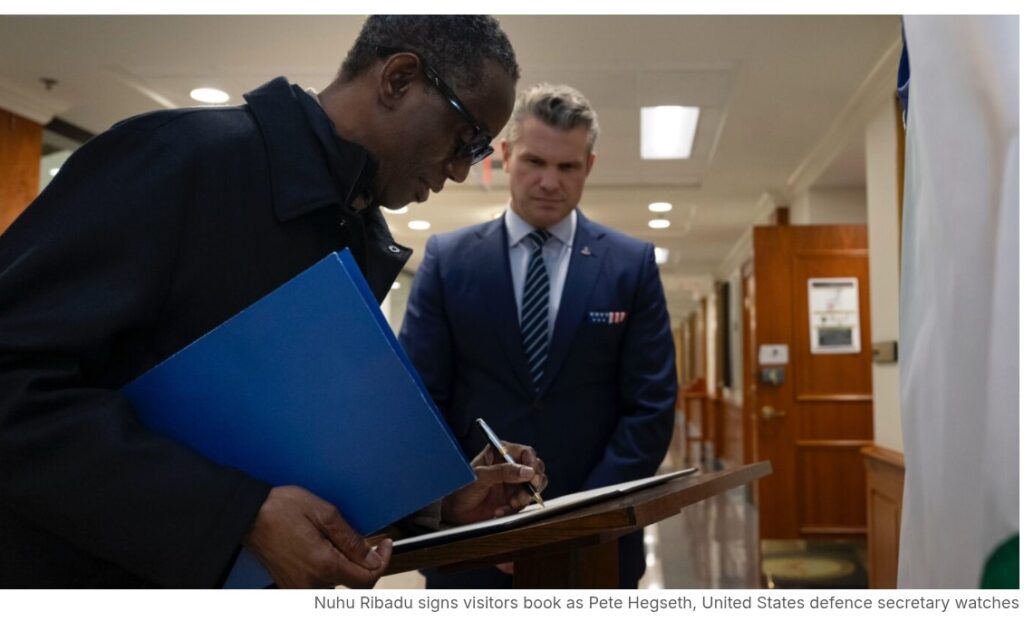

Nigeria’s diplomatic and security landscape entered a tense new phase this week after National Security Adviser Nuhu Ribadu met with the United States Secretary of Defense, Pete Hegseth, and Chairman of the Joint Chiefs, Dan Caine, following President Donald Trump’s unexpected threat to deploy American forces to Nigeria. The meetings, which were not listed on the public schedules of either U.S. official, were part of a high-level delegation dispatched by President Bola Tinubu to address what has become one of the most sensitive international incidents in recent years.
Trump’s comments — promising to send troops “guns-a-blazing” to “wipe out Islamic terrorists killing Christians” — sent shockwaves through both diplomatic circles and Nigerian public discourse. Although widely criticised as reckless and legally baseless, the remarks were serious enough to trigger emergency consultations between Abuja and Washington.
Ribadu’s delegation included Minister of State for Foreign Affairs Bianca Ojukwu, Inspector General of Police Kayode Egbetokun, Attorney General of the Federation Lateef Fagbemi, and Chief of Defence Staff Olufemi Oluyede. Their mission was clear: de-escalate tensions, counter narratives of state-sponsored Christian persecution, and prevent any misinterpretation in Washington that could lead to unilateral U.S. actions.
On Wednesday, the Nigerian team met with U.S. lawmaker Riley Moore, a prominent voice among American politicians who have repeatedly cited what they claim is evidence of Christian persecution in Nigeria. The same day, Congress held hearings on the issue, amplifying political pressure in the United States.
Related News
Nigeria, Germany Move to Deepen Cooperation on Security, Power and Infrastructure
Nigeria and Germany have reaffirmed plans to strengthen bilateral relations following a high-level telephone conversation between President Bola Tinubu and…
King Charles III to Host Nigerian President Tinubu in First UK State Visit in 37 Years
Buckingham Palace has confirmed that King Charles III will host Nigerian President Bola Ahmed Tinubu and First Lady Oluremi Tinubu…

Macron Says “China Is Welcome” in Europe as Trade Tensions With U.S. Reshape Global Alliances
French President Emmanuel Macron has declared that “China is welcome” in Europe, a statement that has intensified debate about Europe’s…
ABC News later confirmed that Ribadu’s unpublicized meeting with Hegseth and Caine took place Thursday evening. The secrecy surrounding the meeting — no press access, no official public mention — has heightened speculation about the seriousness of the discussions and the urgency of Nigeria’s diplomatic counter-effort.
During the congressional hearing, Jonathan Pratt, a senior official at the U.S. State Department’s Bureau of African Affairs, disclosed that Nigeria’s delegation was scheduled to meet with both State Department and Department of Defense officials. Pratt added that Washington and Abuja would explore joint measures, including a possible task force, to address accusations of religious persecution.
However, not all U.S. officials supported Trump’s rhetoric. Representative Sara Jacobs condemned his comments as “reckless,” noting that Congress has not authorized military action in Nigeria and that any intervention without Nigeria’s consent would violate international law. Her remarks added clarity to the limits of executive power, even under an administration known for extreme positions.
Meanwhile, reactions across Nigeria have been intense, polarized, and often laced with sarcasm, frustration, or distrust. Some citizens supported the diplomatic approach and welcomed the engagement with Washington. Others accused the Nigerian government of downplaying religiously targeted violence or failing to address terrorism while focusing on optics.
Social media commentary reflected deep cynicism. Some users joked about fictional deployments of U.S. fighter jets and warships, mocking Trump’s threats as sensationalism. Others insisted that Christian communities, especially in northern Nigeria, face targeted attacks that the government has refused to acknowledge publicly.
A number of commenters expressed fears that Nigerian officials might use diplomacy to deflect responsibility or hide uncomfortable truths during talks with American lawmakers. Critics argued that without drastic improvements in security and governance, external pressure — whether diplomatic, legal, or symbolic — would continue to mount.
As the diplomatic conversations continue, the episode has laid bare both Nigeria’s internal vulnerabilities and the increasing willingness of foreign actors to intervene rhetorically — or politically — in the country’s security affairs. For now, the future hinges on whether Abuja can convince Washington that the situation, however dire, does not justify foreign boots on Nigerian soil.