Sokoto–Badagry Highway Expansion Reaches Badagry–Ogun Axis as Federal Construction Intensifies
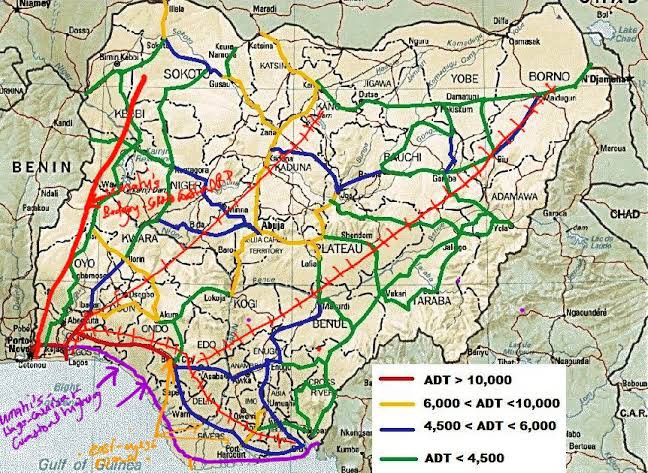

The ambitious Sokoto–Badagry Highway project has entered a new and strategically significant phase, extending deep into the Badagry–Ogun industrial corridor. What initially began as a state-level rehabilitation project in Ogun has now evolved into a full-scale federal construction effort, marking one of the most important North–South road linkages currently underway in Nigeria.
The federal expansion now covers the stretch from Agbara Junction through Lusada to Atan — a zone known for its concentration of manufacturing hubs, export-oriented factories, distribution companies, and growing residential communities. This corridor had previously benefited from Ogun State’s intervention, with one carriageway rehabilitated to ease the overwhelming congestion that plagued local commuters and industrial transporters. That upgrade temporarily stabilized mobility, but it also revealed the region’s larger infrastructural burden and the need for a unified federal approach.
Now, under the broader Sokoto–Badagry Highway initiative, the Federal Government has mobilized contractors who have commenced heavy-duty work along the axis. These activities include clearing major alignments, preparing new roadbeds, widening the existing rehabilitated sections, and beginning emergency works on deteriorated areas beyond Ogun’s earlier intervention. The scale of the work signals a transition from piecemeal maintenance to a comprehensive North–South integration effort.
Related News
Aerial Footage Shows Progress on Sokoto–Badagry Super Highway Construction
New aerial footage circulating online has revealed ongoing construction work on the proposed Sokoto–Badagry Super Highway, a major infrastructure project…
Kaduna State Government Takes Over Ahmadu Bello Stadium, Begins Major Reconstruction
The Kaduna State Government has officially taken over ownership of the iconic Ahmadu Bello Stadium from the Federal Government, following…
Umahi Inspects Ongoing Rehabilitation of Lagos–Ota–Abeokuta Expressway
Minister of Works David Umahi has inspected the rehabilitation of the Lagos–Ota–Abeokuta Expressway, describing the project as a priority infrastructure…
This highway, once completed, will link Sokoto in the far northwest to Badagry on Nigeria’s southwestern coastline — creating a massive mobility corridor for goods, travelers, and regional trade. Federal authorities view it as a priority project for strengthening national logistics, stimulating cross-regional commerce, and reducing transportation bottlenecks that often inflate the cost of moving agricultural produce, manufactured goods, and essential supplies across Nigeria.
However, the extension of this road has also sparked public debate. While many residents and observers see it as a long-overdue infrastructural improvement that will support commerce and reduce travel times, others have expressed concerns about security implications. Some commenters worry that enhanced road connectivity could inadvertently ease the movement of criminal elements or bandits from the northern regions into the southwest. These concerns, though speculative, reflect the broader national anxiety surrounding security and mobility.
Still, supporters argue that modern infrastructure is essential for economic growth and that highway development should not be halted based on fear. They note that road networks across West Africa have long achieved similar connectivity without triggering regional destabilization. They also emphasize that with proper security management and federal oversight, the highway will serve as a unifying development asset rather than a threat.
The project’s supporters also highlight the potential benefits for Lagos and Ogun: improved access for industries, reduced congestion on Lagos-bound routes, better regional trade flows, and stronger urban–rural economic integration. For many, the Sokoto–Badagry Highway is more than a construction project — it represents a long-awaited modernization of Nigeria’s transportation backbone.
As the federal team continues work along the Badagry–Ogun axis, expectations are high that Nigeria may finally be taking meaningful steps toward correcting decades of underinvestment in road infrastructure. The project’s completion will not only unify distant parts of the country but also strengthen the economic engine of the southwest, enabling smoother movement of goods and people in a way that supports national productivity.
For now, the machinery is in motion, the alignments are being cleared, and the highway continues to stretch southward — signaling a new chapter in Nigeria’s quest for efficient, modern, and interconnected transportation routes.