PDP Expels Governors Bala Mohammed, Dauda Lawal, Seyi Makinde and Others Amid Deepening Internal Crisis
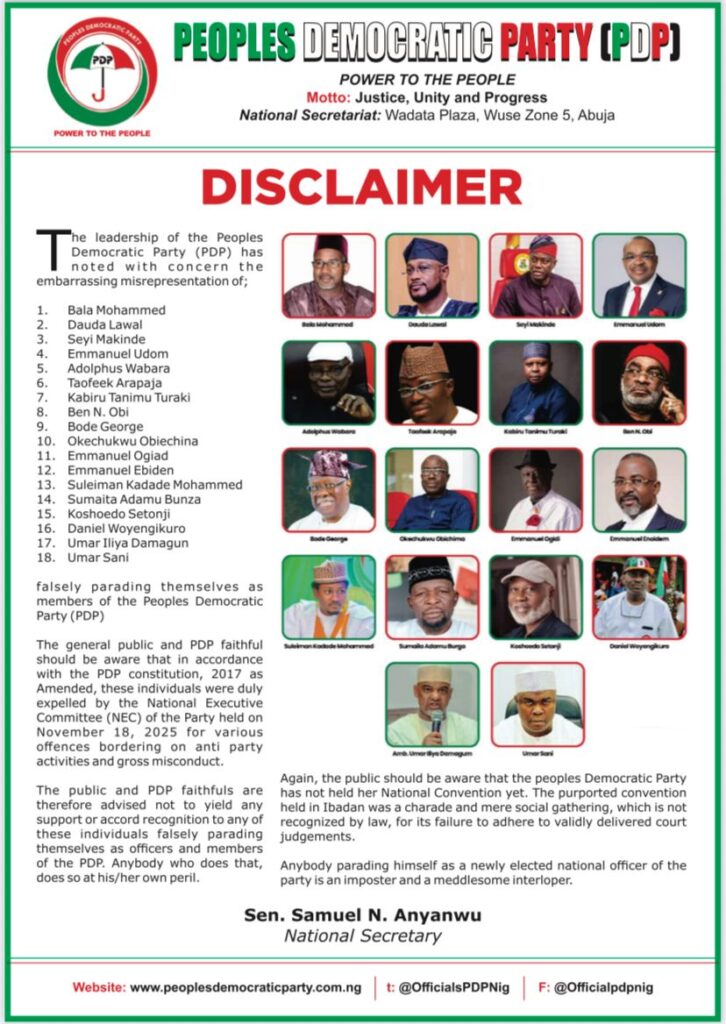

The Peoples Democratic Party (PDP) on Wednesday announced the expulsion of a significant number of influential members, including Bauchi State Governor Bala Mohammed, Zamfara State Governor Dauda Lawal, and Oyo State Governor Seyi Makinde, marking one of the most dramatic internal shake-ups in the party’s recent history.
The announcement was contained in an official disclaimer notice signed by Senator Samuel Anyanwu, the PDP National Secretary, who explained that the individuals listed had been “duly expelled” by the National Executive Committee (NEC) during its meeting of November 18, 2025. According to the notice, the expulsions were carried out in line with the PDP Constitution (2017 as Amended) and were based on allegations of anti-party activities, gross misconduct, and actions deemed injurious to the integrity of the party.
The disclaimer specifically names 18 individuals, including prominent political figures such as former governors, former party chairmen, ex-ministers, and senior stakeholders. Among those listed are Emmanuel Udom, Adolphus Wabara, Taofeek Arapaja, Kabiru Tanimu Turaki, Ben Obi, Bode George, Suleiman Kadade Mohammed, Umar Damagun, Umar Sani, and several others.
Related News
Henry Seriake Dickson Defects from PDP to Newly Formed Nigeria Democratic Congress
Senator Henry Seriake Dickson has formally defected from the Peoples Democratic Party (PDP) to the newly registered Nigeria Democratic Congress…

Hon. Sarah Ivie Adidi Receives “Her Excellence Award” During International Women’s Day Event in Abuja
Reps aspirant Sarah Ivie Adidi has been honoured with the 2026 “Her Excellence Award” during an event marking International Women’s…
Governor Peter Mbah Urges Ndigbo to Return to Strategic Politics
Peter Mbah, Governor of Enugu State, has urged the Igbo political class to return to what he described as “strategic…
According to the statement, these individuals have continued to “falsely parade themselves as members and officers of the PDP,” prompting the leadership to issue a public warning. The party stressed that anyone offering recognition or support to the expelled members “does so at his or her own peril.”
The notice also addressed recent political developments, particularly the controversial convention held in Ibadan, which the PDP leadership dismissed as a “charade” and a “mere social gathering” that violated existing court judgments. The party insisted that no valid national convention has taken place and that any individual claiming to be a newly elected PDP national officer is an “imposter and meddlesome interloper.”
The expulsions have triggered a wave of strong reactions nationwide, mirroring the escalating tension within the party. Critics and commentators described the situation as evidence of a party in disarray, with some suggesting that external political forces are taking advantage of PDP’s internal vulnerabilities.
On social media, many users suggested the ruling APC was actively working to weaken the opposition, while others argued that the PDP’s inability to maintain internal cohesion is the root cause of the crisis. Some commenters pointed out that long-standing grievances, unresolved leadership disputes, and factional battles—particularly involving figures aligned with Nyesom Wike—have led to a state of near paralysis within the party.
Observers note that the removal of three sitting governors—each with significant political influence in their states—could reshape the party’s national strategy ahead of the 2027 elections. Some analysts argue that the expulsions may embolden other factions within the PDP to assert themselves, possibly leading to more fragmentation if reconciliation efforts fail.
The development underscores the scale of instability confronting the PDP, once considered Nigeria’s most formidable political machine. With the party sharply divided and its top-tier leaders publicly trading accusations, many observers warn that the PDP may struggle to present a unified front as the nation approaches another election cycle.
For now, the party maintains that its actions are necessary to preserve discipline and restore internal order. Whether the expulsions will stabilize or further fracture the PDP remains to be seen.