EFCC Detains Former Attorney-General Abubakar Malami Over Terrorism Financing and Financial Crime Allegations
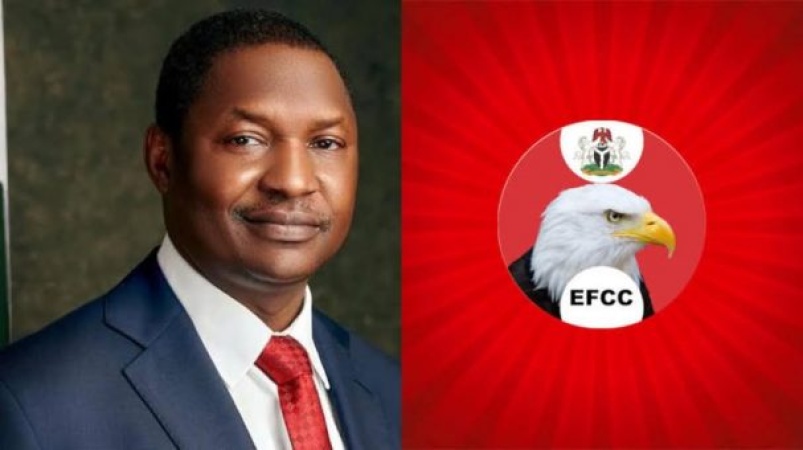

The Economic and Financial Crimes Commission (EFCC) has detained former Attorney-General of the Federation and Minister of Justice, Abubakar Malami (SAN), over allegations linked to terrorism financing, money laundering, and the handling of large sums of recovered public funds. The development has triggered widespread public reactions and renewed scrutiny of financial accountability among former senior government officials.
According to sources familiar with the investigation, Malami was taken into custody for questioning over multiple financial issues, including the alleged movement of suspicious funds, the operation of multiple bank accounts, and large-scale investments reportedly traced to Kebbi State. Of particular interest to investigators is an alleged investment portfolio valued at about ₦10 billion, which the EFCC is currently examining for legitimacy and compliance with financial regulations.
The former minister is also being questioned over the whereabouts and management of funds recovered from foreign jurisdictions. These include approximately $322 million recovered from Swiss accounts linked to late former military ruler, General Sani Abacha, as well as an additional $22 million reportedly recovered from the Island of Jersey in the United Kingdom. EFCC sources disclosed that the commission is seeking detailed explanations on how these funds were handled during Malami’s tenure as the nation’s chief law officer.
Investigators are also examining transactions related to the Central Bank of Nigeria’s Anchor Borrowers Programme, particularly a ₦4 billion facility allegedly linked to one of Malami’s wives. Sources within the commission revealed that she may be invited for questioning as part of efforts to establish the full scope of financial transactions connected to the case.
Related News

Gunmen Attack ADC Leaders in Benin as Obi, Oyegun Allege Assassination Attempt
Tension rose in Benin City after gunmen attacked the African Democratic Congress (ADC) secretariat and the residence of former Edo…

NDLEA Arrests Lekki Real Estate Executive Kolapo Oladapo Over Alleged Drug Distribution Network
The National Drug Law Enforcement Agency has arrested Lekki-based real estate executive Kolapo Oladapo following the recovery of 89.2 kilograms…

Rising Phone Thefts and Scams Spark Fear at Lagos’ Ikeja Computer Village
Nigeria’s largest technology market, Ikeja Computer Village, is facing growing concerns over rising phone theft and scam activities.
As of late Tuesday night, Malami was said to remain in EFCC custody after reportedly failing to meet bail conditions set by the commission. A senior EFCC official, speaking on condition of anonymity, confirmed that the allegations against the former minister span several areas of financial crime and will require extended interrogation and forensic analysis of financial records. The official further disclosed that asset tracing and possible asset attachment are being considered as part of the investigation.
However, Malami has firmly rejected the terrorism financing allegation and described it as false, misleading, and politically motivated. In a detailed public statement issued on his verified social media account, the former minister denied ever being accused, investigated, or charged by any local or international security agency in connection with terrorism financing.
He further argued that the retired military officer referenced in some reports as the source of the claims had, by his own admission, stated that he was not accusing Malami of financing terrorism. According to Malami, the officer only referenced vague institutional or business relationships that were misrepresented in public discourse to imply guilt by association.
Malami also defended his tenure as Attorney-General by citing his involvement in strengthening Nigeria’s anti-money laundering and counter-terrorism financing frameworks. He highlighted the establishment of the Nigerian Financial Intelligence Unit as an independent body, the passage of the Money Laundering (Prevention and Prohibition) Act, 2022, and the enactment of the Terrorism (Prevention and Prohibition) Act, 2022 as key milestones achieved under his supervision.
He further maintained that his office worked closely with regulatory agencies such as the Central Bank of Nigeria, law enforcement bodies, and international partners to improve Nigeria’s compliance with global anti-money laundering and counter-terrorism financing standards. Malami argued that these efforts directly contributed to Nigeria’s exit from the Financial Action Task Force (FATF) grey list, making the allegations against him inconsistent with his official record.
The detention has sparked intense public debate, with many Nigerians calling for a comprehensive investigation not only into Malami but also into other former public office holders whose tenures overlapped with the period of escalating insecurity in the country. Some commentators have described the arrest as a positive signal of renewed seriousness in tackling the financial roots of terrorism, while others have expressed skepticism, citing a history of high-profile arrests that failed to translate into successful prosecutions.
Legal analysts have also raised questions about the EFCC’s bail procedures, noting that, under Nigerian law, bail is traditionally granted by the courts rather than investigative agencies. Civil society organizations have urged the commission to ensure strict adherence to due process and the rule of law as the investigation progresses.
As the probe continues, Nigerians are watching closely to see whether the case will lead to formal charges, court proceedings, and possible convictions. For many, the outcome will serve as a critical test of the government’s commitment to accountability, transparency, and the fight against terrorism financing in Nigeria.