Controversy Trails Rapid Promotion of Tinubu’s ADC, Nurudeen Yusuf, Within One Yea
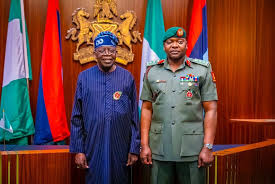

A decision by President Bola Tinubu to approve the promotion of his Aide-de-Camp (ADC), Nurudeen Yusuf, to the rank of brigadier-general has generated significant debate and unease within sections of the Nigerian Army and the wider public. The controversy stems from the fact that the officer had already been promoted earlier in the year, making the latest advancement his second within a 12-month period.
The approval was conveyed in a letter dated December 12, 2025, addressed to the Chief of Army Staff, Lieutenant General Wahid Shaibu, and signed by the National Security Adviser, Nuhu Ribadu. In the letter, the President formally authorised Yusuf’s elevation to the rank of brigadier-general, a move that immediately drew attention because of its timing and perceived deviation from established promotion timelines within the Nigerian Army.
Nurudeen Yusuf was decorated as a colonel in January 2025, placing his promotion to brigadier-general less than a year later. Within military tradition, progression to such a senior rank typically follows a clearly defined path that includes time-in-rank requirements, completion of mandatory professional courses, and availability of vacancies. As a result, several serving and retired officers have privately and publicly expressed concern, describing the promotion as unusually rapid.
Some officers, including those believed to be Yusuf’s coursemates, reportedly viewed the decision as an example of preferential treatment. Critics argue that accelerating one officer’s career outside the normal structure risks undermining morale and discipline within the armed forces, particularly among those who have waited years to advance through the ranks under the same system.
Related News

Henry Seriake Dickson Defects from PDP to Newly Formed Nigeria Democratic Congress
Senator Henry Seriake Dickson has formally defected from the Peoples Democratic Party (PDP) to the newly registered Nigeria Democratic Congress…

Hon. Sarah Ivie Adidi Receives “Her Excellence Award” During International Women’s Day Event in Abuja
Reps aspirant Sarah Ivie Adidi has been honoured with the 2026 “Her Excellence Award” during an event marking International Women’s…
Governor Peter Mbah Urges Ndigbo to Return to Strategic Politics
Peter Mbah, Governor of Enugu State, has urged the Igbo political class to return to what he described as “strategic…
A senior military officer, speaking anonymously, was quoted as saying that the promotion “defies logic” given the short interval between Yusuf’s elevation to colonel and his new rank. As of the time of reporting, neither the Presidency nor the Nigerian Army had issued a detailed public explanation addressing these concerns or clarifying whether standard promotion requirements were waived.
However, a source within the Presidency, who requested anonymity due to a lack of authorisation to speak on the matter, explained that the decision was taken to maintain rank parity among senior security officials assigned to the Presidential Villa. According to the source, similar promotions had recently occurred within other security agencies attached to the President.
In August 2025, the Nigeria Police Force promoted the President’s Chief Personal Security Officer, Usman Shugaba, from Deputy Commissioner of Police to Commissioner of Police. Likewise, the Department of State Services (DSS) elevated the President’s Chief Security Officer, Adegboyega Fasasi, to the rank of Director. The Presidency source noted that these positions are considered broadly equivalent in status to a brigadier-general within the Nigerian Army.
The source further argued that without a corresponding promotion, Yusuf would have remained junior in rank to his counterparts from the police and DSS within the presidential security structure. Such an imbalance, the source claimed, could affect cohesion, command relationships, and esprit de corps among the President’s security team.
Nurudeen Yusuf was appointed ADC to President Tinubu on May 1, 2023, approximately four weeks before the President’s inauguration. At the time of his appointment, he held the rank of lieutenant-colonel. His subsequent rise to colonel and now brigadier-general has therefore occurred within a relatively short span.
Beyond internal military concerns, the promotion has also sparked wider public debate about governance, transparency, and institutional integrity. While some commentators argue that the President, as Commander-in-Chief of the Armed Forces, has the constitutional authority to approve special promotions, others caution that frequent reliance on such discretion could weaken established systems and create perceptions of favoritism.
Supporters of the decision maintain that exceptional postings, particularly within the sensitive environment of presidential security, may warrant exceptional measures. Critics, however, insist that adherence to due process remains essential to preserving professionalism and stability within the armed forces.