Atiku Abubakar Responds to Son’s Defection to APC, Sparks Nationwide Political Debate
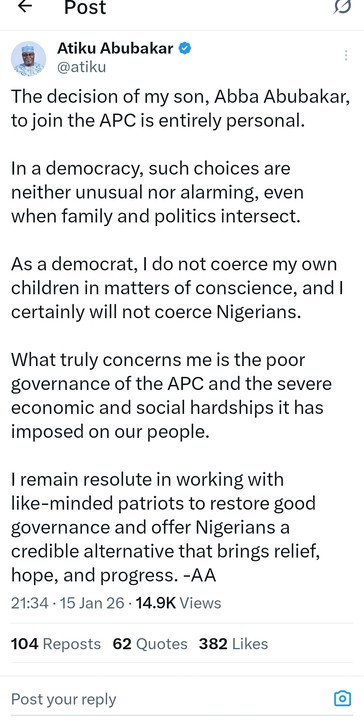

Former Vice President of Nigeria and perennial presidential contender, Atiku Abubakar, has reacted to the decision of his son, Abba Abubakar, to join the ruling All Progressives Congress (APC), stating unequivocally that the move was a personal decision and not influenced by him.
In a statement released on January 15, Atiku emphasized that democratic values allow individuals the freedom to choose their political paths, even when such decisions cut across family lines. According to him, political pluralism within families is neither unusual nor alarming in a functioning democracy.
“The decision of my son, Abba Abubakar, to join the APC is entirely personal,” Atiku said. “As a democrat, I do not coerce my own children in matters of conscience, and I certainly will not coerce Nigerians.”
Atiku used the opportunity to restate his opposition to the APC-led federal government, arguing that his primary concern remains what he described as poor governance and the worsening economic and social conditions facing Nigerians. He maintained that his political mission is focused on offering Nigerians a credible alternative capable of delivering relief, hope, and progress.
Related News

Henry Seriake Dickson Defects from PDP to Newly Formed Nigeria Democratic Congress
Senator Henry Seriake Dickson has formally defected from the Peoples Democratic Party (PDP) to the newly registered Nigeria Democratic Congress…

Hon. Sarah Ivie Adidi Receives “Her Excellence Award” During International Women’s Day Event in Abuja
Reps aspirant Sarah Ivie Adidi has been honoured with the 2026 “Her Excellence Award” during an event marking International Women’s…
Governor Peter Mbah Urges Ndigbo to Return to Strategic Politics
Peter Mbah, Governor of Enugu State, has urged the Igbo political class to return to what he described as “strategic…
Despite the measured tone of Atiku’s statement, the development quickly ignited heated reactions across political circles and social media platforms. Many Nigerians viewed the defection as politically symbolic, raising questions about loyalty, internal family dynamics, and the broader implications for Atiku’s political ambitions.
Some commentators praised Atiku’s response as evidence of democratic maturity, arguing that his willingness to allow his son make an independent political choice reflects respect for freedom of association. Supporters described the former vice president as a liberal-minded leader who separates governance principles from personal relationships.
Others, however, interpreted the move as damaging optics for Atiku, particularly as he remains a prominent opposition figure. Critics argued that a politician whose own son aligns with the ruling party may struggle to convincingly present himself as a viable alternative to that same government. Several commenters questioned how Atiku could inspire public confidence when, in their view, his immediate family appeared unconvinced by his political project.
The situation also reignited longstanding partisan debates, with supporters of the APC framing the defection as a political gain for the ruling party. Some went as far as suggesting that Abba Abubakar’s decision reflected a lack of faith in his father’s political direction, while others speculated—without evidence—that the move could be a strategic infiltration rather than a genuine defection.
The discussion soon expanded beyond Atiku’s family, morphing into broader arguments about political dynasties, leadership credibility, and comparisons with other political families, including that of President Bola Tinubu. These exchanges highlighted the deeply polarized nature of Nigeria’s political environment, where personal decisions are often interpreted through partisan lenses.
Political analysts note that while family defections can create short-term controversy, their long-term impact depends on how effectively politicians refocus public attention on policy substance rather than symbolism. In Atiku’s case, the challenge may lie in ensuring that debates around his son’s decision do not overshadow his critique of governance, economic management, and national direction.
As Nigeria gradually inches toward another election cycle, the episode underscores the intense scrutiny faced by political leaders and the increasingly blurred lines between personal choices and public perception in the country’s democratic space.