Gavin Newsom Mocks Donald Trump With Satirical “California Peace Prize” Announcement
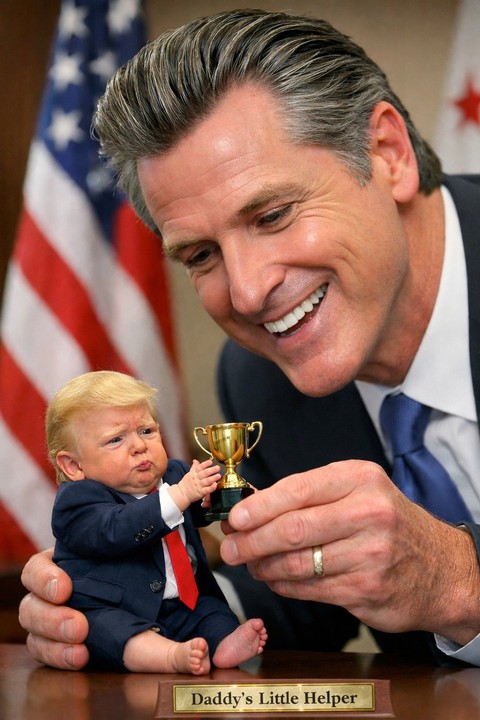

California Governor Gavin Newsom has ignited fresh political controversy after a satirical social media post appeared to announce that United States President Donald Trump had been awarded a “California Peace Prize.” The announcement, shared through the Governor’s Press Office account on X (formerly Twitter), was widely interpreted as mockery rather than a serious recognition, triggering intense reactions across political and social media spaces.
The post, attributed to the Governor’s Press Office, stated that the award was being given to Donald Trump “in honor of lasting one full year in office,” accompanied by congratulatory language that many readers immediately identified as sarcastic. The message was followed by another post from Newsom’s personal account, in which he warned U.S. allies and business leaders that there was “no diplomacy” with Trump, urging them to show more resolve rather than deference.
Although no such award as the “California Peace Prize” officially exists, the tone and timing of the announcement made clear that it was intended as political satire. Observers noted that the post appeared to mock Trump’s long-standing fixation with international recognition, particularly the Nobel Peace Prize, which Trump has repeatedly referenced during and after his time in office.
Related News

Six US Troops Killed in Iranian Strike on Kuwait Port, Says CENTCOM
The United States Central Command has confirmed that six American service members were killed following an Iranian strike on a…

Trump-Linked Financier Signs Preliminary Gas Deal With Russia’s Novatek for Alaska Project
An American financier with ties to former U.S. President Donald Trump has reportedly signed an early-stage agreement with Russian energy…

US Commends NAF Ahead of AH-1Z Helicopter Delivery
The United States Government has praised the Nigerian Air Force for its preparedness ahead of the delivery of AH-1Z attack…
The post quickly gained traction online, drawing reactions from both critics and supporters of the former president. Some users described Newsom’s action as a calculated act of trolling, pointing out that the California governor has a history of sharp online exchanges and public criticisms directed at Trump. Others applauded the move as a creative form of political commentary, while critics accused Newsom of trivialising serious geopolitical issues through mockery.
Supporters of Trump, however, viewed the post as disrespectful and emblematic of what they described as political elitism. They argued that Trump’s foreign policy decisions, particularly his rhetoric on global conflicts and U.S. interests, should not be dismissed through satire. Some went further to defend Trump’s record, claiming he had taken decisive positions on international crises where other leaders had hesitated.
On the other side of the debate, Trump’s critics welcomed the post as a pointed critique of his leadership style. They argued that Trump’s confrontational approach to diplomacy and repeated public complaints about not receiving international accolades made him a fitting subject for satire. Several commenters described the post as highlighting what they see as the irony between Trump’s self-image as a peacemaker and the turbulence that often characterised his administration’s foreign relations.
Political analysts note that the exchange reflects broader tensions within American politics, where social media has become a central battleground for messaging, symbolism, and public perception. Governors and other subnational leaders in the United States increasingly use digital platforms not only to communicate policy but also to shape national political narratives and position themselves within broader ideological debates.
Newsom, widely seen as a prominent figure within the Democratic Party, has often positioned himself as a vocal counterweight to Trump-style politics. While he has not formally declared any future national ambitions, his high-profile clashes with Republican figures, including Trump, continue to draw attention both domestically and internationally.
The incident also underscores how political satire can blur lines, especially for audiences outside the United States who may initially interpret such announcements at face value. Several commentators were quick to clarify that the so-called peace prize was fictional, emphasising that the post was intended purely as sarcasm rather than an official act of recognition.
As reactions continue to pour in, the episode highlights the deeply polarised nature of contemporary U.S. politics, where even a satirical post can provoke passionate debate about leadership, diplomacy, and national identity. Whether viewed as sharp political humour or unnecessary provocation, Newsom’s mock “award” has once again placed the rivalry between him and Donald Trump at the center of public discourse.