I Rely on Allah for Reelection in 2027 – Governor Abba Kabir Yusuf Speaks Amid Political Realignments in Kano
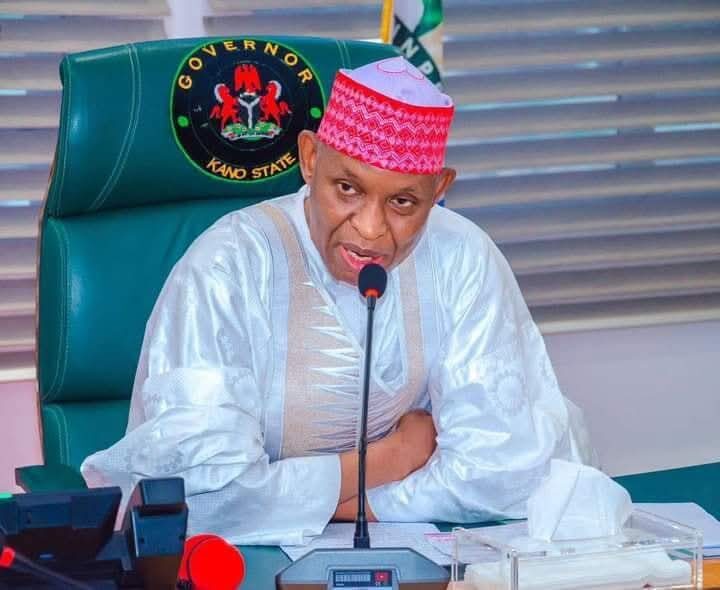

Governor Abba Kabir Yusuf of Kano State has stated that his expectation of reelection in the 2027 general elections rests solely in the hands of Allah, describing divine will as the ultimate source of political power. The governor made the remarks on Saturday while presenting motorcycles to members of his social media team, marking his first public comments on the 2027 election cycle since controversies emerged around his political realignments.
Reflecting on his emergence as governor in 2023, Yusuf said his victory was not the product of any individual’s influence but the will of God. According to him, political discussions about 2027 should not distract from the immediate responsibilities of governance, especially at a time when Kano State faces pressing challenges.
“In 2023, it was God who gave me power, not anybody else, and I still thank and appreciate Him as the only one who will allow me to continue in 2027,” the governor said. He added that excessive focus on future elections was misplaced, noting the unpredictability of life. “Even all the talk about 2027 is a misplaced priority, because who knows whether he will make it to tomorrow, let alone 2027,” he stated.
Governor Yusuf emphasized that his primary concern remains the stability and development of Kano State. He stressed that peace, security, and good governance must take precedence over political calculations. “We have to get it right to have our full peace and security before talking about anything, and that is my major concern now, not anything else,” he said.
Related News

Henry Seriake Dickson Defects from PDP to Newly Formed Nigeria Democratic Congress
Senator Henry Seriake Dickson has formally defected from the Peoples Democratic Party (PDP) to the newly registered Nigeria Democratic Congress…

Hon. Sarah Ivie Adidi Receives “Her Excellence Award” During International Women’s Day Event in Abuja
Reps aspirant Sarah Ivie Adidi has been honoured with the 2026 “Her Excellence Award” during an event marking International Women’s…
Governor Peter Mbah Urges Ndigbo to Return to Strategic Politics
Peter Mbah, Governor of Enugu State, has urged the Igbo political class to return to what he described as “strategic…
The governor also underscored his allegiance to the state rather than to any individual or political structure. “Let me remind everybody that, to me, Kano comes first, not loyalty to anybody. Everyone should know that no one is bigger than Kano; we shall all be loyal to Kano,” Yusuf declared.
His comments have drawn renewed attention to the evolving dynamics of Kano politics, particularly the ongoing debate around the Kwankwasiyya movement and its origins. Speaking at the same event, a former Deputy Governor of Kano State, Professor Hafiz Abubakar, offered a historical account of the movement’s formation, disputing the widespread perception that it was solely created by Senator Rabiu Musa Kwankwaso.
According to Professor Abubakar, the Kwankwasiyya movement was established by a group of political actors during a period of political marginalization. “Myself and five others created the Kwankwasiyya Movement and even gave it a Red Cap symbol, not Dr Rabiu Musa Kwankwaso,” he said.
He further explained that figures such as Dr. Yunusa Adamu Dangwani, Rabiu Suleiman Bichi, and others were instrumental in shaping the movement’s identity and structure at a time when political pressure against Kwankwaso was intense. “At that time, we gave every support to Kwankwaso to survive the political tsunamis directed at him by the political bigwigs in Kano, and that was how we created the movement,” Abubakar stated.
Professor Abubakar, however, accused Kwankwaso of failing to acknowledge the contributions of those who stood by him during that period. He argued that this attitude led to the gradual alienation of key loyalists. Drawing a comparison with the late Mallam Aminu Kano, Abubakar said earlier political leaders were more inclusive in recognizing collective efforts.
“We thought Kwankwaso would act like the late Mallam Aminu Kano, who always acknowledged that others created NEPU, PRP and the Sawaba movements, giving them credit at every opportunity. Alas, that was not the case with Kwankwaso,” he said.
The statements by Governor Yusuf and Professor Abubakar have generated strong reactions across political circles and on social media, with supporters and critics interpreting the remarks through the lens of Kano’s long-standing political rivalries. While some view Yusuf’s comments as an attempt to assert independence from political godfatherism, others see them as controversial given the role political alliances have historically played in the state.
As political activities gradually intensify ahead of 2027, the unfolding discourse highlights the deep-rooted complexities of Kano politics, where questions of loyalty, leadership, and legacy continue to shape public debate.